
The short answer
What did transfer between heart preparations support about a nerve effect, and what did it leave unidentified chemically?
Read the evidence
Different records within the same investigation
The following comparison distinguishes the specific questions answered by the inspected records.
| Record or test | What it establishes | What remains different |
|---|---|---|
| Fluid-transfer effect | Supports an active influence carried with fluid | Does not alone identify its molecule |
| Chemical-property comparison | Constrains identity through further observations | One shared property is not a complete identification |
The effect could travel with fluid
Loewi’s Nobel lecture describes his 1921 observation: fluid associated with nerve stimulation in a frog heart produced a corresponding response when transferred to a test heart. The important contrast was between an electrical event confined to the first preparation and an active influence carried by the fluid. This supported chemical mediation of the effect in that setting. It did not establish that all nervous transmission everywhere was chemical, nor did the initial observation identify every property of the substance responsible. The question answered by transfer was narrower than the full biological theory that later developed around it.
Sources for this section: [1]
Identity required additional comparisons
Dale’s lecture distinguishes the original transfer experiments from the subsequent accumulation of evidence about the released substance. Loewi similarly discusses response to atropine, rapid loss of activity and the connection with acetylcholine. Agreement across properties strengthened a chemical identification beyond the first transferable effect. The historical distinction is useful: a preparation can contain an active influence without that observation alone specifying its molecular identity. Describing the experiment as if it directly displayed a labelled acetylcholine molecule would erase the further work that made the interpretation credible and would understate the contributions of the wider research community.
Exercise: identify the informative contrast
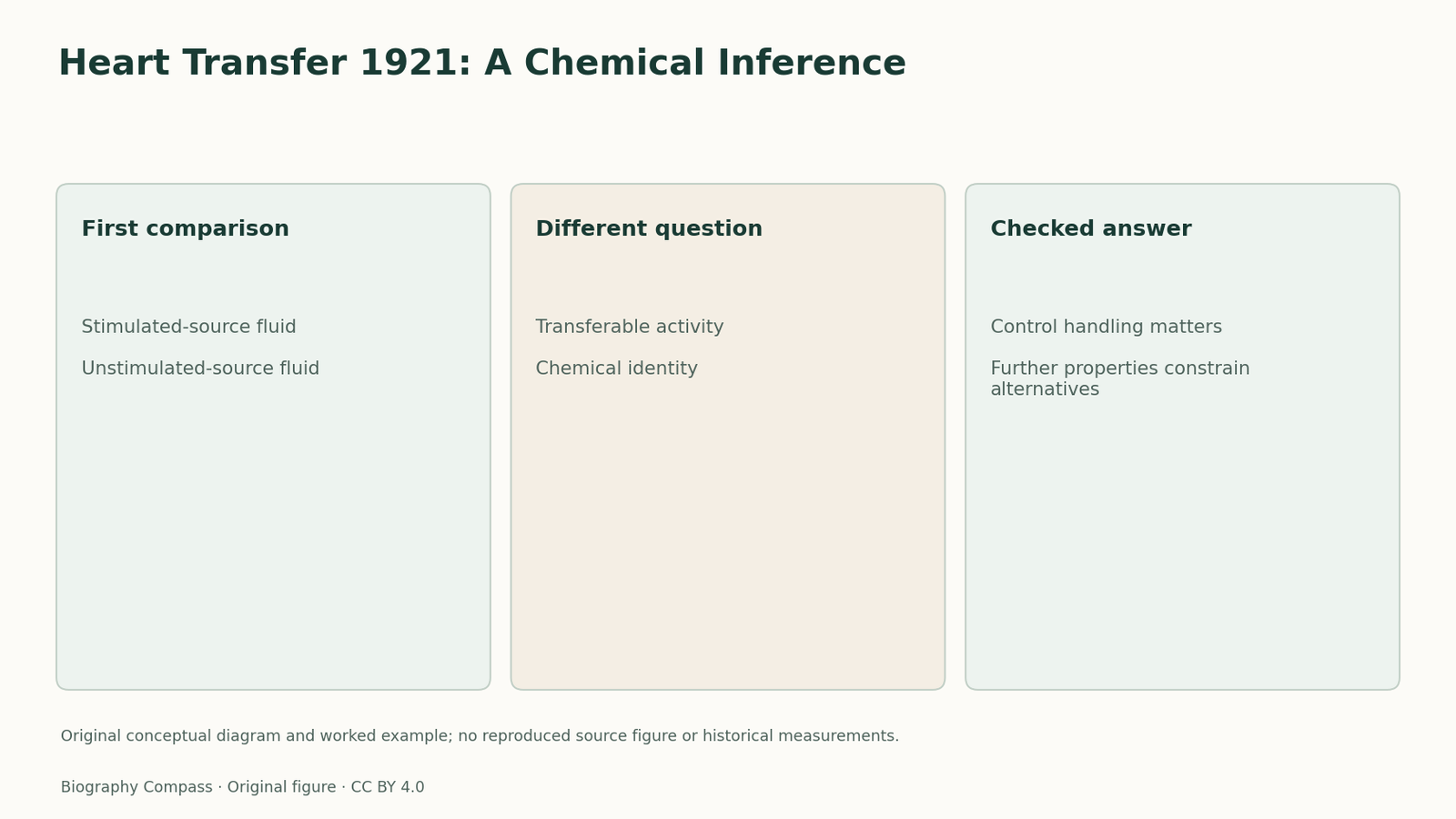
Imagine three invented observations. Fluid A comes from an unstimulated preparation; fluid B comes from a stimulated one; a second heart changes after B but not after A. Which difference is associated with the response in this simplified comparison? The stimulation-associated fluid. Does that identify a particular molecule? No. It supports an active difference between the fluids under the stated conditions. The answer would be weaker if both fluids changed the recipient in the same way, because transfer, handling or some shared feature could then account for the effect. These are classroom observations rather than historical measurements. A further question is whether repeating the comparison with a new recipient would change the kind of conclusion. It could strengthen reproducibility within the example, but repetition of an effect would still not supply chemical identity. Those are different dimensions of evidence.
Sources for this section: [1]
A second comparison asks a new question
Now imagine the activity of B disappears after a particular treatment, while a reference substance loses activity under the same treatment. This resemblance is relevant, but one shared property still does not prove identity. Several chemically different substances can share a response. A stronger identification needs independent comparisons that constrain the alternatives. Dale’s cited lecture connects pharmacological characterisation with transfer evidence; Katz’s linked biography addresses a later, distinct question about release at nerve endings. Read the initial experiment as a carefully delimited result, then ask what each later record added instead of compressing the entire history into one dramatic moment.
Sources for this section: [2]
Continue the chronology
Related history guides
Nerve Waves: Components Versus One Speed
Examine Erlanger and Gasser’s compound nerve-signal question, distinguish recording limits from biological differences, and solve an original timing exercise.
Read the timeline1932–1958After-Potentials: Signal Shape and Recovery
Explore Gasser’s after-potential evidence, separate voltage changes from excitability, and check how baseline shifts can alter a measured spike height.
Read the timelineBiography context
Explore Graz, Austria through connected lives
Connected biographies
Researchers and related approaches
1873–1961
Otto Loewi
Pharmacologist and chemical-transmission researcherExplore Otto Loewi’s medical training, frog-heart evidence, collaboration and forced exile, with a careful distinction between transfer and identity.Read biography1911–2003
Bernard Katz
Physician and biophysicistBernard Katz investigated chemical communication between nerves and muscle, developing quantal-release ideas with collaborators and sharing the 1970 medicine Nobel.Read biographyQuick answers
Common questions
- Did transfer alone identify acetylcholine?
- No. Chemical identification depended on further comparisons.
- Are the A and B fluids historical records?
- No. They are an original exercise about the logic of a control comparison.
Primary and institutional sources
How this history was checked
The references below distinguish the original study from later explanations. The worked exercise and comparison are newly written for this article. This article was reviewed on 8 November 2026.