
The short answer
What did the activity following an impulse reveal beyond whether a nerve had fired at all?
Read the evidence
Different records within the same investigation
The following comparison distinguishes the specific questions answered by the inspected records.
| Record or test | What it establishes | What remains different |
|---|---|---|
| Potential record | Describes an electrical change | Excitability is a separate measurement |
| Peak above baseline | Depends on the chosen local reference | A larger elevation need not be an equal change in every component |
The spike is not the entire record
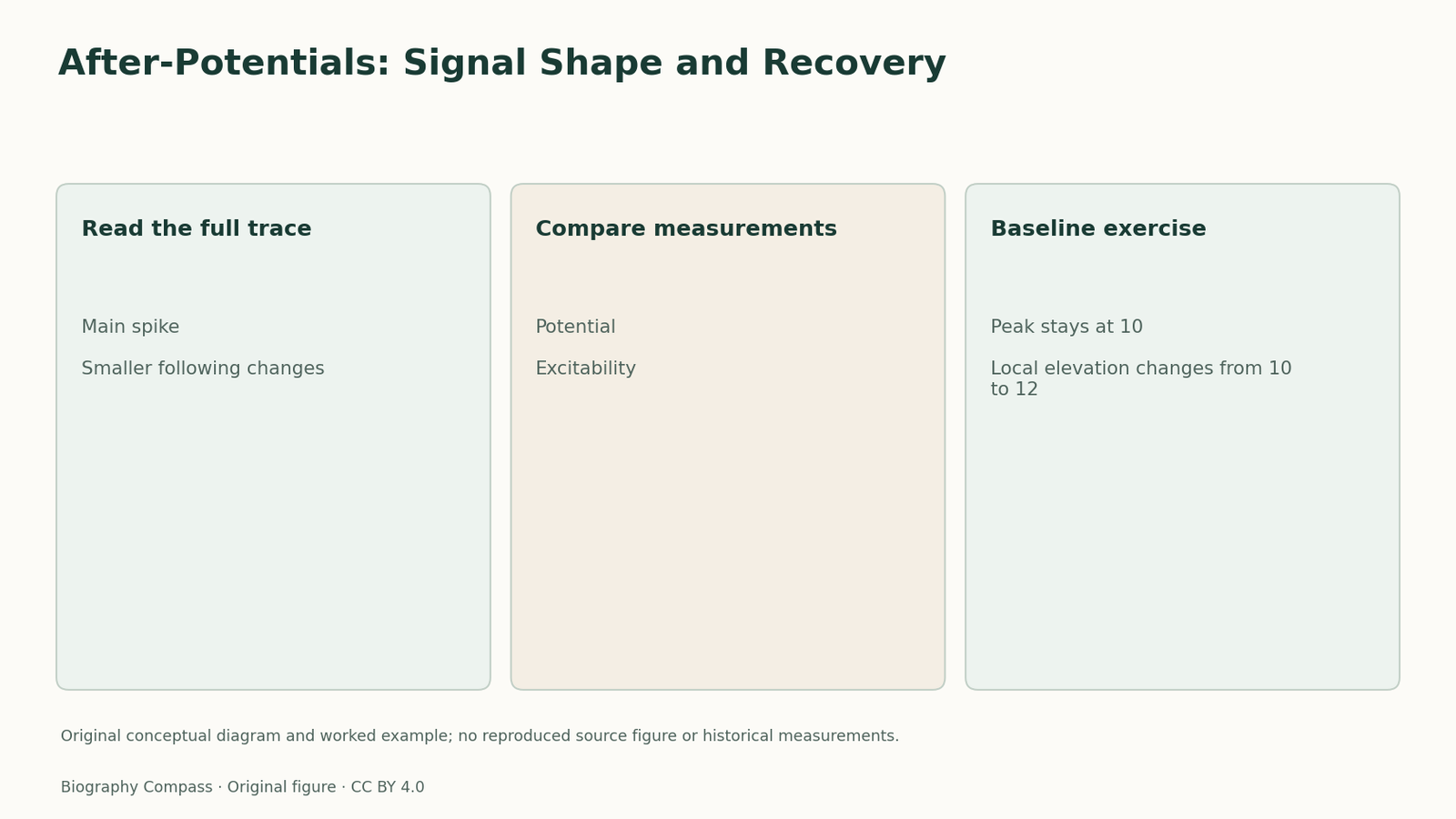
Gasser’s lecture distinguishes a rapid spike from the smaller potential changes that follow it. He also describes a separate excitability cycle: the responsiveness of a nerve to further stimulation changes over time. Their temporal relationship was scientifically useful, but the quantities are not identical. One is an electrical-potential record; the other concerns the ability to respond. This distinction gives the topic its central question: what can the shape after a spike reveal, and what must be tested independently? Ignoring the small later signal could discard information even when the main spike remained readily visible.
Sources for this section: [2]
Preparation and prior activity matter
The lecture describes after-potentials as sensitive to conditions including oxygen supply, surrounding chemistry and previous activity. It therefore compares records from isolated preparations with excitability measurements closer to natural circulation. The lesson is not that an isolated preparation is automatically invalid. It is that a recognisable spike does not guarantee that all smaller features preserve the same state. A comparison needs to specify which condition changed and which measurement checks it. Otherwise a change in preparation can be mistaken for a stable difference between fibre categories, or a response to earlier activity can be mistaken for a permanent property.
Sources for this section: [2]
A later paper sharpened the comparison
Gasser’s 1958 paper examined postspike positivity in unmyelinated fibres of dorsal-root origin and compared it with other fibre groups. Its abstract separates the size of a positive component from broader differences in behaviour. The indexed discussion also warns that an apparent change in spike elevation can reflect the baseline on which the spike is recorded. This is an interpretation problem about a summed signal. A taller elevation on a changing trace need not mean that every component responsible for the spike has increased by the same amount. Fibre group, recent activity and measurement reference all belong in the explanation.
Sources for this section: [1]
Exercise: measure from the right reference
Consider an invented trace with a peak at ten units. If its local baseline is zero, the peak rises ten units above that baseline. If a second trace has a peak at the same ten units but a local baseline of minus two, its elevation above the local baseline is twelve. Has the absolute peak moved? No. Has the measured elevation changed? Yes. This example demonstrates why baseline and peak must be reported separately; it is not a historical measurement. It also cannot identify a membrane mechanism. For that, an investigator needs further evidence linking the observed changes to the relevant electrical and biological processes. A second check asks whether comparing only the two twelve-unit elevations would recover the absolute peak positions. It would not. One must retain both the reference and the height above it; otherwise different records can appear equivalent after information about their baselines has been discarded.
Sources for this section: [1]
Continue the chronology
Related history guides
Biography context
Explore United States through connected lives
Connected biographies
Researchers and related approaches
1888–1963
Herbert S. Gasser
Physiologist and research-institute directorExplore Herbert Gasser’s training, collaboration with Erlanger, research on nerve after-potentials and leadership of the Rockefeller Institute.Read biographyQuick answers
Common questions
- Are voltage and excitability interchangeable?
- No. They are related but different measurements.
- Are the ten-unit peaks historical data?
- No. They form an original example showing why a baseline matters.
Primary and institutional sources
How this history was checked
The references below distinguish the original study from later explanations. The worked exercise and comparison are newly written for this article. This article was reviewed on 8 November 2026.