
The short answer
How did dynamic scattering turn liquid crystal into a display?
Compare the evidence
Observation, method and result
Compare the inspected records and the different claims they support.
| Record | Evidence | Limit |
|---|---|---|
| Kyoto Prize technical account | Driven liquid crystal scatters light; 1968 prototypes. | An optical modulation method is not light emission. |
| MIT development history | Separates team research and later twisted-nematic methods. | Not all subsequent LCDs use dynamic scattering. |
The liquid crystal changes the path of light
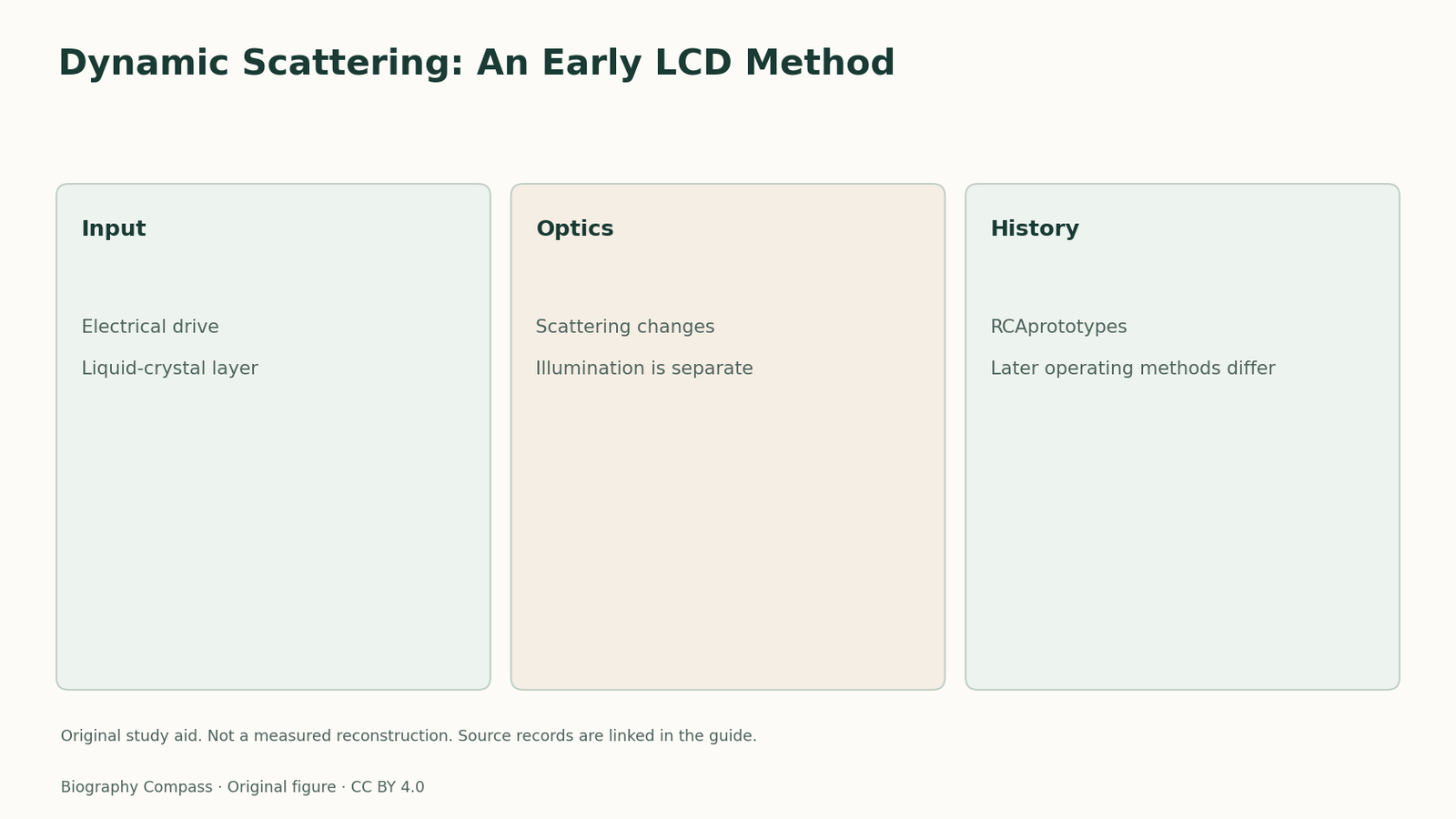
The Kyoto Prize account explains that dynamic scattering made the liquid-crystal layer turn milky and scatter light when driven electrically. The visible state therefore depended on how the material affected light passing through or reaching it. It was not the same process as an LED emitting light through its semiconductor structure. A neutral diagram should show an electrical input changing an optical state, with separate arrows for illumination and the light encountered by a viewer.
Sources for this section: [1]
A prototype proves a particular method
RCA demonstrated prototype displays in 1968. MIT’s account places the work within a team and distinguishes dynamic scattering from later twisted-nematic operation. The distinction protects an important achievement from an exaggerated claim. Early liquid-crystal devices helped establish the possibility of electronic displays using these materials, but a later screen’s presence in a laptop or television does not prove that it operates by the same scattering mechanism. A technology family can continue while its dominant device method changes.
Compare mechanisms instead of naming every screen alike
Make three rows labelled electrical action, optical change and visible result. Fill the dynamic-scattering row with the supported description: a driven layer scatters light and changes appearance. Leave a separate row for a later method until its own technical evidence has been consulted. A supported answer recognises continuity in using liquid crystals while refusing to transfer one mechanism to every product. It should also preserve the collaborative nature of the RCA work rather than turning the name of a prominent research leader into sole authorship of all flat-panel display technology.
Continue the chronology
Related history guides
Biography context
Explore United States through connected lives
Connected biographies
People behind the records
1936–2014
George Heilmeier
Electrical engineer and research leaderGeorge Heilmeier led early liquid-crystal display work at RCA and later directed major government and industrial research programmes.Read biographyb. 1938
M. George Craford
Physicist and LED research leaderM. George Craford developed yellow and high-brightness LEDs through semiconductor-material research and industrial teams at Monsanto, HP and Lumileds.Read biographyQuick answers
Common questions
- How did dynamic scattering turn liquid crystal into a display?
- Dynamic scattering changed the liquid crystal’s optical state so it scattered light. It was an early LCD method, distinct from light emission and from later twisted-nematic operation.
Primary and institutional sources
How this history was checked
Source notes distinguish documented facts from the explanatory examples and diagrams created for this guide. This article was reviewed on 7 November 2026.