
The short answer
How did semiconductor materials change the colour of an LED?
Compare the evidence
Observation, method and result
Compare the inspected records and the different claims they support.
| Record | Evidence | Limit |
|---|---|---|
| Craford transcript | Explains composition and nitrogen-related efficiency. | A qualitative explanation does not supply a measured spectrum. |
| Illinois and QEPrize histories | Document industrial roles and early 1970 sdevelopment. | Their 1971/1972 labels differ and should remain visible. |
Colour is connected to the semiconductor
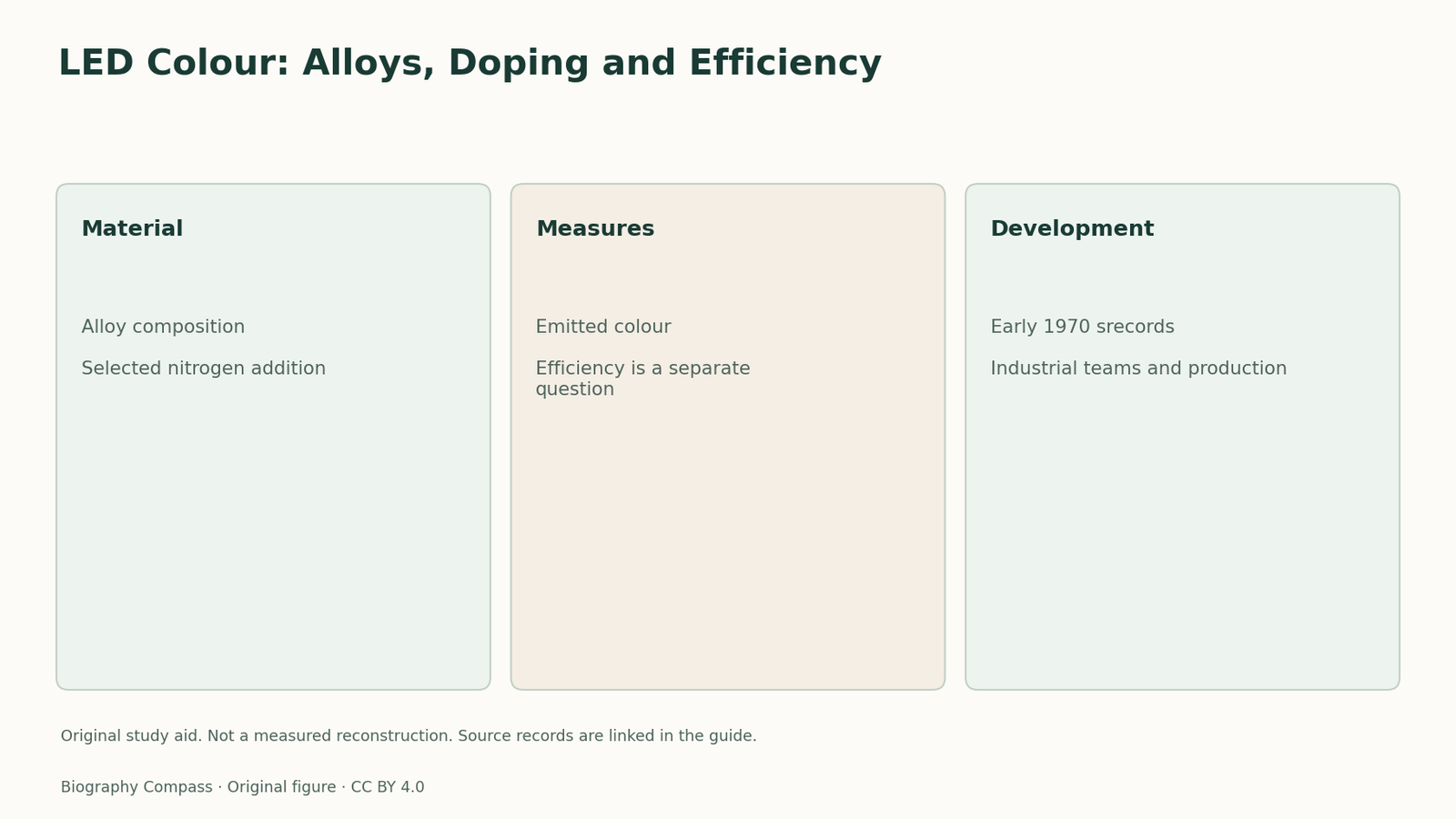
In the Queen Elizabeth Prize transcript, Craford explains LED colour through the semiconductor material. His account places alloy composition at the centre of the development, rather than treating coloured light as a filter added outside an otherwise identical source. The relevant distinction is between the device generating light and the packaging through which a person sees it. A neutral diagram can label material choice, light generation and visible colour without inventing a wavelength measurement for an untested specimen.
Sources for this section: [3]
Reaching yellow also raised an efficiency problem
Craford describes adding nitrogen to gallium arsenide phosphide to improve performance at shorter visible wavelengths. Simply changing the composition toward yellow could reduce efficiency. The nitrogen addition therefore addressed how effectively the material produced light, not merely the name of its colour. Read that first-person explanation beside the university’s career account of GaAsP:N development. Together they connect a material decision with a practical obstacle while keeping the physics explanation separate from later summaries of awards and applications.
Keep chronology and the measures distinct
Illinois associates the improved technology with 1971, while the Queen Elizabeth Prize identifies the yellow invention with 1972. These summaries do not establish a single precise day, so this guide refers to the early 1970s and preserves the difference. Make separate columns for colour, efficiency and production setting. A supported answer explains how a change can improve one measure while creating a problem for another. It should not turn recognition of an early yellow device into a claim that Craford alone developed every blue or white LED, or that a material’s promise immediately established economical mass production.
Continue the chronology
Related history guides
Biography context
Explore United States through connected lives
Connected biographies
People behind the records
b. 1938
M. George Craford
Physicist and LED research leaderM. George Craford developed yellow and high-brightness LEDs through semiconductor-material research and industrial teams at Monsanto, HP and Lumileds.Read biography1936–2014
George Heilmeier
Electrical engineer and research leaderGeorge Heilmeier led early liquid-crystal display work at RCA and later directed major government and industrial research programmes.Read biographyQuick answers
Common questions
- How did semiconductor materials change the colour of an LED?
- The semiconductor material helps determine emitted colour. Doping and other material choices can improve efficiency at a desired colour; colour and efficiency are related but distinct properties.
Primary and institutional sources
How this history was checked
Source notes distinguish documented facts from the explanatory examples and diagrams created for this guide. This article was reviewed on 7 November 2026.