
The short answer
A company can retain an old founding date while an operating business has a later incorporation date. LG’s reports show how to follow that continuity and keep the reporting boundary attached to each number.
Original source-reading framework
Attach a boundary to every date and number
The business lineage, legal person and accounting perimeter answer different questions.
| Country | Useful question | Matching record |
|---|---|---|
| Business lineage | When did manufacturing begin? | Historical production and company records. |
| Legal continuity | Which entity survived a split or merger? | Spin-off notes and corporate outline. |
| Time boundary | How many months does the total cover? | Audit report and statement headings. |
| Revenue mix | Revenue of which entity and on what basis? | Separate 2025 composition in LG Corp.’s filing. |
Chronology
A timeline of the turning points
Chemical separation
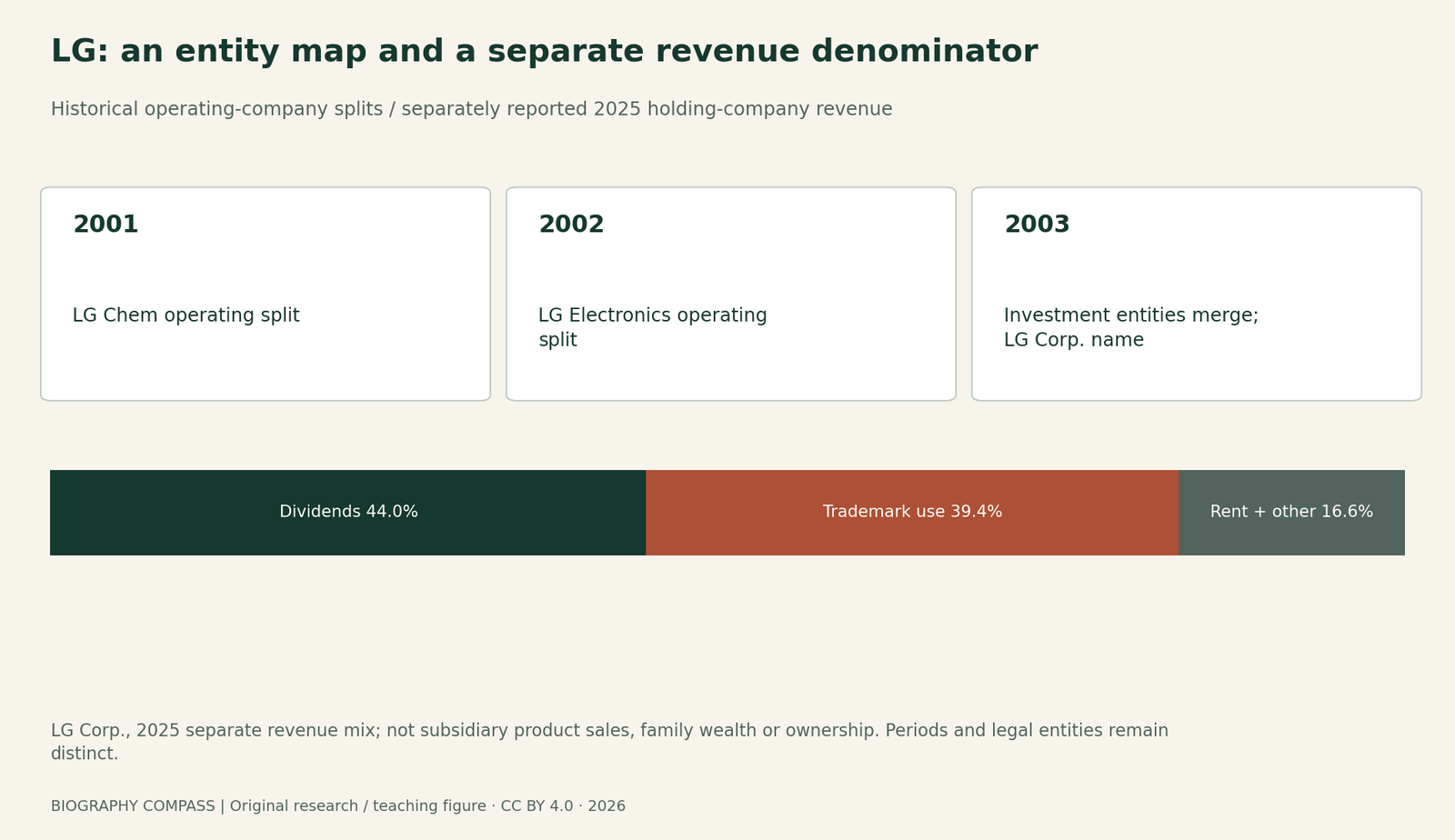
LG Chem operating company spun off; registration followed on 3 April.
Electronics approvals
Board and shareholder approvals preceded execution.
Electronics separation
Spin-off effective on 1 April; registration completed on 2 April.
Holding-company merger
LGEI merged into LGCI; the latter became LG Corp.
Separate revenue composition
44.0% dividends; 39.4% trademark-use income; 16.6% rental income and other.
Why apparently incompatible founding dates can both be useful
LG Corp.’s 2025 business report gives its establishment date as 5 January 1947 and its conversion into a holding company as 1 March 2003. LG Electronics’ 2003 financial notes describe the operating company being spun off in April 2002. These statements concern different corporate histories. The first follows a continuing legal entity through changes in function and name; the second describes the incorporation of an operating company after separation. Brand heritage, business activity and legal continuity may therefore use different starting points. A research note should name the entity before deciding which date answers the question.
The chemical operation separated before the electronics operation
LG Chem’s 2004 annual report supplies a specific earlier step. Note 1 to its non-consolidated statements says the company was spun off from LG Chem Investment, formerly LG Chemical, on 1 April 2001 and completed registration on 3 April. The note describes its manufacturing activities and facilities. This is an operating-company account of a legal separation, rather than a claim that chemical manufacturing itself first began in 2001. Preserve both event dates because the effective separation and the completion of registration are different actions. The wording also identifies the predecessor from which the business emerged.
Sources for this section: [3]
The electronics report identifies approvals and execution separately
Note 30 of LG Electronics’ 2003 report records a board resolution on 15 November 2001 and shareholder approval on 28 December 2001. The spin-off took effect on 1 April 2002, with registration completed on 2 April. The new operating company undertook electronics and information-and-communications businesses. The same note says shares were distributed proportionately to the predecessor’s shareholders. These events form a sequence: a plan was authorised and then executed. A headline saying “LG split in 2001” would conceal the distinction between approval and the later transfer of activities, assets, liabilities and employment obligations.
Sources for this section: [2]
The 2003 merger joined investment entities
The electronics report then records that LG Electronics Investment was legally merged into LG Chem Investment on 1 March 2003. The surviving investment entity changed its name to LG Corp. This was not a merger of every LG factory into one manufacturing company. The operating businesses continued through distinct companies while the investment structure changed above them. The later business report describes LG Corp. as a pure holding company. Its account establishes the declared structure and revenue model; a conclusion that the change solved every governance problem would require further evidence about decisions, transactions and accountability after the conversion.
A reporting period can change even when the brand looks continuous
The 2003 electronics audit report covers a full year ended 31 December 2003 and a nine-month period from the April 2002 spin-off to December 2002. Comparing their totals as if both were twelve-month years would mix different time exposures. Dividing each total by months can provide a rough monthly average, but it does not remove seasonality, changes in product mix or the effects of the separation. For a historical chart, show the period lengths visibly. A shared logo and a side-by-side table do not guarantee that the figures are directly comparable.
Sources for this section: [2]
Read the holding company’s revenue with its denominator
The 2025 filing lists dividends, LG trademark-use fees and rental income among LG Corp.’s income sources. On its separate-financial-statement basis, the revenue composition is 44.0 percent dividend income, 39.4 percent trademark-use income and 16.6 percent rental income and other items. Together these sum to 100.0 percent. The denominator is the holding company’s separately reported operating revenue for that reporting period. It is not worldwide LG consumer sales, the share of televisions sold by a subsidiary or the founding family’s ownership. The revenue labels and reporting basis belong in the chart title or immediately beside it.
Sources for this section: [4]
Consolidation and ownership need their own questions
The same filing discusses subsidiaries included in the consolidated reporting boundary and separately describes major affiliate businesses. The word “group” in everyday language can cover a broader set of relationships than one company’s consolidated financial statements. An affiliate name therefore does not by itself settle whether all its revenue appears in a particular consolidated total. Likewise, dividend income received by a holding company is not a percentage of the chairman’s personal wealth. To investigate ownership, seek dated holdings and voting rights; to investigate accounts, read the stated consolidation and accounting policies. Each question has a different evidential object.
Sources for this section: [4]
Exercise: locate the entity, event and denominator
A fictional summary says: “Koo Ja-kyung founded a new LG in 2003. Its factories earned 44 percent of sales from dividends, and the 2002 electronics total proves the next year’s annual growth rate.” Mark the missing information before correcting the prose. Which company continued from 1947? Which operation was newly incorporated in 2002? Which entities merged in 2003? Which revenue table supplies 44.0 percent, and how long is the 2002 comparison period? Finally identify why the 2003 action should not be attributed to a chairman who retired in 1995.
Reference answer: continuity does not erase reorganisation
LG Corp. retained the 1947 establishment history while becoming a holding company through the 2003 investment-entity merger. Operating LG Chem and LG Electronics had been separated in 2001 and 2002 respectively. Koo Ja-kyung’s retirement predates the holding-company conversion. The 44.0 percent figure describes dividend income within LG Corp.’s separate 2025 revenue composition, and the electronics comparison includes a nine-month 2002 period. None of these facts alone measures improved governance, factory productivity or a family’s wealth. They provide something more basic and essential: a reliable map of which organisation did what, when, and within which reporting boundary.
Continue the chronology
Related history guides
GoldStar A-501: Four Different Dates
Read GoldStar’s A-501 through production, a 1959 advertisement, museum catalogues and 2013 heritage registration, keeping each date and object distinct.
Read the timeline2017–2024Lotte: A Split and a Share Table
Trace Lotte’s 2017 investment-business split, Wellfood’s later changes and its 2024 shareholder table, keeping corporate names, dates and denominators clear.
Read the timelineConnected biographies
People and institutions
1907–1969
Koo In-hwo
LG founder and manufacturing entrepreneurKoo In-hwo built a manufacturing enterprise from cosmetics, plastics and household goods, then backed the electronics business that became LG Electronics.Read biography1925–2019
Koo Ja-kyung
Second chairman of LG and education-foundation leaderKoo Ja-kyung led LG from 1970 to 1995 after two decades in its manufacturing operations, supporting research, overseas plants and professional management.Read biographyQuick answers
Common questions
- Was LG Electronics first established as a business in 2002?
- Its business lineage goes back to GoldStar in 1958. The 2002 date concerns the operating company formed through a spin-off.
- Does the 44.0 percent dividend share measure family ownership?
- No. It is one category’s share of LG Corp.’s separately reported 2025 operating revenue.
Primary and institutional sources
How this history was checked
Original corporate, museum and institutional records establish the dated facts. The reading exercises and diagrams are original editorial work. This article was reviewed on 27 October 2026.
- LG Corp.Koo Ja-kyung: biographical chronology
- LG ElectronicsAnnual Report 2003: financial-statement audit period and note 30, Spin-Off, p. 103
- LG ChemAnnual Report 2004: non-consolidated statements, note 1, The Company, printed pp. 76–77
- LG Corp.; Korea Exchange KIND disclosure2025 annual business report, filed 18 March 2026: company outline and separate revenue composition