
The short answer
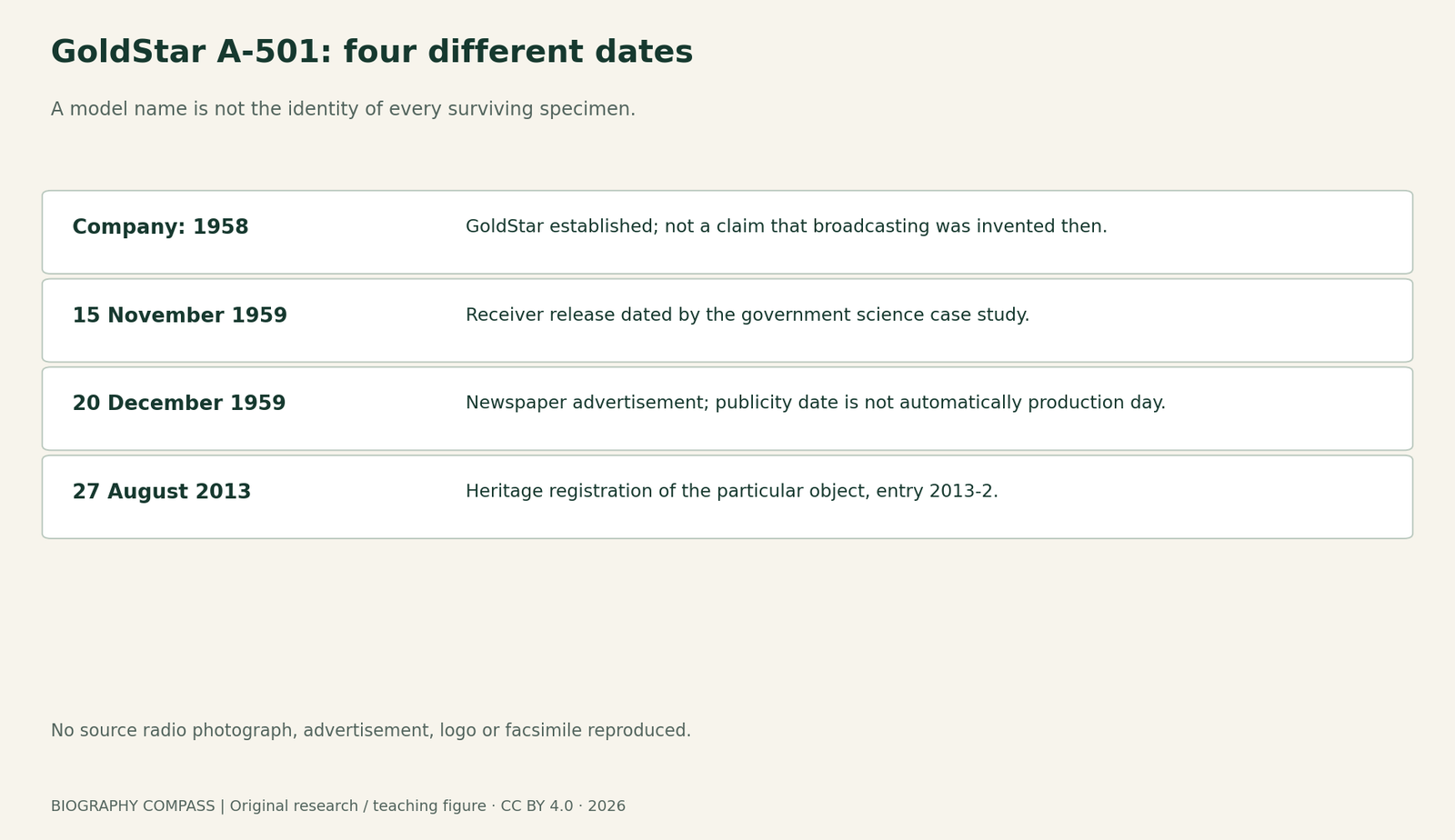
A radio can have a manufacturing date, an advertisement date and a heritage-registration date. Reading those records together explains an industrial milestone without turning every date into a founding date.
Original source-reading framework
One model, several records
Keep the event and evidential object attached to each date.
| Country | What the record establishes | What requires another record |
|---|---|---|
| Company history | 1958 organisational establishment. | Exact production day of each specimen. |
| Technical case study | 1959 product release and technical description. | Independent measurement of every impact claim. |
| Advertisement | A message published on 20 December 1959. | Sales and household ownership. |
| Heritage registration | Registration of a particular object in 2013. | An invention in that registration year. |
Chronology
A timeline of the turning points
Company
GoldStar established.
Product
A-501 release dated by the science case study.
Advertisement
Dated Chosun Ilbo advertisement preserved in institutional history.
Heritage entry
Registration of the A-501 (2013-2) object.
Start with the object and the institution describing it
The Korea Heritage Service records GoldStar Radio A-501 (2013-2) as a movable registered cultural heritage object. Its owner and manager are the National Museum of Korean Contemporary History. The entry gives a production period of 1959 and registration on 27 August 2013. The model name identifies a kind of radio; the registration suffix identifies a particular entry. Begin a research note with both. Otherwise a statement about one preserved object can quietly become a claim about all radios made under that model name, or a registration date can be mistaken for the year the product was invented.
Sources for this section: [4]
Company establishment and product production are different clocks
LG Electronics’ corporate history dates GoldStar’s establishment to 1958 and its first radio to 1959. The detailed founder narrative also distinguishes the company’s October 1958 establishment from the following year’s A-501. This resolves a common compression in short biographies, including a brief founder chronology that places GoldStar under 1959. An enterprise must organise technical work before it can release a product. When recording the dates, use separate event labels: company established, product developed or released, and later corporate name changed. A date attached to one event cannot automatically fill all three fields.
The technical case study identifies a manufactured receiver
The government’s 2015 science-and-technology case book describes the A-501 as a five-valve radio released on 15 November 1959. It explains the designation through AC power, five valves and the first model. Its discussion includes component localisation, reception and low-voltage conditions. These details make the product more concrete than the broad phrase “Korea’s first radio.” They concern a manufactured receiver and its technical setting, rather than the beginning of radio broadcasting or the discovery of radio waves. The case was prepared long after production and identifies LG Electronics as the responsible institution; its celebratory framing remains visible.
Sources for this section: [6]
An advertisement establishes what was presented to buyers
The National Institute of Korean History reproduces a GoldStar radio advertisement from the Chosun Ilbo dated 20 December 1959. Its discussion draws attention to the way domestic technology and a consumer product were presented to the public. The dated advertisement is evidence that this message was circulating by that day. It does not establish that every reader bought a receiver, that all advertised claims were tested independently, or that the advertisement appeared on the first day of production. Advertising can be read as an artefact of selling and aspiration, with its audience and medium kept in view.
Sources for this section: [7]
Two catalogues do not necessarily describe the same specimen
The Modern Design Museum’s A-501 entry, published through Google Arts & Culture, lists GoldStar as creator and 1959 as the date. It records dimensions of 40 by 17 by 17 centimetres. The heritage entry gives 42.2 by 14.4 by 18 centimetres for its registered object. Do not average these values or infer that the model changed size over time. The institutions may hold different specimens, measure different extremities or use different conventions. An exact comparison requires object identifiers, the order of axes and a statement of what was measured. The model label alone is insufficient.
Manufacture, design and business sponsorship have different authors
A museum creator field naming GoldStar identifies the manufacturing organisation. The Korean-language Design Museum entry also discusses designer Park Yong-gui, while LG’s founder history describes Koo In-hwo’s decision to support electronics. These attributions concern different work. The founder backed a new business; designers developed the product’s appearance and use; engineers and production workers made the receiver function and repeatably produced it. A biography can connect these contributions without replacing the manufacturer with one executive’s name. When quoting a catalogue, retain the exact role rather than treating every credited person as the sole inventor.
A surviving radio preserves evidence, not a complete market census
The object’s survival lets institutions study its materials, layout and manufacturing marks. The registration record also shows that a public institution judged it worth preserving as heritage. Neither fact supplies a production total, a market share or the number of households that could afford one. A claim about access would need prices, wages, distribution and household ownership records for a defined period. A claim about technical independence would need a component-level account. The useful conclusion is narrower and still substantial: the A-501 provides material evidence for an early Korean consumer-electronics manufacturing programme.
Exercise: repair a confused museum caption
Consider this fictional caption: “LG was founded on 27 August 2013 when Koo In-hwo invented broadcasting. The A-501 was advertised on 20 December 1959, so that was its first production day. Every surviving model measures exactly 40 centimetres wide.” Rewrite it as four short statements, each naming an event or object and the source that establishes it. Then identify the evidence needed to decide whether the two catalogues describe the same physical receiver. The exercise tests the relationship between labels, dates and claims; it does not require access to the original photographs or reproduction of the historic advertisement.
Reference answer: label each clock and preserve the open question
GoldStar was established in 1958; the receiver dates to 1959, with the science case book giving release on 15 November. A newspaper advertisement appeared on 20 December 1959. The particular heritage object was registered on 27 August 2013. Those are four different events. Nothing in the registration establishes the invention of broadcasting. The museum dimension statement must remain attached to its specimen, while the heritage dimensions remain attached to the registered object. To settle the specimen question, seek accession numbers, provenance and measurement notes. A useful caption can state the industrial milestone clearly while leaving that narrower question open.
Continue the chronology
Related history guides
LG: Splits and Reporting Boundaries
Follow LG’s 2001–2003 corporate splits and merger, then read its 2025 separate revenue mix without confusing brand history, operating companies and accounts.
Read the timeline2017–2024Lotte: A Split and a Share Table
Trace Lotte’s 2017 investment-business split, Wellfood’s later changes and its 2024 shareholder table, keeping corporate names, dates and denominators clear.
Read the timelineConnected biographies
People and institutions
1907–1969
Koo In-hwo
LG founder and manufacturing entrepreneurKoo In-hwo built a manufacturing enterprise from cosmetics, plastics and household goods, then backed the electronics business that became LG Electronics.Read biography1925–2019
Koo Ja-kyung
Second chairman of LG and education-foundation leaderKoo Ja-kyung led LG from 1970 to 1995 after two decades in its manufacturing operations, supporting research, overseas plants and professional management.Read biographyQuick answers
Common questions
- Was the A-501 created in 2013?
- No. The registered object is dated 1959; 27 August 2013 is its heritage-registration date.
- Why do museum dimensions differ?
- The records describe different institutional objects and may use different measurement conventions. The evidence read does not establish a single cause.
Primary and institutional sources
How this history was checked
Original corporate, museum and institutional records establish the dated facts. The reading exercises and diagrams are original editorial work. This article was reviewed on 27 October 2026.
- LG Corp.Koo In-hwoi: achievements and retrospective company history
- LG Corp.Koo In-hwoi: biographical chronology
- LG ElectronicsLG Electronics corporate history, including 1958–1969
- Korea Heritage ServiceGoldStar Radio A-501 (2013-2): registered movable heritage record
- Modern Design Museum, via Google Arts & CultureGold Star A-501, 1959: collection object record
- Ministry of Science, ICT and Future Planning; National Assembly Library copy70 Representative Achievements in Science and Technology, 2015: A-501 case, printed pp. 28–29
- National Institute of Korean History, Our History NetAdvertising and consumer culture: GoldStar radio advertisement of 20 December 1959