
The short answer
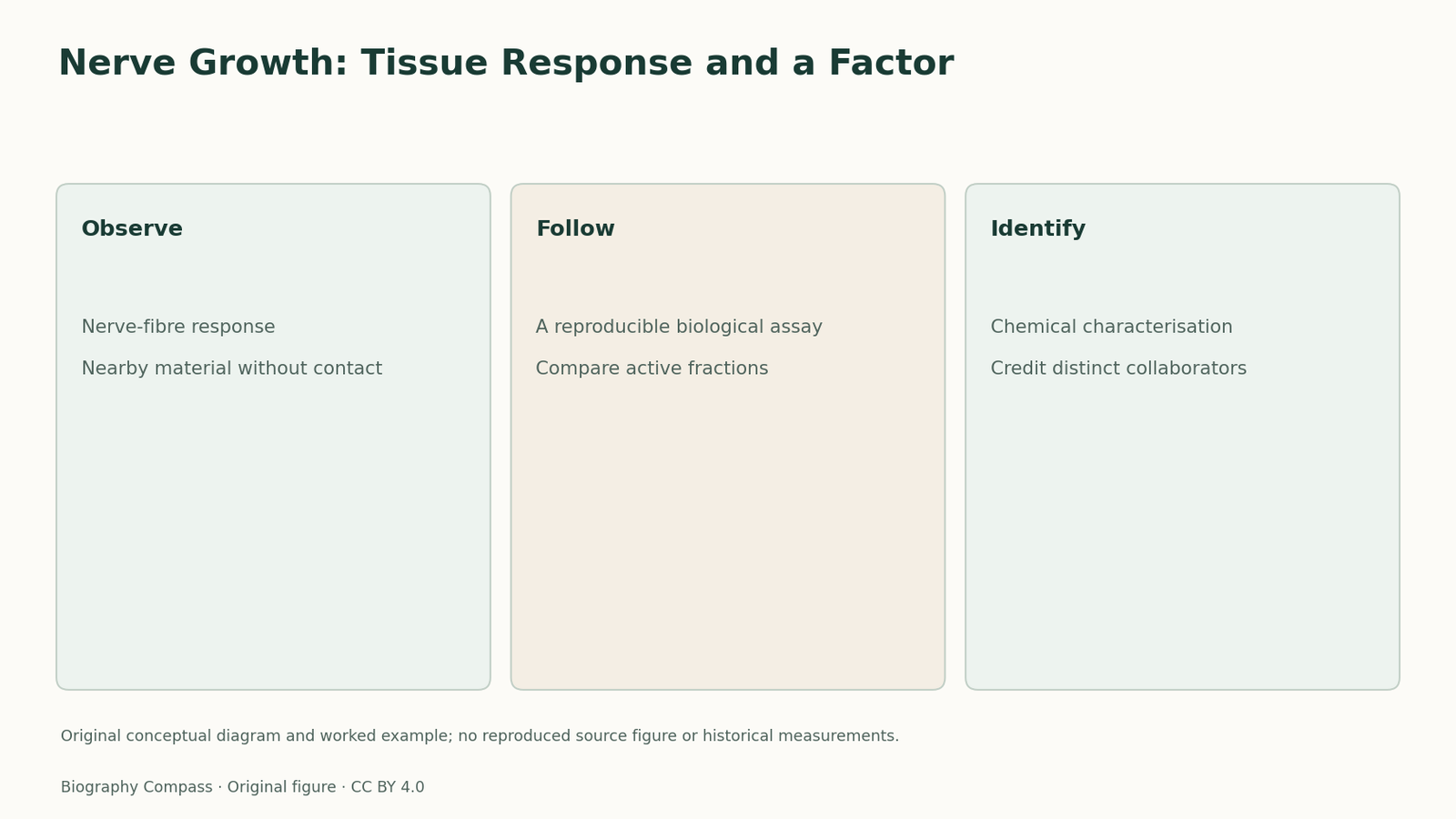
How did explant assays distinguish promoted neurite growth from a complete account of the active molecule?
Read the evidence
Different records within the same investigation
The following comparison distinguishes the specific questions answered by the inspected records.
| Record or test | What it establishes | What remains different |
|---|---|---|
| Visible outgrowth | Provides a biological response to compare. | Does not alone identify its molecular cause. |
| Effect at a distance | Supports activity without direct tissue contact. | Does not establish purity or one unique component. |
| Chemical characterisation | Investigates the responsible material. | Uses a different evidential step from the initial image. |
The question separated a tissue response from normal development
The 1954 culture paper investigated how mouse sarcoma material affected sensory and sympathetic ganglia from chick embryos. Studying the tissues outside the intact embryo made a particular interaction accessible for comparison. The concrete question was whether nearby tumour material could elicit nerve-fibre growth without ordinary embryonic relationships explaining the entire response. A striking visible effect could then become a repeatable biological readout, rather than remaining an impression drawn from one unusual developing animal.
Sources for this section: [1]
Growth without direct contact supported a transferable activity
The original summary describes extensive fibres around ganglia placed near the sarcoma fragments. Levi-Montalcini’s lecture explains that proximity without contact was an important feature of the Rio work with Meyer. This supported an activity capable of acting across the intervening environment, rather than requiring the tissues to be physically joined. The result did not identify the activity’s molecular structure. It made a mechanistic alternative testable and supplied a way to recognise active material during subsequent investigation.
The assay and the chemical identity were successive achievements
Levi-Montalcini’s lecture describes how the culture response became useful for biochemical work with Stanley Cohen. An active fraction could be compared through the biological effect it produced. That is different from assuming the fraction is already a chemically pure substance. The account also notes that normal mouse tissue could produce a milder related effect, complicating a simple tumour-exclusive story. Preserving that observation makes the emerging growth-factor interpretation more informative: a strong source of activity need not be its only biological source.
Sources for this section: [2]
Place and collaboration should remain visible
The culture work involved Meyer’s facilities in Rio, within a programme connected to Hamburger’s St. Louis laboratory. Its publication date and experimental setting should not be collapsed into a claim that every step occurred in the same place and year. The Nobel recognition later joined Levi-Montalcini and Cohen’s contributions. The original paper, however, credits Meyer and Hamburger for the culture study. A research history can connect these contributions while retaining the different roles of developmental observation, a usable assay and chemical characterisation.
An original distance-effect exercise and answer
Imagine a fictional tissue A that produces a stronger outgrowth response when material B is nearby but not touching it. Does that prove B contains a single purified growth molecule? No. It supports an effect transmitted through the shared environment, while several active components or indirect changes could remain possible. These labels are teaching abstractions, not a culture recipe or historical measurements. An informative next question asks whether the same biological response follows the activity as material is separated and characterised. The answer should also compare an appropriate non-B condition and distinguish increased outgrowth from every other possible developmental change. A measurable response is a powerful guide to identification, but it is not the finished molecular identity itself.
Continue the chronology
Related history guides
Protein Targeting 1975: Timing the Membrane
Compare Blobel and Dobberstein’s 1975 transfer studies through precursor processing, protected location and different products, with a membrane-transfer exercise.
Read the timeline1952–1975Virus Plaques 1952: Infectious Units and Counts
Read Dulbecco’s 1952 plaque result alongside the later poliovirus work, distinguishing measured infectious units from total physical particles and later genetic claims.
Read the timelineBiography context
Explore Rio de Janeiro, Brazil through connected lives
Connected biographies
Researchers and related approaches
1909–2012
Rita Levi-Montalcini
Neurobiologist and growth-factor researcherRita Levi-Montalcini investigated nerve development and growth factors, connecting tissue-culture responses with a collaborative search for the active material.Read biography1912–1991
Salvador Luria
Microbiologist and scientific institution builderSalvador Luria studied bacterial viruses, helped establish microbial genetics and later combined research leadership at MIT with public political engagement.Read biographyQuick answers
Common questions
- Did the culture halo establish a complete molecular structure?
- No. It supplied a biological effect for subsequent chemical investigation.
- Where was the key culture work conducted?
- Meyer’s tissue-culture facilities in Rio de Janeiro were central to the work discussed here.
Primary and institutional sources
How this history was checked
The references below distinguish the original study from later explanations. The worked exercise and comparison are newly written for this article. This article was reviewed on 8 November 2026.
- Levi-Montalcini, Meyer and Hamburger, Cancer Research, 1954In Vitro Experiments on the Effects of Mouse Sarcomas 180 and 37 on the Spinal and Sympathetic Ganglia of the Chick Embryo
- Nobel Prize OutreachRita Levi-Montalcini — Nobel lecture
- Nobel Prize OutreachRita Levi-Montalcini — Facts
- Nobel Prize OutreachRita Levi-Montalcini — Biographical