
The short answer
A pattern is useful only if its coordinates still refer to something. This study treats correspondence as the object of an original logic puzzle, without giving an experimental protocol.
Record comparison
A count can survive a wrong correspondence
Keep the historical record distinct from the stipulated model.
| Question | Record or stipulated input | Consequence and limit |
|---|---|---|
| Registered Y | B2, C1, C3 | Common positions B2, C3. |
| Y corrected after hidden rotation | B2, A3, A1 | Common positions A1, B2. |
| Same count | Both intersections have size 2 | The recoverable master positions differ. |
Chronology
A timeline of the turning points
Joint publication
The selected method paper appeared.
A method that retained arrangement
The selected opening of Joshua and Esther Lederberg’s 1952 paper proposes transferring colonies in a fixed spatial arrangement between media. Its stated problem concerns indirect selection and the distinction between pre-existing variation and change attributed to a selective environment.
The important information is not just how many positions remain visible. It is which position on one record corresponds to which position on another. The complete paper’s later experimental results are outside the selected reading.
Sources for this section: [1]
A virtual master and two masks
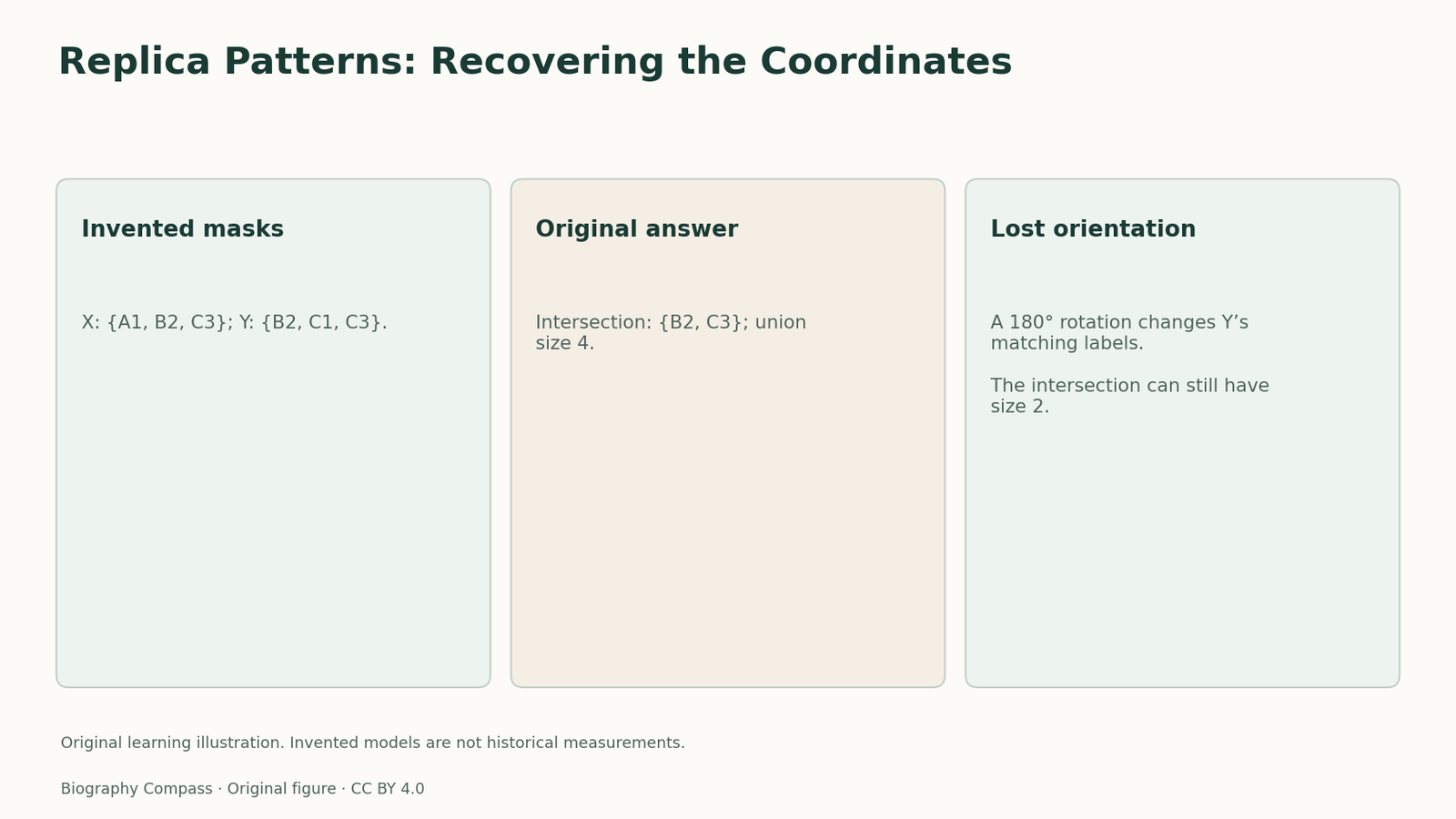
Invent an unchanged 3×3 master with labels A1, A2, A3/B1, B2, B3/C1, C2, C3. Replica X marks A1, B2, C3. Replica Y marks B2, C1, C3. For this puzzle, every mark is exact and absence means failure of that mask’s stipulated condition. Coordinates are preserved and there is no growth noise.
Which master positions satisfy both masks? Which satisfy at least one? Explain why a count alone would not let you retrieve the corresponding master labels. This is a virtual set task, not an instruction for culturing or selecting microorganisms.
Sources for this section: [1]
Reference answer
The intersection is {B2, C3}; its size is 2. The union is {A1, B2, C1, C3}; its size is 4. Returning to the unchanged master means identifying those original coordinates, rather than treating a marked replica as a newly created label set.
Now suppose Y was accidentally recorded after a 180° rotation without recording that change. Correcting it maps B2, C1, C3 to B2, A3, A1. The apparent intersection with X becomes {A1, B2}, also of size 2. Equal counts conceal a different answer.
Sources for this section: [1]
What a matching pattern can establish
The puzzle demonstrates how correspondence can preserve recoverable information and how a hidden transformation can corrupt it. It does not prove that marks in a real biological experiment have one unique cause. Controls would have to address measurement, transfer and interpretation separately.
Nor does this small set calculation reproduce the historical evidence for mutation timing. It explains one informational component of the method and why an unselected reference can matter.
Sources for this section: [1]
Continue the chronology
Related history guides
Biography context
Explore United States through connected lives
Connected biographies
The working life behind the record
Quick answers
Common questions
- Does the virtual puzzle establish a biological mutation mechanism?
- No. It isolates correspondence and set logic; causal biological conclusions need experimental evidence.
- Is a colony count enough to recover labels?
- No. Different labelled sets can have equal counts.
Primary and institutional sources
How this history was checked
Selected records support the historical discussion. Invented inputs and original answers are labelled; no complete uninspected work is claimed. This article was reviewed on 31 October 2026.