
The short answer
A successful signal can establish one stage of a mechanism while leaving another untested. An original abstract assay matrix makes that difference explicit without providing an experimental protocol.
Record comparison
Different readouts support different claims
Keep the historical record distinct from the stipulated model.
| Question | Record or stipulated input | Consequence and limit |
|---|---|---|
| B | Binds; one strand cut | Nicking, not a two-strand break. |
| C | Binds; neither strand cut | Recognition retained without detected cleavage. |
| D | No binding or cut detected | A negative result with several possible explanations. |
Chronology
A timeline of the turning points
Joint molecular record
The selected paper appeared before its later repository deposit.
The selected molecular controls
Jinek and colleagues’ selected 2012 experiments distinguish RNA-dependent recognition, HNH cleavage of the complementary strand and RuvC-like cleavage of the other strand. Mutant results separate nicking from the two-strand cleavage produced by the active enzyme.
Those are separable claims about a molecular system. A binding signal is not itself a readout of both cuts, and the selected work is not a clinical-outcome study.
Sources for this section: [1]
A stipulated observation matrix
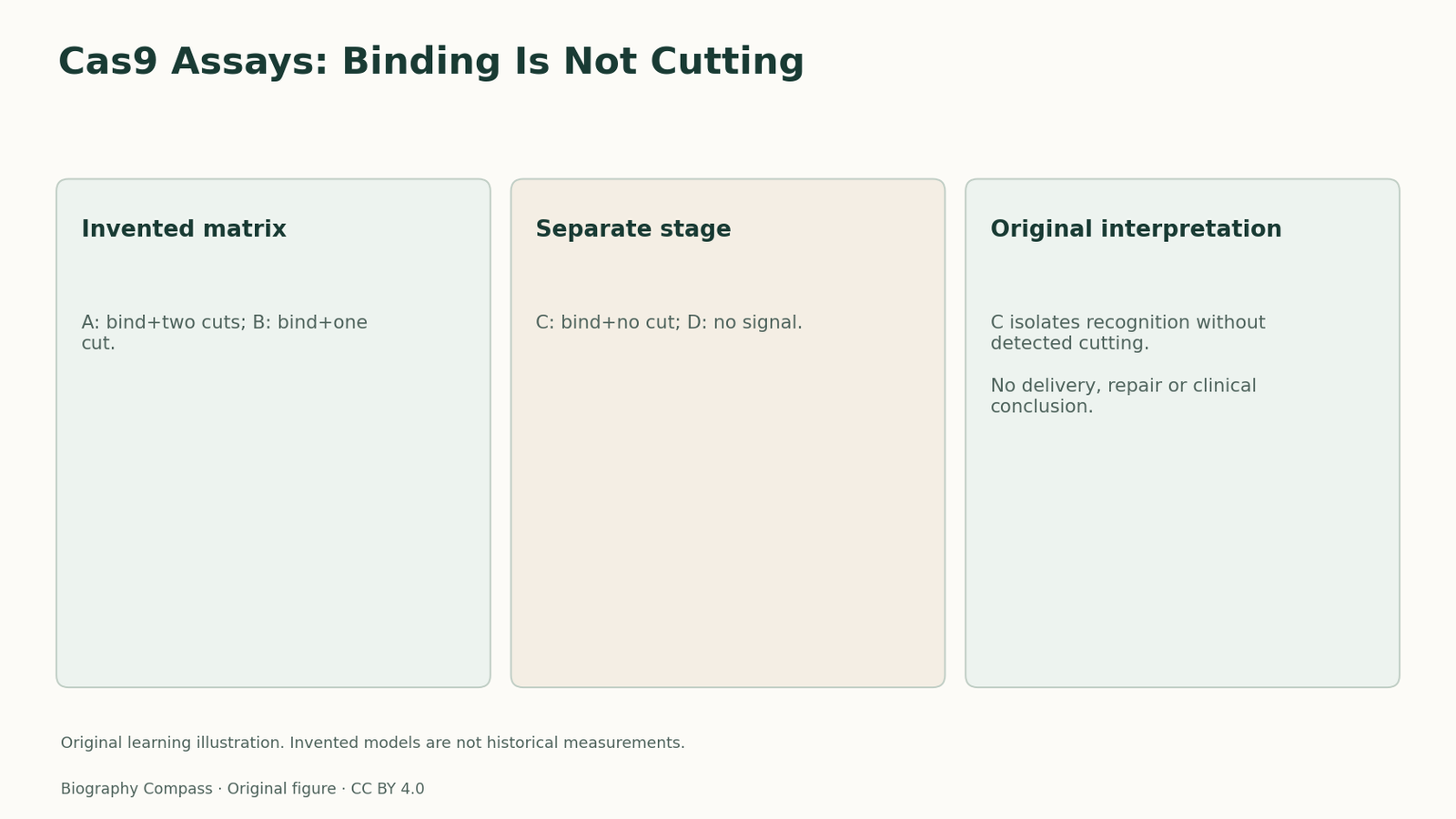
Invent four anonymous protein preparations tested under the same defined recognition condition on an abstract circular double-stranded substrate. Cuts, when present, occur at a single paired site. The readouts are exact: A binds and cuts both strands; B binds and cuts only strand 1; C binds and cuts neither; D neither binds nor cuts. Assume the assays detect their stated events perfectly.
Classify each preparation’s supported result. Which yields a nicked substrate, which a linear substrate and which provides the strongest evidence that recognition can be retained while cleavage is absent? No sequences, delivery method or laboratory conditions are supplied.
Sources for this section: [1]
Reference answer
A supports binding and double-strand cleavage; one complete paired cut makes the stipulated circle linear. B supports binding and single-strand nicking. C supports binding without detected cleavage and is therefore the cleanest comparison with A for separating recognition from cutting. D supplies no positive binding or cleavage result.
D alone cannot tell us why the readouts are absent. A failed preparation, lost recognition or another unmeasured problem could fit those observations. Even for C, the conclusion is restricted to the supplied assay’s conditions and detection assumptions.
Sources for this section: [1]
What comes after the matrix
The fixture’s anonymous preparations are not labels for particular historical mutants. Identifying an altered residue or catalytic domain requires additional information; the matrix does not supply it.
Likewise, a molecular cut does not establish delivery to a living organism, a desired repair outcome or a beneficial treatment. The record’s explanatory strength comes from differentiating stages, and the original exercise preserves rather than erases those boundaries.
Sources for this section: [1]
Continue the chronology
Related history guides
Biography context
Explore United States through connected lives
Connected biographies
The working life behind the record
Quick answers
Common questions
- Are A–D the original paper’s mutant names?
- No. They are anonymous invented preparations.
- Does a linear substrate prove a useful treatment?
- No. The fixture stops at molecular readouts and supplies no organismal or clinical outcome.
Primary and institutional sources
How this history was checked
Selected records support the historical discussion. Invented inputs and original answers are labelled; no complete uninspected work is claimed. This article was reviewed on 31 October 2026.