
The short answer
Why did a song made outside a film become inseparable from India’s most famous playback singer? Its story joins a lyricist, a composer, a fundraising concert and the repeated act of remembering soldiers after the 1962 war with China.
Chronology
A timeline of the turning points
A war and its aftermath
The India–China war supplied the immediate setting for a song remembering dead soldiers.
National Stadium concert
Mangeshkar performed before President Radhakrishnan, Prime Minister Nehru and a large audience.
Pradeep’s own presentation
His daughter later recalled him singing for Nehru in Mumbai and presenting the handwritten poem.
Anniversary recollections
Interviews and commemorations renewed debate about what happened at the original event.
A concert song after military defeat
Ae Mere Watan Ke Logon emerged after the 1962 India–China war, when bereavement and military defeat entered national public life together. Kavi Pradeep wrote the words, C. Ramchandra composed the music and Lata Mangeshkar became its best-known singer. This division of labour matters: the song is often casually called Lata’s, although its authorship and performance belong to different people.
The first performance formed part of a fundraising event organised by the film industry. It addressed a public beyond cinema through the skills and celebrity that cinema had developed. Commemoration gave the gathering its purpose; the song did not begin as a scene attached to a fictional heroine or a film’s romantic plot.
Where and when was it first sung?
Detailed anniversary reporting places Mangeshkar at New Delhi’s National Stadium on 27 January 1963, during Republic Day celebrations. President S. Radhakrishnan and Prime Minister Jawaharlal Nehru attended. The distinction between the celebrations and Republic Day itself helps explain why dates are sometimes compressed to 26 January in later retellings.
Venue claims also drift. Some accounts give the Red Fort or Ramlila Maidan; the detailed IANS report and Pradeep profile identify National Stadium. That disagreement should be resolved through the more specific event reporting, rather than combining several Delhi locations into one imagined concert. The performance date is not automatically the release date of every later commercial recording.
A reluctant singer and a remembered meeting
In a 2013 interview Mangeshkar said she initially declined because her recording schedule left too little rehearsal time. Pradeep’s insistence persuaded her. This is her retrospective account, given fifty years after the event, and it provides evidence of how she remembered the work’s preparation rather than a surviving rehearsal log.
She also recalled Nehru praising the song and asking to meet her afterwards. The famous account of his tears has become central to the song’s reception. Its historical significance is that listeners repeatedly framed the performance as an encounter between public grief, artistic expression and political leadership; an emotional anecdote need not carry every claim about the concert’s sound or staging.
Voice, chorus and the identity of a recording
Saregama’s authorised upload of a later concert version credits Mangeshkar and chorus as performers, C. Ramchandra as music director and Pradeep as lyricist. The catalogue identifies its album as Lata Mangeshkar–Mukesh Live in Concert Vol 2. Those details prevent a common mistake: treating any widely circulated recording as an unedited document of the 1963 National Stadium event.
The Indian Express identifies an Asavari basis for the melody. A raga association helps locate melodic vocabulary but does not make a concert song identical to a classical raga recital. The alternation implied by solo and chorus credits also gives listeners a useful comparison: attend to the relationship between the individual voice and the larger collective response in the particular version chosen.
The author behind the public occasion
Pradeep’s contribution reaches beyond the story of the singer moving Nehru. His daughter Mitul told IANS that he had not been invited to the Delhi event. She recalled a separate Mumbai function on 21 March 1963 at which he sang the song for Nehru and handed over the handwritten poem. The distinction restores the writer to a history frequently dominated by its celebrity performer.
The Print places the work within Pradeep’s longer career of patriotic songwriting. That history also invites a more precise question than whether the song is simply nationalistic: how does a work made for mourning become a reusable expression of public identity? Its continuing presence at commemorations shows how a particular wartime response acquired a life beyond its original occasion.
Anniversaries and the work of memory
Mangeshkar told her interviewer she had expected limited reach because the song was not attached to a film. Instead it became a regular request at concerts. Repetition separated the work from the circumstances of one cold evening and made it available to listeners who had not experienced the 1962 war.
A 2014 Mumbai commemoration illustrates why an anniversary should not be confused with a reenactment: advance reporting explicitly said Mangeshkar would not sing at that event. To understand the song now, keep the first concert, later recorded versions and subsequent political commemorations distinct. Their connections explain its durability; their differences preserve the historical detail that a familiar melody can otherwise obscure.
Biography context
Explore New Delhi, India through connected lives
Connected biographies
The singer’s wider career
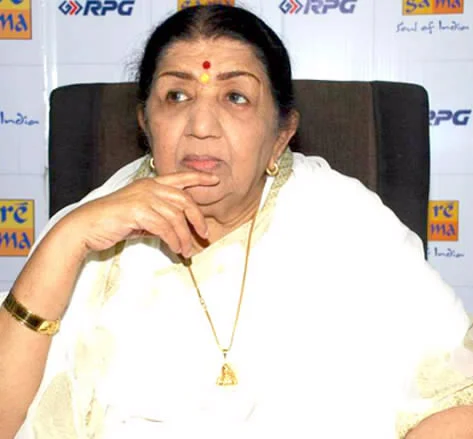
1929–2022
Lata Mangeshkar
Playback singer and recording artistLata Mangeshkar supplied the singing voice for generations of Indian film performers and recorded devotional, patriotic and other non-film music.Read biographyQuick answers
Common questions
- Was Ae Mere Watan Ke Logon written for a film?
- No. It was made for a public concert after the 1962 war with China, and Mangeshkar initially expected a non-film song to have limited reach.
- Who wrote and composed it?
- Kavi Pradeep wrote the words and C. Ramchandra composed the music. Lata Mangeshkar performed it.
- Was the first performance on Republic Day itself?
- The detailed anniversary reports used here give 27 January 1963, during Republic Day celebrations, at New Delhi’s National Stadium.
- Is the Saregama concert upload the original 1963 performance?
- Its label identifies it as a track from Lata Mangeshkar–Mukesh Live in Concert Vol 2. It should not be represented as an authenticated recording of the first event.
Primary and institutional sources
How this history was checked
Research uses published interviews, event reporting and the label’s credits. The complete concert audio was not auditioned for this guide; no lyrics are reproduced, and the later photograph is not an event image. This article was reviewed on 23 October 2026.
- IANS / NDTVFiftieth anniversary: event, venue and Mitul Pradeep’s recollections
- Lata Mangeshkar / IANS / NDTV2013 interview: preparation and memories of Nehru
- The PrintKavi Pradeep: songwriting and the 1963 performance
- Saregama MusicAuthorised later concert recording: album and performance credits
- The Indian ExpressPatriotic songs: Asavari and National Stadium context
- The Indian Express2014 commemoration: Mangeshkar would not sing
- Wikimedia Commons / Bollywood HungamaLater 2010 photograph: exact rights record
- Bollywood HungamaSaregama album launch photograph: original source