
The short answer
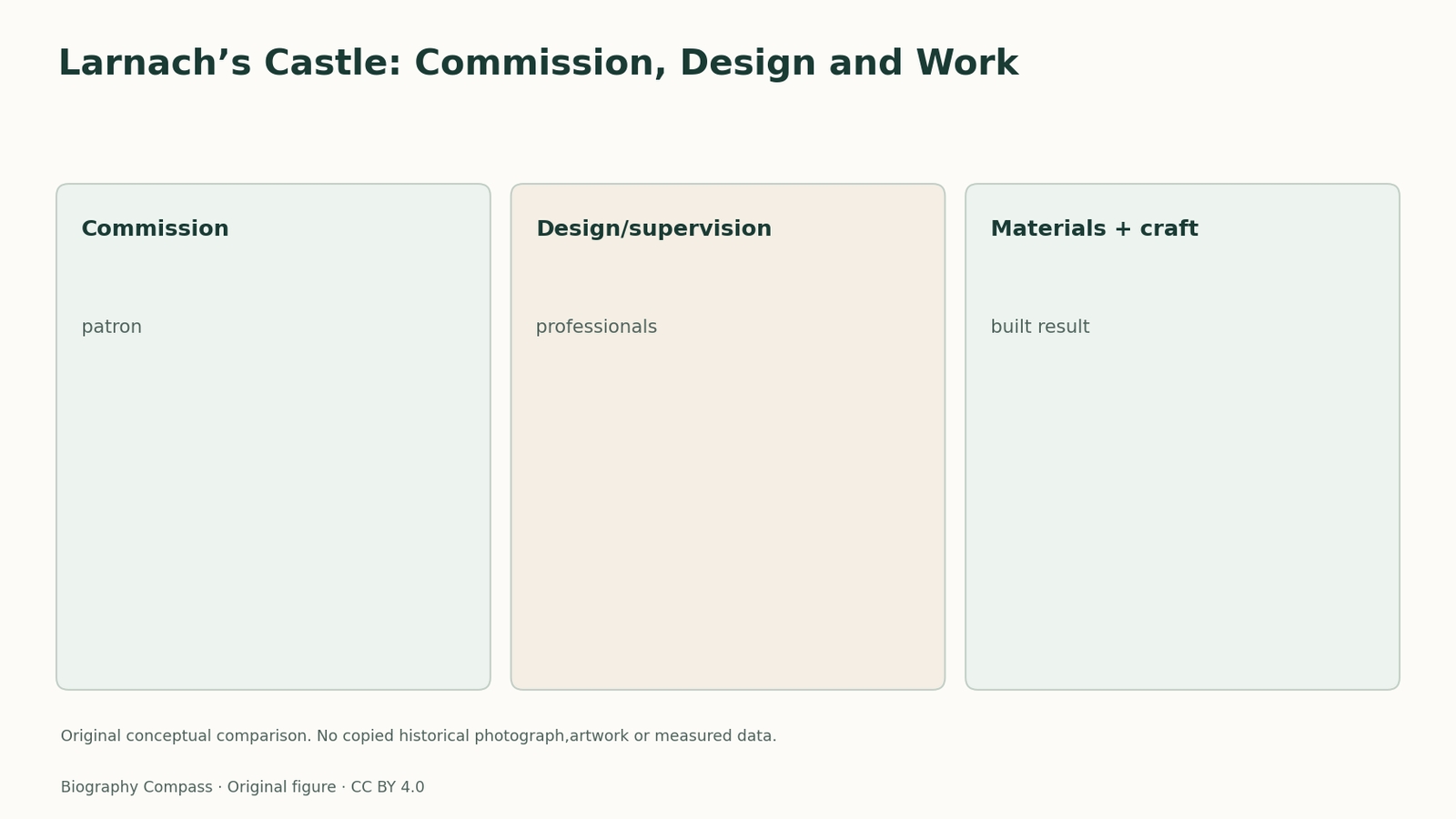
How should a patron’s commission be separated from architectural design and building labour?
Read the records together
Contributions,evidence and scope
Different records illuminate different parts of this particular undertaking.
| Record | What the record establishes | What remains distinct |
|---|---|---|
| Biographical account | Explains patronage, business and occupation. | Ownership does not identify every designer. |
| Heritage listing | Records stages, supervision, materials and craft. | Tentative design attribution is not converted into certainty. |
| Lawson contextual assessment | Places the house within a professional career. | Context does not resolve every original-plan question. |
A patron’s name is not a complete construction credit
Larnach’s Castle is named for the person who commissioned and occupied it. That association answers a patronage question, but not every question about its design or construction. Heritage New Zealand’s record identifies Lawson’s supervision and discusses the original design more tentatively than a simple sole-author label. A separate heritage assessment places the house among Lawson’s major works. Reading those descriptions together allows a positive credit for professional involvement without pretending that all uncertainty about the initial plans has disappeared. The building was an undertaking involving a client, design expertise, contracting and skilled labour.
The construction sequence had several milestones
The heritage chronology distinguishes the foundation stone in 1871, the family’s occupation in 1874, completion of further rooms and shell work, and later additions. These dates describe different stages rather than rival answers to one question about when the house existed. A household could live in part of a building while finishing work continued. The distinction helps explain why a single date on a tourist summary can be inadequate for a complex commission. It also separates the original residence from later changes that should not automatically be assigned to the same design decision.
Sources for this section: [2]
Materials and craft were part of the result
The listing describes local stone and timber alongside materials brought from farther away. It also credits the Godfrey family’s carved stonework. Such details reveal how the appearance of the house depended on procurement and craft as well as the patron’s resources. A named room or façade might contain work from several trades. This is why assigning authorship by ownership alone loses information. The building’s later preservation history is another subject; the present article concerns how a private commission became a material object through different contributions, without inventing the names of workers not identified in the inspected record.
Make an attribution-and-stage worksheet
Use three columns: commission, design/supervision, and craft/construction. Put Larnach in the first, Lawson’s documented involvement in the second, and the recorded carving work in the third. Then add a separate line for the construction milestones. The checked answer to “does the family’s move prove every room was complete?” is no: the heritage chronology distinguishes occupation from later finishing. The answer to “does the patron’s name prove sole architectural authorship?” is also no. This original worksheet supports a fuller building history while preserving uncertainties in the design record. It does not turn a stylistic judgment in an older classification report into a proven account of a personal dispute.
Continue the chronology
Related history guides
Cornwall Park 1901: Gift, Trust and Public Use
Trace Cornwall Park’s 1901 gift and endowment, explaining how privately held trust land could support public enjoyment alongside a separately governed domain.
Read the timeline1860sSt Pancras: Shed, Platforms and Storage
Explore how St Pancras combined its railway approach, elevated platforms, broad roof and storage undercroft, with separate engineering and hotel credits.
Read the timelineBiography context
Explore New Zealand through connected lives
Connected biographies
People behind this work
1833–1898
William Larnach
Banker, businessman and New Zealand politicianWilliam Larnach is remembered for combining banking and political office with the commission of the Otago Peninsula house known as Larnach Castle.Read biography1831–1903
William Rolleston
Provincial leader and education institution builderWilliam Rolleston helped build Canterbury’s educational institutions and shaped land policy, while his national public career also involved the coercive government action at Parihaka.Read biography1845–1906
Richard Seddon
PremierRichard Seddon consolidated Liberal government while combining social reform with an assertive imperial outlook.Read biographyQuick answers
Common questions
- Did naming the castle for Larnach make him its architect?
- No. Patronage, professional design or supervision, and the craftspeople’s work are separate contributions.
Primary and institutional sources
How this history was checked
The cited records distinguish contemporary accounts,official catalogues and later institutional or scholarly interpretation. The comparison and worked exercise are original editorial material. This article was reviewed on 7 November 2026.