
The short answer
Two independently driven wheels create a control problem as well as a propulsion problem. A controller’s number of positions does not, on its own, tell us the motion assigned to each position.
Evidence and original analysis
Commands versus resulting motion
All travel pairs below are invented.
| Pair(dL, dR) | Midpoint arc-travel | Heading change |
|---|---|---|
| (1, 1) | 1 unit | 0 radians |
| (−1, 1) | 0 units | 1 radian |
| (0, 1) | 0.5 units | 0.5 radians |
Chronology
A timeline of the turning points
Design account
Independent drives and a controller described.
Original exercise
Ideal wheel travel stipulated.
What the historical record explains
NRC’s account links independent drives to easy pivoting and describes an eight-position controller. It also records feedback from patients and a cheek-operated control.
The Toronto account identifies Counsell and Owens among the collaborators.
These sources explain a design relationship: propulsion had to be made controllable by its intended users. They do not provide a complete switch truth table, wheel spacing or calibrated speed record.
Specify a separate teaching model
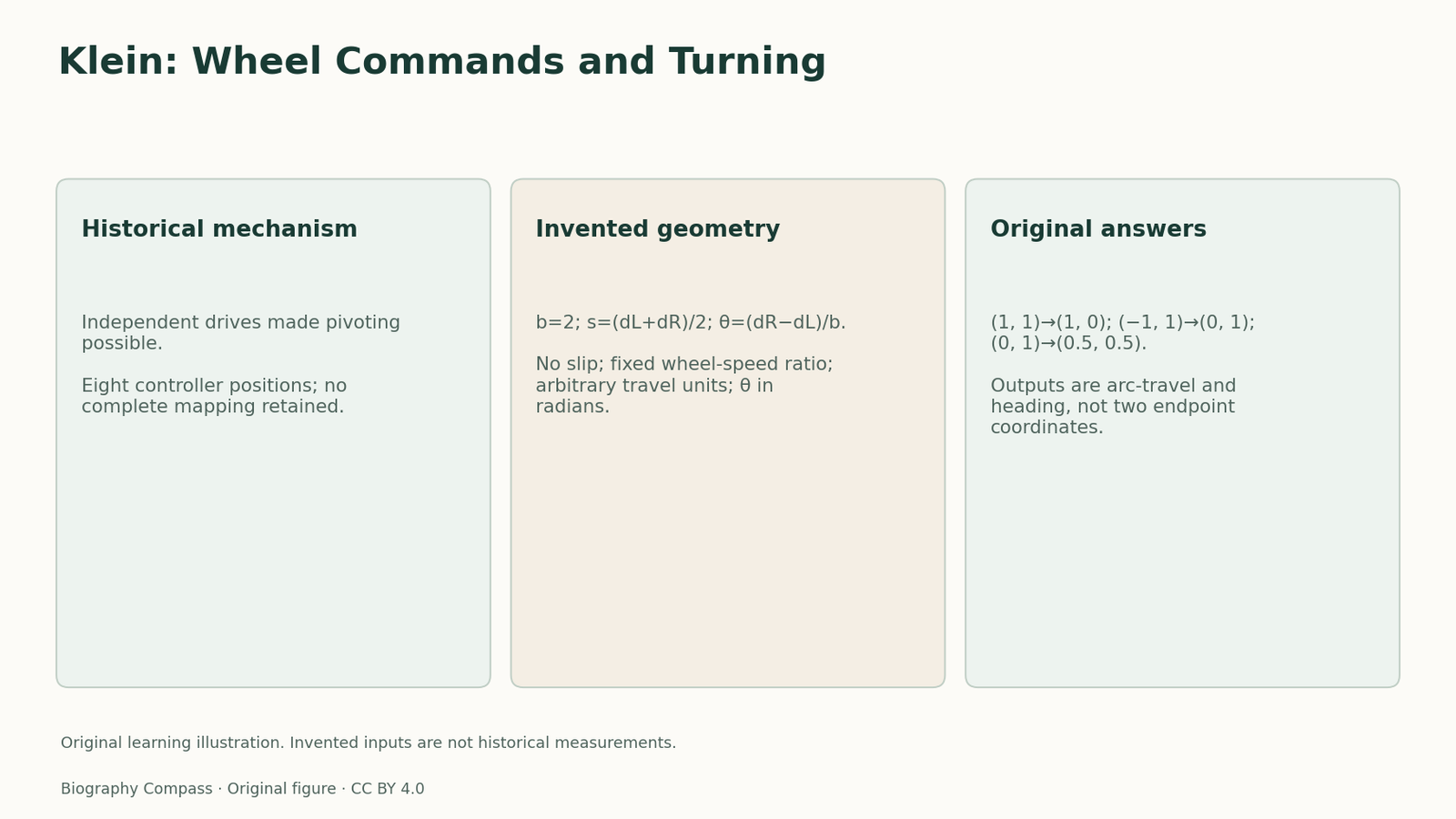
Invent a rigid two-wheel platform rolling without slip. Its wheel spacing is b=2 arbitrary length units. For signed left and right wheel travels dL and dR, define midpoint arc-travel s=(dL+dR)/2 and heading change θ=(dR−dL)/b radians. Positive travel means the stipulated forward direction. Each pair is travelled with a constant wheel-speed ratio.
Evaluate three command pairs: A=(1, 1), B=(−1, 1), C=(0, 1). For each, calculate s and θ. Which produces a pivot about the midpoint? Explain why s is not generally the straight-line distance between the starting and finishing midpoint positions.
Sources for this section: [1]
Reference answer
A gives s=1 and θ=0: straight travel. B gives s=0 and θ=1 radian: counter-rotation pivots about the midpoint in this ideal model. C gives s=0.5 and θ=0.5: the midpoint follows an arc while the stationary left wheel provides the turning centre.
For a finite turn, arc length differs from the chord joining its endpoints. Calling s “forward displacement” would hide that distinction. The formula describes rolling geometry, not a promise that a real chair moves exactly this way.
Sources for this section: [1]
What remains unspecified
Nothing in the eight-position count establishes eight speeds or these three command pairs. A historical command reconstruction would need additional records. The calculation deliberately supplies its own geometry and commands. It provides no stability, accessibility, fitting or medical recommendation.
Sources for this section: [1]
Continue the chronology
Related history guides
Biography context
Explore Canada through connected lives
Connected biographies
Researcher and context
Quick answers
Common questions
- Are these the original eight commands?
- No. The record supplies a count; the exercise supplies its own commands.
- Is a curved path’s arc length its endpoint distance?
- Generally no. They agree for straight travel but differ for a finite curve.
Primary and institutional sources
How this history was checked
Selected records support the historical explanation. Invented inputs and original calculations are labelled separately. This article was reviewed on 31 October 2026.