
The short answer
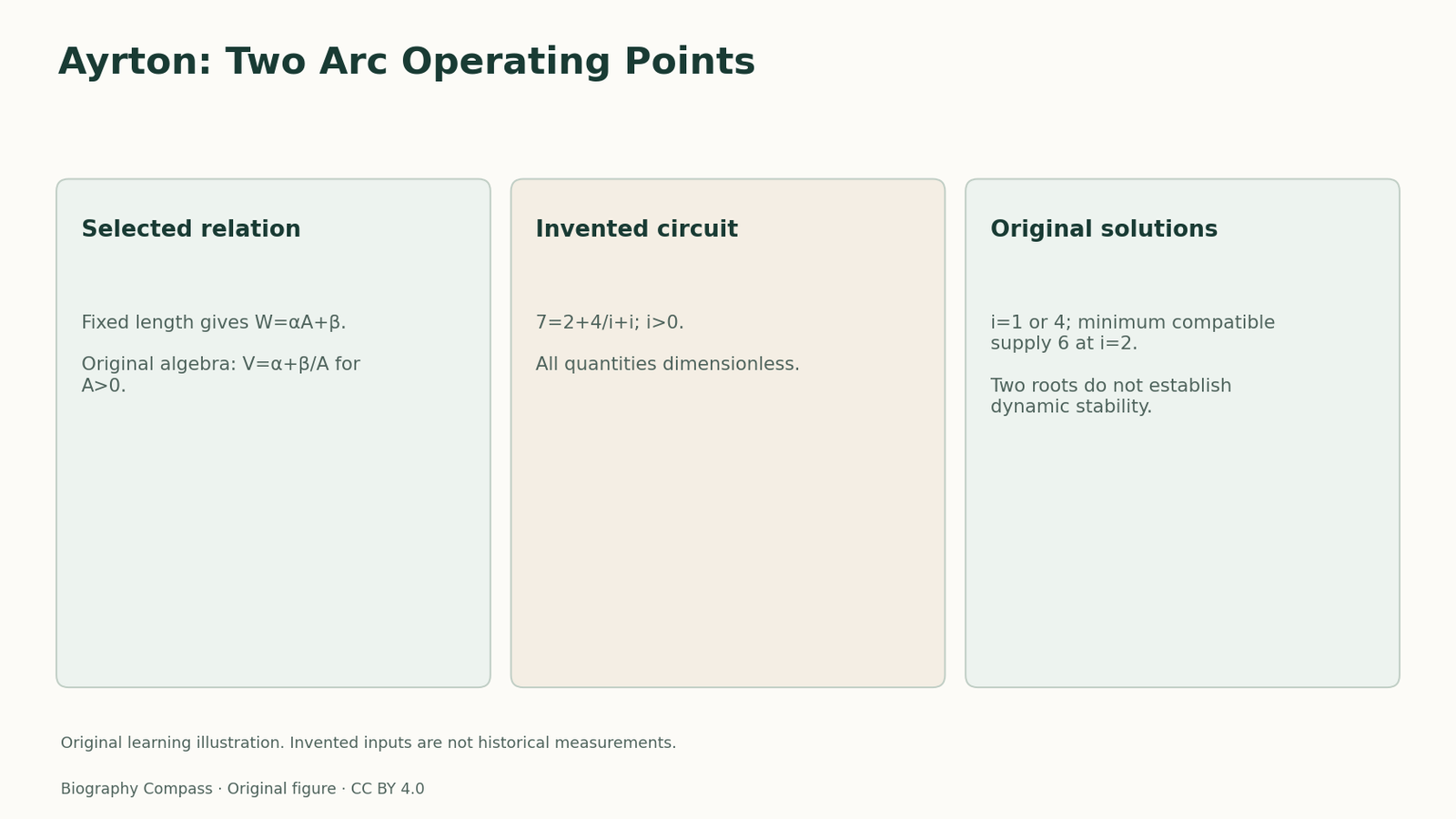
A component and its supply must satisfy their equations together. Two solutions can therefore belong to one fixed component relation, rather than to two competing theories.
Evidence and original analysis
One relation, several supply cases
All numbers in these cases are invented.
| Supply | Positive current solutions | Voltage check |
|---|---|---|
| 5 | None | Below the minimum 6 |
| 6 | i=2 | Component 4+series 2 |
| 7 | i=1 or 4 | 6+1 or 3+4 |
Chronology
A timeline of the turning points
Experimental account
Power expressed using current and apparent length.
Original fixture
Dimensionless supply and component rules stipulated.
From power to potential difference
On printed page 183, Ayrton writes W=38.881A+11.664+l(2.074A+10.54), with W in watts, A in amperes and l the apparent arc length in millimetres. The stated regime is a silent arc with solid carbons.
At a fixed l this has the form W=αA+β. Dividing by positive current gives V=α+β/A. That algebra explains a reciprocal term; it does not make every arc obey this relation. No historical coefficients are used in the invented circuit below.
Sources for this section: [1]
An original load-line problem
Let i>0 be normalised current. Stipulate arc voltage v=2+4/i and a series voltage drop equal to i. With supply 7, solve 7=2+4/i+i. At each solution, calculate the two voltage drops.
Next find the smallest supply compatible with any positive current. Does supply 5 admit a solution? Keep all quantities dimensionless; these are not operating amperes or a device recommendation.
Sources for this section: [1]
Reference answer
Multiplying by i gives i²−5i+4=0, so i=1 or 4. At i=1 the component drop is 6 and the series drop 1. At i=4 they are 3 and 4. Both sums equal 7.
For i>0, i+4/i≥4, with equality at i=2. Thus 2+i+4/i has minimum 6. Supply 5 has no positive solution; 6 gives one tangent solution; 7 gives the two roots above.
Equivalently, subtract 6 to obtain (i−2)²/i≥0. This avoids treating the minimum as merely a feature guessed from a drawing.
Sources for this section: [1]
Existence is not stability
The algebra supplies possible steady operating points under the stipulated rules. It contains no time evolution, capacitance, thermal response or disturbance model. Consequently it does not say which root a real circuit would reach or maintain. Those questions need additional dynamics and evidence.
Sources for this section: [1]
Continue the chronology
Related history guides
Biography context
Explore United Kingdom through connected lives
Connected biographies
Researcher and context
Quick answers
Common questions
- Are the toy coefficients historical measurements?
- No. They are original dimensionless inputs.
- Which root is stable?
- The stipulated static equations do not answer that question.
Primary and institutional sources
How this history was checked
Selected records support the historical explanation. Invented inputs and original calculations are labelled separately. This article was reviewed on 31 October 2026.