
The short answer
A lesson can survive as marks on paper or as a recording, but neither object is the whole act of learning. The institutions associated with Khan describe a practice in which listening, imitation, phrasing and memorisation remain active tasks.
Source comparison and original decisions
Compare the evidence with the new plan
The source statements and the invented planning choices have different jobs.
| Question | Representation | Original diagnosis |
|---|---|---|
| Order list | Names a sequence of events. | A, B, C, D can be correct while timing differs. |
| Timed list | Adds onset positions. | C differs by one pulse in the fixture. |
| Demonstration | Teaching descriptions include phrasing and ornamentation. | Those qualities need further evidence beyond this grid. |
Chronology
A timeline of the turning points
Historical award record
Performance and raga composition recognised.
Selected curriculum
Skills described; Fall course not offered.
Notation exists within an oral practice
AACM describes students learning by hearing, imitating and memorising. It acknowledges notation and allows students to record classes, while encouraging learning by ear. Instrumental, tabla and vocal work are related parts of its teaching.
Permission for a student to record a class is not a general licence to republish that recording. Nor does a document’s survival show how well its reader can carry out the demonstrated action.
Sources for this section: [1]
Several kinds of musical information
The SFCM partnership entry names Khan’s compositions alongside training in melody, rhythm, phrasing and ornamentation. It explicitly says the listed course was not offered in Fall 2026.
The historical NEA record describes ragas as melodic motifs within a disciplined improvisatory tradition.
These descriptions give reasons to separate pitch order from timing and articulation. They do not supply the sound of a particular lesson, or make the invented letters below into a raga. The task isolates one information problem so that its limits remain visible.
Original task: matching order is not matching timing
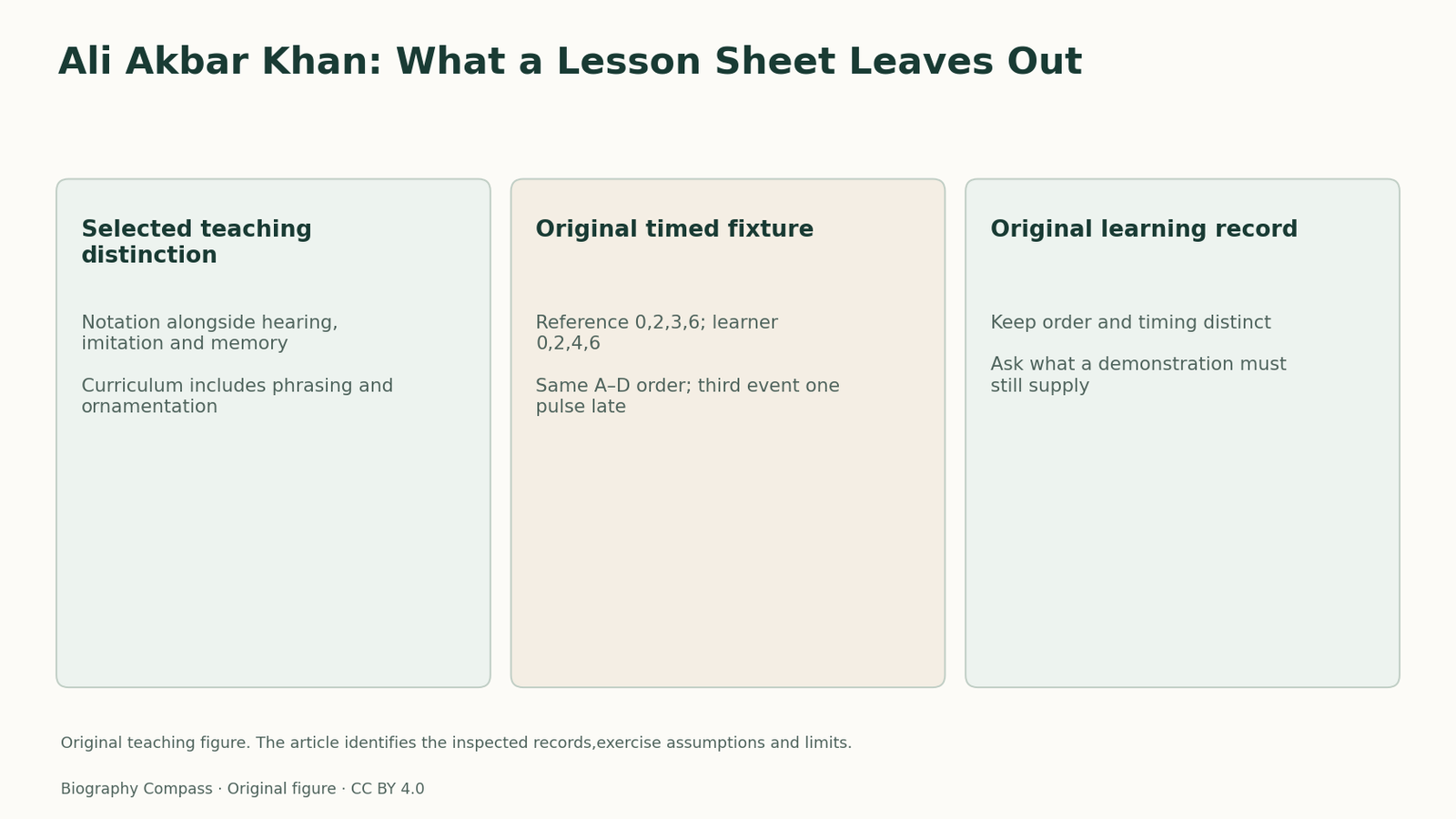
Use an invented eight-pulse interval [0,8). The reference events are A at 0, B at 2, C at 3, D at 6. A learner writes the correct order A, B, C, D, but plays at 0,2,4,6. Which event differs in timing? What additional information would be needed to compare phrasing or ornamentation? The letters and pulse grid are ours, not Indian note names or an authentic tala.
Sources for this section: [1]
Reference diagnosis and a better study record
C is one pulse late; its reference onset is 3, not 4. Correct pitch order alone cannot reveal that error. A timed event list can preserve the onset distinction, but it still omits how one sound is approached, connected or released unless further instructions are supplied.
A useful learning record would therefore distinguish the order list, the timed list and questions for a demonstration. Keep any authorised recording linked to its lesson context and access terms. No performance was listened to for this study, and no claim is made that a corrected grid would reproduce the tradition’s phrasing or the teacher’s artistry.
Sources for this section: [1]
Continue the chronology
Related history guides
Biography context
Explore San Rafael, United States through connected lives
Connected biographies
The related working life
Quick answers
Common questions
- Does correcting C produce an authentic raga?
- No. The letters, timing grid and event sequence are invented and contain no authentic raga or tala specification.
Primary and institutional sources
How this history was checked
Read the selected records and their stated publication contexts. This article was reviewed on 31 October 2026.