
The short answer
A single repealing provision changed the constitutional basis for party competition. Understanding its importance requires distinguishing the earlier one-party amendment, the dates in the 1991 Act and the conditions under which opposition parties then operated.
Original comparison
A constitutional opening and its practical tests
Read what changed in the text separately from what later evidence can establish.
| Country | 1982 amendment | 1991 repeal and aftermath |
|---|---|---|
| Party rule | KANU alone named in Section 2A | Section 2A repealed |
| Presidential nomination | KANU-specific membership and nomination | Political-party nomination provisions |
| Key legal date | Commenced 25 June 1982 | Commenced 20 December 1991 |
| Political conditions | Constitutional monopoly and repression | Competition returned; coercion and violence persisted |
Chronology
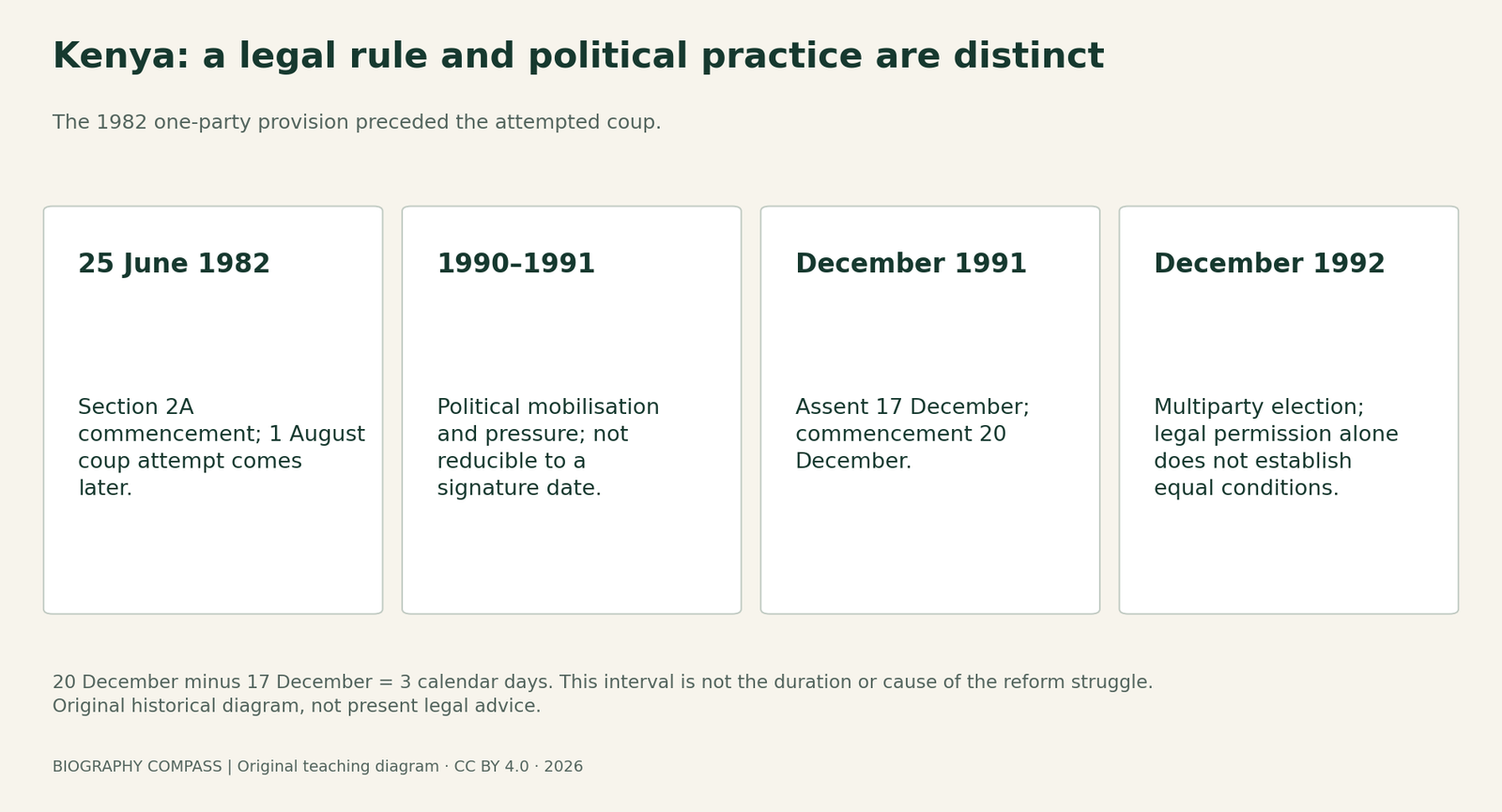
A timeline of the turning points
Section 2A commenced
Act No. 7 inserted a constitutional monopoly for KANU.
Attempted coup
The military attempt occurred after the amendment.
Pressure for pluralism
Opposition, civil society and international pressure intensified.
Assent
Date recorded on Act No. 12.
Commencement
The repeal and related nomination changes took effect.
Multiparty general election
Legal pluralism was tested in a competitive but coercive political environment.
Read the earlier amendment before the repeal
Act No. 7 of 1982 inserted Section 2A into the Constitution and named the Kenya African National Union as the country’s only political party. The same Act altered presidential nomination provisions to require KANU membership and nomination. Its first page records assent on 17 June and commencement on 25 June 1982. Parliament’s institutional history describes this as a shift from a de facto one-party system to a de jure one. The distinction means that dominance already exercised in practice acquired an explicit constitutional rule. It does not mean that opposition had previously enjoyed unrestricted political space.
The 1982 coup attempt was a later event
The attempted military overthrow occurred on 1 August 1982. A timeline that places the June amendment after the coup reverses cause and chronology. The TJRC found that the coup’s suppression and subsequent measures intensified repression, but the constitutional monopoly already existed. The commission documents detention, torture and restrictions on political activity during the Moi administration. These findings explain why removing a party clause had larger significance than changing an organisation’s name in a legal text. The rule operated alongside security institutions and other legislation that limited citizens’ capacity to organise and challenge executive power.
Pressure involved more than presidential willingness
The opening followed sustained demands from Kenyan politicians, religious leaders, lawyers, human rights advocates and other citizens, alongside international pressure. The TJRC describes the repression of pro-democracy organising and the detention of opponents, including Kenneth Matiba and Charles Rubia. Its historical account attributes the eventual concession to combined local and international demands. That evidence supports a multi-actor explanation. Moi and Parliament possessed the institutional authority to change the Constitution, while those demanding change faced risks outside those institutions. Describing the repeal solely as a presidential gift would conceal the mobilisation that made the issue unavoidable.
Assent and commencement are separate dates
The Constitution of Kenya (Amendment) (No. 2) Act 1991 is Act No. 12. Its first page records assent on 17 December and commencement on 20 December. Section 2 repealed Section 2A; subsequent provisions replaced KANU-specific nomination language with political-party provisions. The difference is substantive: the Constitution could now accommodate competing parties. It is also chronological: a party resolution, parliamentary stage, assent and commencement need not occur on one day. The guide uses the dates printed on the Act for those legal stages. It does not turn an uncited parliamentary passage date into the commencement date.
Sources for this section: [2]
The next election tested institutions and conditions
The 1992 multiparty contest did not arise under a wholly new constitution or automatically neutral administration. A December 1992 High Court ruling described the repeal and related changes while addressing a challenge to Moi’s presidential nomination. Its procedural disposition should not be expanded into a judgment declaring every electoral practice fair. The TJRC records political violence and displacement around the 1992 and 1997 elections. These findings support a distinction between permission for party competition and the security, administrative fairness and accountability needed to exercise it. Repeal was an important institutional opening; democratic practice remained contested. The ruling also discusses subsequent 1992 proposals and enacted changes. It is therefore a warning against attributing every later feature of presidential competition, including the separate term-limit debate, to the December 1991 repealing provision. Each reform needs its own text and date.
Worked exercise: identify the change and its limits
Test three statements against named records: “the coup caused the June amendment”; “the repeal began on the assent date”; and “legal multiparty politics ensured safe competition.” The reference answers are: compare 25 June with 1 August 1982 to reject the first chronology; distinguish 17 December assent from 20 December commencement in Act No. 12; and use the TJRC’s later election-violence findings to reject the third inference. As an original date calculation, the two printed December dates are three calendar days apart. That interval is not a measure of how long political reform took, because mobilisation and institutional change extended far beyond those dates.
Continue the chronology
Related history guides
Connected biographies
People connected with this policy
1924–2020
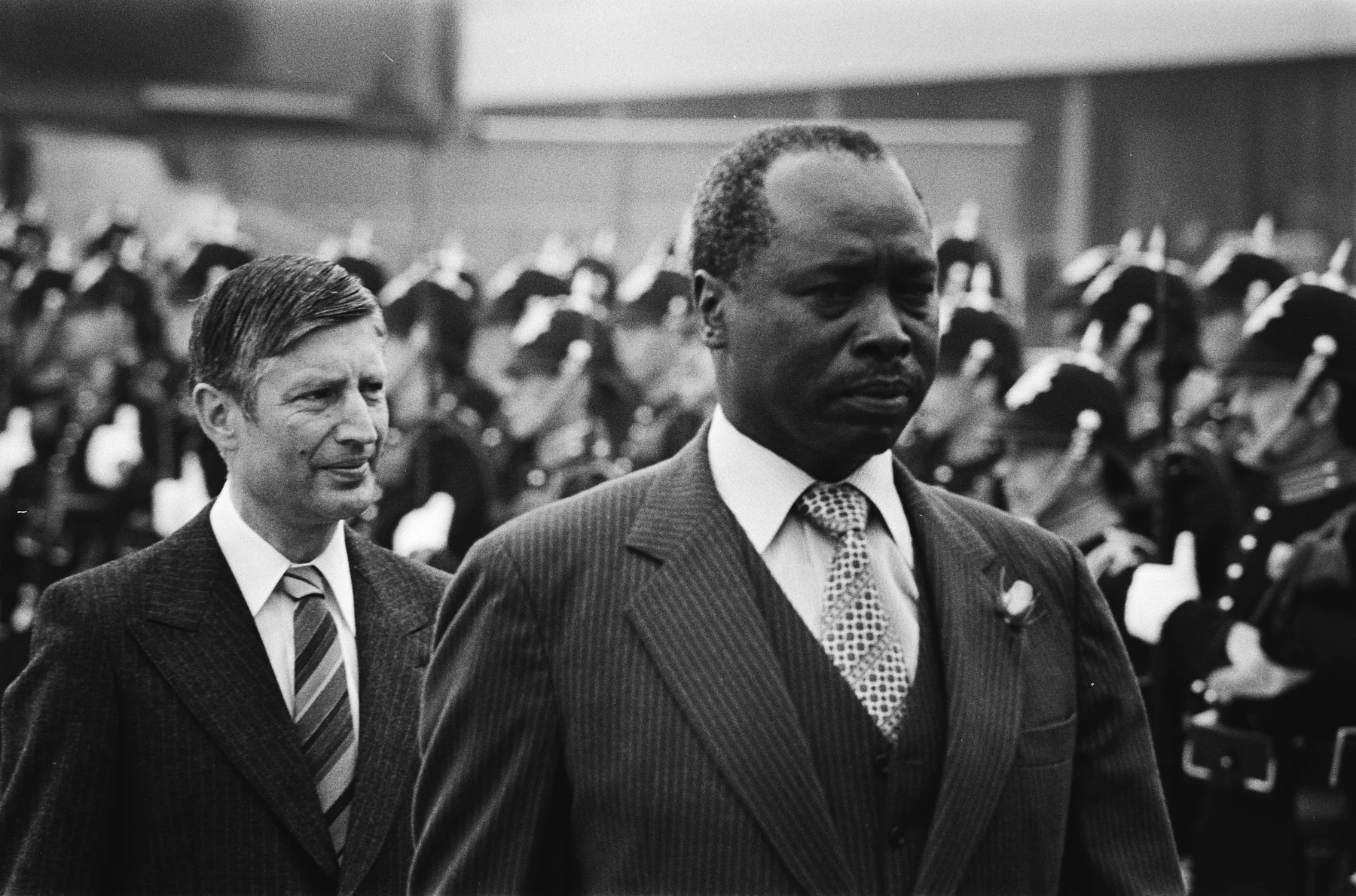
Daniel arap Moi
Teacher, KADU politician and Kenya’s second presidentDaniel arap Moi rose from teaching and KADU regional politics to serve as vice-president and then president from 1978 to 2002. His long rule combined diplomatic prominence with documented repression and the eventual return of legal party competition.Read biography
1931–2022
Mwai Kibaki
Economist, finance minister and Kenya’s third presidentMwai Kibaki moved from university economics into KANU, Cabinet and opposition politics before winning the presidency in 2002. His administration expanded primary education and later governed through a coalition after the disputed 2007 election.Read biography1911–1994
Oginga Odinga
Nationalist organiser, Kenya’s first vice-president and opposition leaderOginga Odinga helped organise Kenyan nationalism, became the republic’s first vice-president and then led opposition to Kenyatta. His later FORD-Kenya leadership linked the independence generation with renewed multiparty politics.Read biographyQuick answers
Common questions
- Was the repeal in 1991 or 1992?
- The repealing Act commenced on 20 December 1991; the first ensuing multiparty general election occurred in December 1992.
- Did the one-party amendment follow the 1982 coup?
- No. It commenced in June, before the attempted coup on 1 August.
- What does the legal change prove?
- It proves removal of the explicit constitutional party monopoly; it does not by itself prove equal or safe competition.
Primary and institutional sources
How this history was checked
Original records anchor the chronology and policy explanation. The comparison, calculation and evidence exercise are original reader aids; the source notes explain limits. This article was reviewed on 27 October 2026.
- Parliament of Kenya / Kenya LawConstitution of Kenya (Amendment) Act 1982, No. 7: original statutory text
- Parliament of Kenya / Kenya LawConstitution of Kenya (Amendment) (No. 2) Act 1991, No. 12: original statutory text
- National Assembly of KenyaFactsheet No. 20: A History of the National Assembly Standing Orders, second edition August 2022
- Truth, Justice and Reconciliation Commission, Kenya; CSVR historical report collectionFinal Report, Volume IIA, 2013: political history, killings, detention and torture
- Kenya Presidential Library and ArchivingHE Daniel Toroitich arap Moi: institutional biography
- High Court of Kenya; transcript hosted by SheriaHubCharles Kagai Mwihia and another v Ndolo Ayah and another [1992] eKLR, original ruling transcript