
The short answer
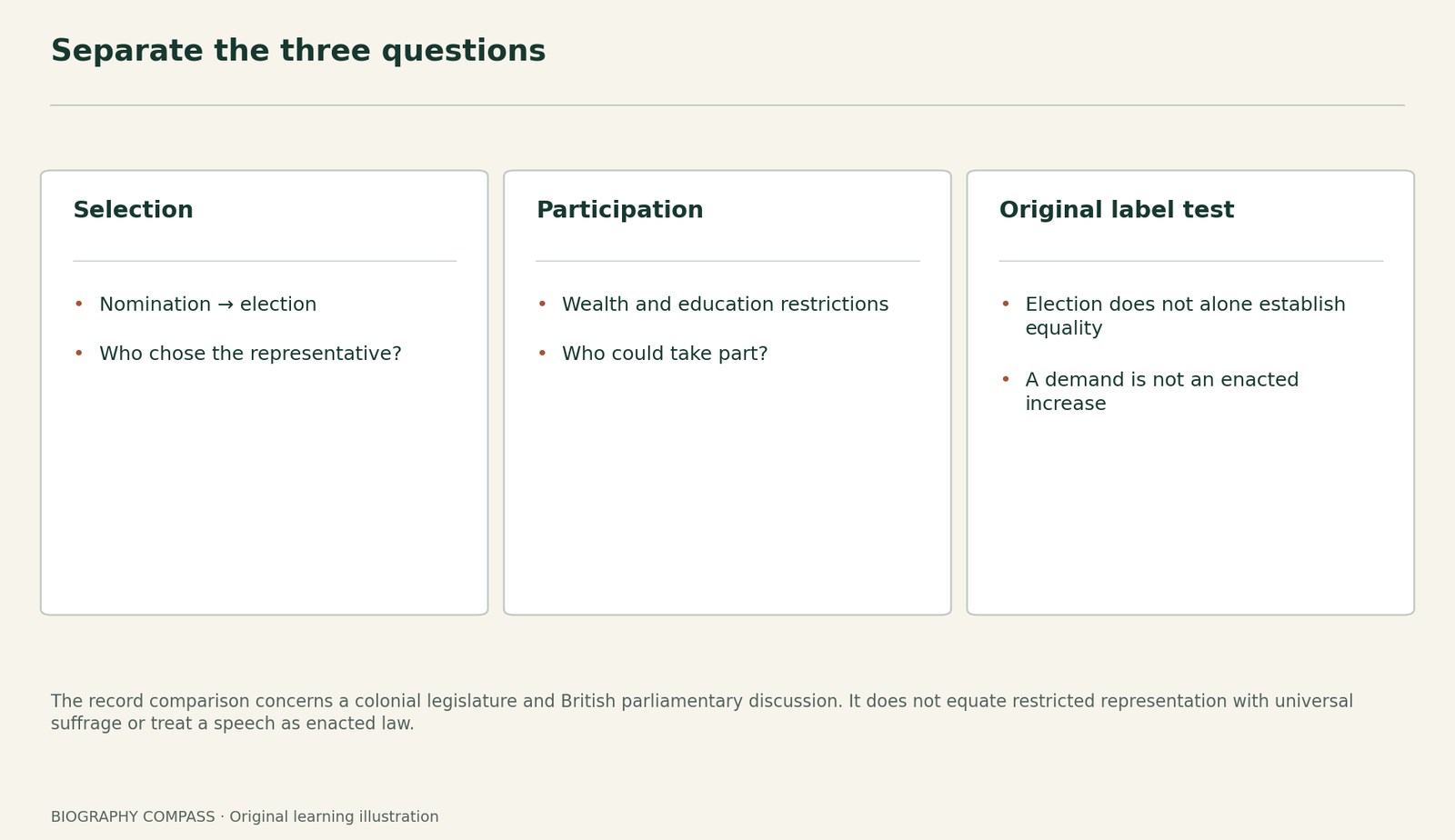
An election can change how representatives are selected while leaving important restrictions intact. The useful historical question is therefore more precise than whether a legislature had become democratic: who selected its members, who could participate, and what influence did the resulting seats provide?
Compare the evidence
Selection, eligibility and influence
Ask what the record establishes and which further claim needs different evidence.
| Record | Supported reading | Boundary |
|---|---|---|
| Historical appointment and result | Nomination followed by restricted African elections. | Not universal or equal political power. |
| Contemporary preparation | Candidate conditions and a forthcoming election. | Not a complete voter register or final result. |
| Parliamentary argument | A reported demand for additional seats. | Not proof of an enacted increase. |
Chronology
A timeline of the turning points
Appointment record
Identify who selected the representative.
Preparatory notice
Separate planned conditions from completed results.
Continuing debate
Do not turn a demand into an enacted outcome.
A nominated voice and a different selection method
Parliament’s historical account identifies the governor’s nomination of Mathu in 1944 and the election of eight African members in 1957. Its related historical-background text says voting rights in that election depended on wealth and education.
An electoral route does not by itself establish that every adult can vote, that all communities have equal representation, or that the legislature controls every part of government. Selection, franchise and distribution of power belong in separate columns.
Read the contemporary preparation as preparation
The 1956 Table journal describes candidate requirements including a minimum age of 25, competence in written and spoken English and an oath. It reports that the proposed African seats had increased from six to eight and that the first election was planned for March 1957.
This is valuable contemporary evidence of the design being prepared. Candidate qualifications should not be mistaken for a complete description of voter eligibility, however. Nor does a statement that an election is forthcoming prove which candidates eventually won. The later historical list answers the result question; the earlier notice helps reconstruct the rules and expectations before the event.
The election did not settle the argument about power
In the Commons debate of 4 June 1957, K. Robinson reported the African members’ demand to increase their seats from eight to fifteen, seeking parity with the other elected racial groups. He also argued for movement toward a common roll. The Colonial Secretary defended existing commitments concerning the communal system.
The dispute demonstrates why the first election cannot be used as a synonym for equal political power. Yet a British member’s account of a demand is still not the demand’s full original manifesto, and neither a speech nor a proposal establishes that the suggested increase became law. Here the parliamentary setting is British, while the representation being debated is Kenyan.
Sources for this section: [3]
Worksheet: repair a museum label
Invented label: “The first African representative was elected; the later election gave all adults an equal voice; a demand for more seats proves the increase took effect.” Mark each clause as supported, contradicted or requiring another record. Write a replacement label that preserves the importance of the changes without supplying evidence that is absent.
Reference answer: the first clause confuses nomination with election. The second ignores the recorded wealth-and-education restriction and mistakes a selection mechanism for equality of power. The last turns a parliamentary report of a demand into a completed decision. A sound replacement distinguishes an appointed voice, a later restricted election and continuing disagreement over the allocation of seats.
The exercise diagnoses the claims rather than ranking the individuals as democratic or undemocratic. A representative could use a limited institution to challenge its limitations. Historical significance and a restricted mandate can coexist.
Continue the chronology
Related history guides
Biography context
Explore Kenya and United Kingdom through connected lives
Connected biographies
Connected political careers
Died 1993
Eliud Mathu
Legislative representativeMathu entered the Legislative Council by nomination.Read biography1922–1992
Masinde Muliro
Minister and opposition leaderMuliro helped sustain the movement for multiparty politics.Read biographyQuick answers
Common questions
- Does an election establish universal suffrage?
- No. The method of selecting a representative and the rules governing who can vote require separate evidence.
Primary and institutional sources
How this history was checked
Compare the selected records and their different purposes, then use the worked example to test the conclusions. This article was reviewed on 30 October 2026.
- Parliament of KenyaHistory of the Parliament of Kenya: selected early representation record
- Society of Clerks-at-the-Table, volume25The Table1956: selected Kenya election notice
- UK House of Commons,4 June1957Central African Federation, Kenya and Tanganyika: selected debate
- Parliament of KenyaParliament Historical Background: selected franchise passage