
The short answer
What could a short simulated protein trajectory show that an average structural model could not, and which assumptions limited that claim?
Read the evidence
Different records within the same investigation
The following comparison distinguishes the specific questions answered by the inspected records.
| Record or test | What it establishes | What remains different |
|---|---|---|
| Average structure | Describes central positions | Can conceal the variation around them |
| Calculated trajectory | Describes model-dependent motion and relationships | Is not a direct experimental movie |
Which protein question was being asked?
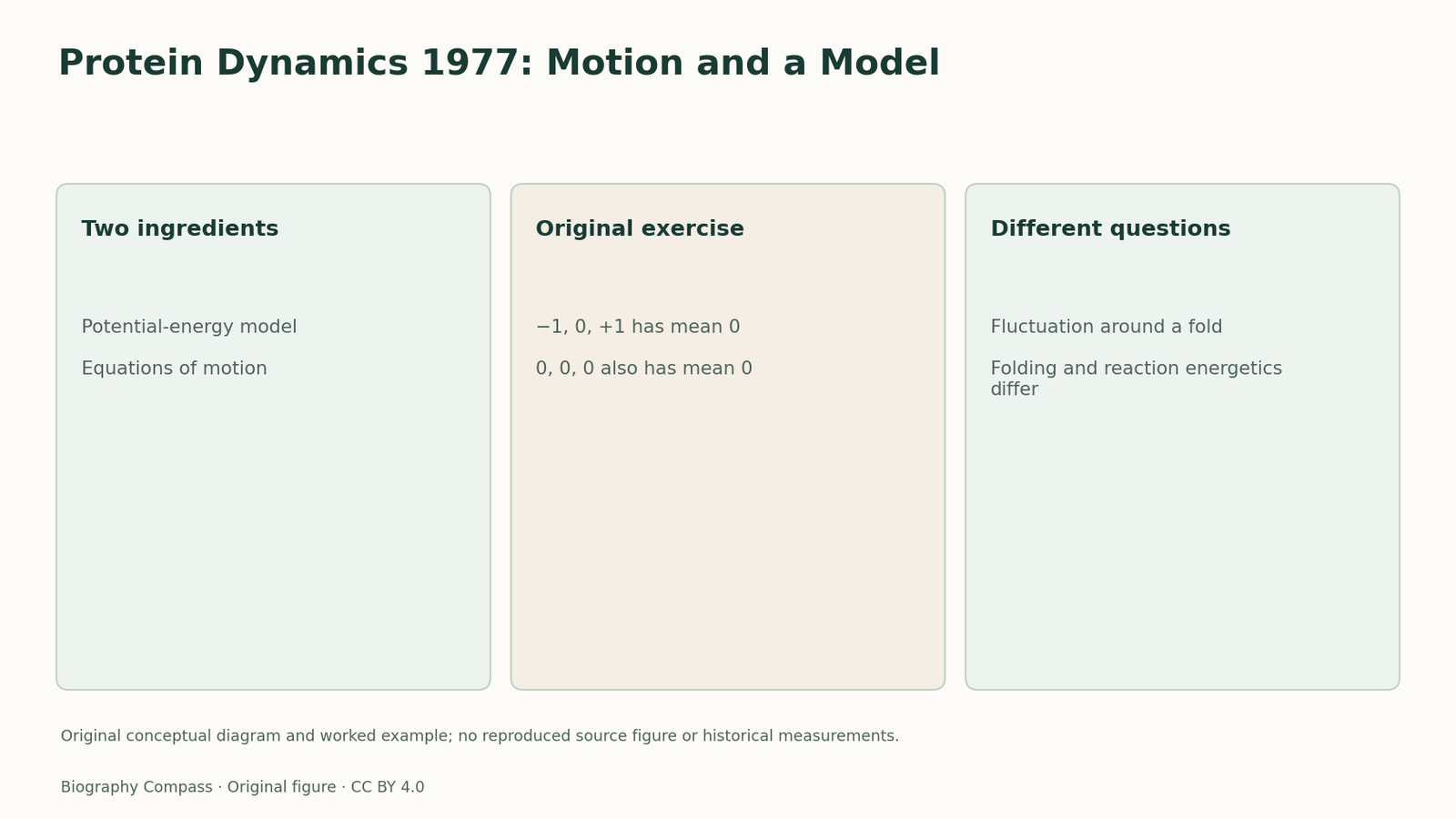
The 1977 study by McCammon, Gelin and Karplus investigated motions of folded bovine pancreatic trypsin inhibitor, BPTI. Its abstract describes solving equations of motion using an empirical potential-energy function. The question was how a folded structure fluctuated, including the magnitude and relationships of movements, rather than whether the investigators could simulate the full folding history of every protein. Naming the system and starting question prevents a retrospective exaggeration. A protein already represented in a folded state and a chain seeking its folded arrangement are related computational subjects, but they are not the same demonstration.
Sources for this section: [1]
A trajectory depends on a model
Karplus’s lecture separates the potential surface governing atomic interactions from the laws used to calculate motion. This distinction is important because a convincing animation can hide its assumptions. A trajectory is a sequence generated under a specified model; it is not a direct movie recorded from all the atoms of a living protein. The original paper interpreted local motions as having a diffusional, fluid-like character within the system studied. That interpretation should retain its scale and context rather than becoming a claim that proteins are shapeless liquids or that every long-timescale event was included.
Exercise: an average can hide fluctuations
Consider invented positions of a model point along one axis: minus one, zero and plus one units. Their average is zero. A second model point remains at zero in all three observations and has the same average position. Do the records describe the same motion? No. The first varies around the mean; the second does not vary in this simplified record. This example contains no historical protein measurements. It explains why an average structure and a description of fluctuations answer different questions, even when they can be represented with the same central coordinate in a static drawing.
Sources for this section: [1]
Compare relationships as well as amplitudes
Now imagine two fictional points that each move between minus one and plus one. In one record they move together; in another, one moves positive when the other moves negative. Their individual ranges can match while their relationships differ. A correlation question therefore adds information beyond a list of average positions or fluctuation sizes. It still does not prove that either invented motion causes a biological function. The historical study made dynamics a tractable object of investigation; interpreting a functional mechanism requires further comparisons. Read the Levitt folding topic for a distinct use of simplification, and the Warshel topic for a calculation focused on reaction energetics. A third invented record can use the same positions in a different order. Its mean and range can remain unchanged while its temporal relationships change. Keeping the order therefore supplies information that a list of positions, stripped of time, would lose.
Sources for this section: [4]
Continue the chronology
Related history guides
Protein Folding 1975: Simplify and Test
Explore Levitt and Warshel’s reduced folding model, distinguish a conditional result from a universal prediction, and test a comparison with an answer.
Read the timeline1976Lysozyme Models: Compare Energy Contributions
Examine Warshel and Levitt’s 1976 lysozyme model, distinguish calculated energy contributions from direct observations, and compare reference settings.
Read the timelineBiography context
Explore United States through connected lives
Connected biographies
Researchers and related approaches

1930–2024
Martin Karplus
Theoretical chemist and molecular-simulation researcherExplore Martin Karplus’s refugee childhood, training with Pauling, molecular-simulation collaborations and the evidence behind the 1977 protein study.Read biography1925–2004
John Pople
Theoretical chemist and computational-methods developerJohn Pople moved from mathematics into theoretical chemistry, combining model design, software and accuracy assessment to make molecular calculations widely usable.Read biographyQuick answers
Common questions
- Was the 1977 study a general protein-folding solution?
- No. It examined dynamics of a particular folded protein.
- Can two records have the same mean but different motion?
- Yes. The original exercise shows a varying coordinate and an unchanging one with the same mean.
Primary and institutional sources
How this history was checked
The references below distinguish the original study from later explanations. The worked exercise and comparison are newly written for this article. This article was reviewed on 8 November 2026.
- McCammon, Gelin and Karplus, Nature, 1977Dynamics of folded proteins
- Harvard Chemistry, 6 January 2025Martin Karplus (1930–2024)
- Harvard Gazette, 7 May 2026Martin Karplus, 94 — Faculty Memorial Minute
- Nobel Prize OutreachMartin Karplus — Nobel lecture
- Nobel Prize OutreachMartin Karplus — Facts
- Nobel Prize OutreachMartin Karplus — Biographical