
The short answer
Why was Decoration’s structure disputed at its first public appearance?
Compare the records
What the sources allow us to say
Read the object record alongside the contextual account.
| Record | Evidence | Reading limit |
|---|---|---|
| Decoration object record | 1923 tempera panel, icon-related form and reception. | Critical quotations represent particular reviewers. |
| Gallery educational resource | Later pavilion murals and 1943 presidency. | Later recognition does not mean all opposition vanished. |
Abstract does not mean without references
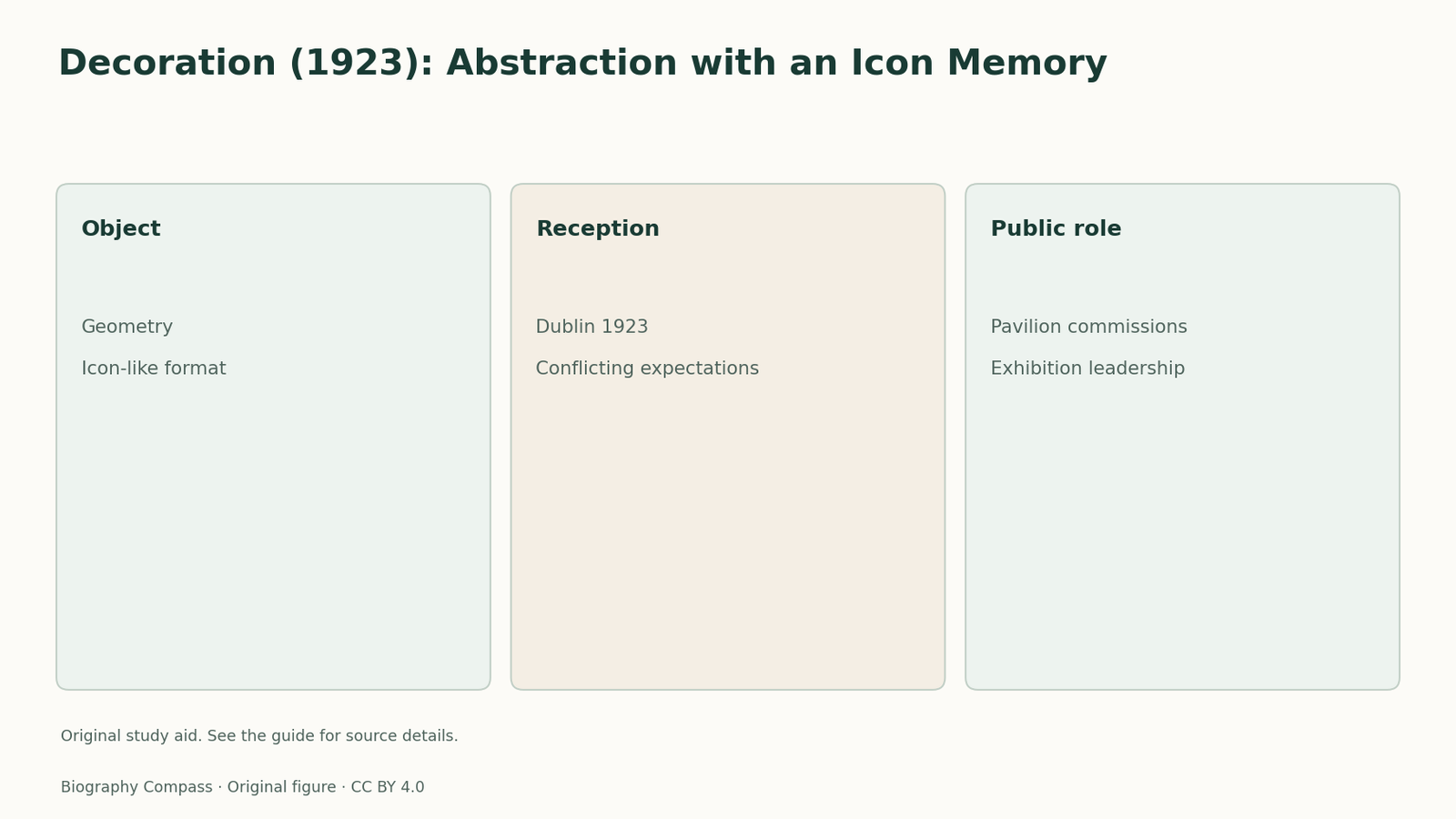
The National Gallery identifies Decoration as a 1923 tempera painting on a wood panel. Its interpretation connects the format, medium and colour range with icons of the Madonna and Child, even though the painting is essentially abstract. This gives the viewer a precise question: how can a work retain a memory of an established image type while changing the arrangement of forms? The connection concerns structure and visual tradition. It does not require naming each geometrical shape as the literal body part of a hidden figure.
Sources for this section: [1]
Reception records a disagreement
The gallery preserves examples of the hostile response when the painting appeared in Dublin. Those reviews document what particular critics expected and how they reacted. They do not constitute a neutral measurement of the painting’s quality, nor prove that every contemporary viewer rejected it. Read the criticism beside the object’s materials and construction. The disagreement becomes historically useful when it shows a gap between new visual procedures and an audience’s accustomed ways of recognising or judging a picture.
A later commission changes the public context
The educational resource records Jellett’s subsequent murals for international exhibition pavilions and her presidency of the Irish Exhibition of Living Art in 1943. Put these events beside the 1923 exhibition on a short timeline. A supported answer describes a changing public role without claiming that opposition disappeared completely. The same career can contain controversy, commissioned work and institutional leadership. This comparison moves beyond an isolated scandal and asks how a painter helped build the conditions in which a modern artistic language could acquire a wider public presence.
Sources for this section: [2]
Continue the chronology
Related history guides
Biography context
Explore Ireland through connected lives
Connected biographies
Read the artist’s biography
1897–1944
Mainie Jellett
Painter and modernist organiserAn Irish painter and organiser who advanced abstraction through painting, public commissions and exhibition leadership.Read biographyQuick answers
Common questions
- Is Decoration a conventional Madonna and Child painting?
- The gallery describes it as essentially abstract while identifying echoes of religious icons in its format, colours and medium.
Primary and institutional sources
How this history was checked
The listed records support the facts. Observation exercises and arguments are Biography Compass editorial interpretations. This article was reviewed on 7 November 2026.