
The short answer
How do layered interiors use light and geometry to unsettle spatial depth?
Compare the records
What the sources allow us to say
Read the object record alongside the contextual account.
| Record | Evidence | Reading limit |
|---|---|---|
| NGMA object record | Wash/tempera,geometrical planes and architectural preference. | A formal description is not a measured building plan. |
| Victoria Memorial biography | Places 1920s experiments after brushwork and satire. | A movement label should not erase an individual trajectory. |
Begin with the object’s recorded material
NGMA identifies Temple Cubistic as wash and tempera on paper. Its description places the work within Gaganendranath’s early 1920s interest in geometrical divisions and architectural compositions. The medium matters because tonal transitions and layered marks can make space without requiring a complete solid outline around every form. Begin by noting boundaries, dark areas and the passages that appear to open into depth. These are observations to test against the museum image, not instructions to discover a hidden architectural blueprint.
Sources for this section: [1]
Planes can produce rather than abolish depth
The museum explains the cubist description through divisions of figure and ground into geometrical planes. It also associates Gaganendranath’s photography with his interest in light and shadow. Read these points together. A divided surface need not eliminate all spatial experience; contrasts and overlapping areas can suggest an interior while making its organisation unfamiliar. The Victoria Memorial account situates these experiments within a broader change of practice after his earlier brushwork and satire. The label identifies an inquiry, not a promise of exact conformity to one European painter’s method.
A diagram of three spatial operations
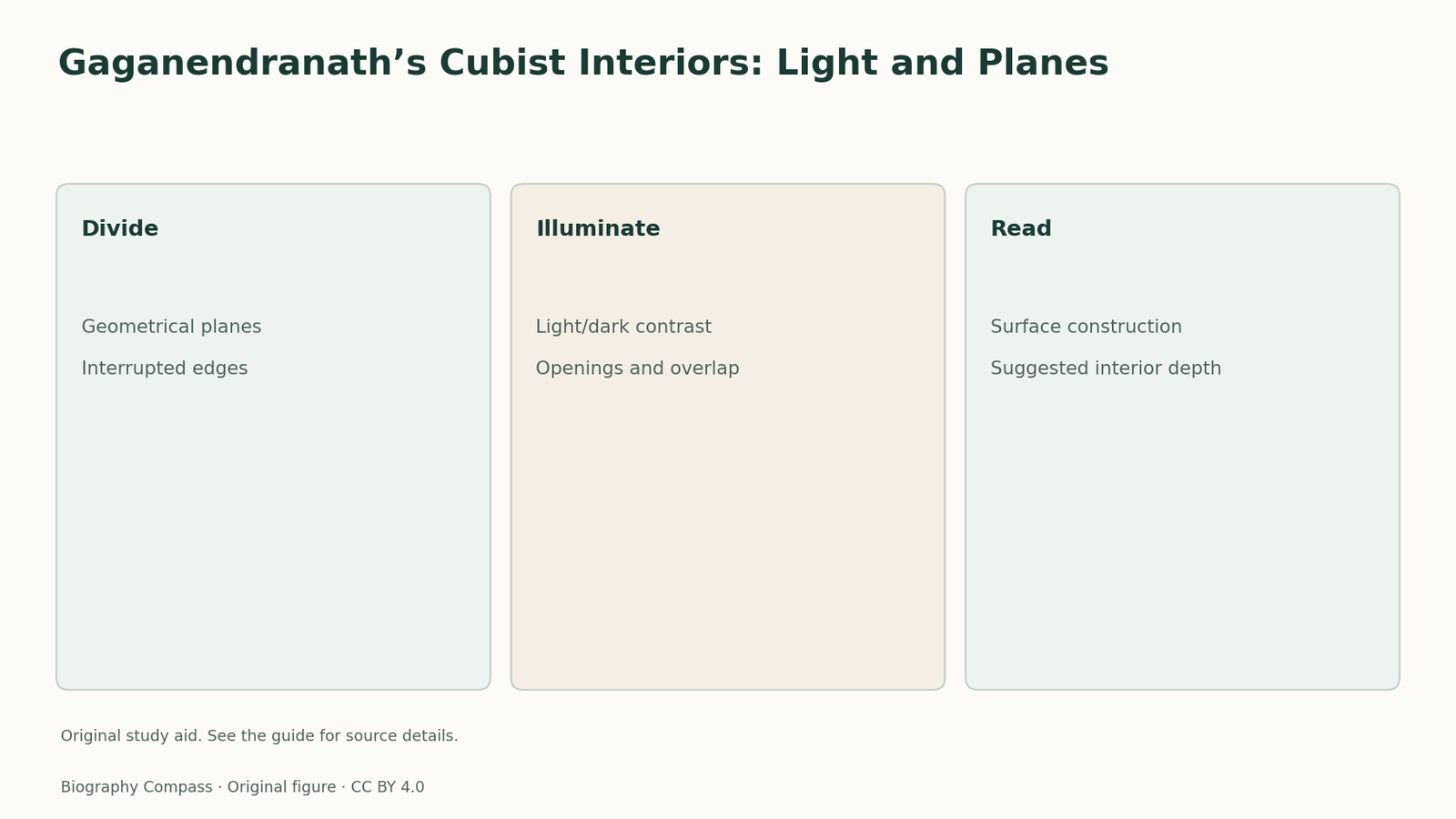
Draw an invented interior using only neutral rectangles and three tones. Make one edge continue across two planes, interrupt another and place a bright opening against a darker field. A supported explanation identifies which operation suggests connection, division or depth. It should state that the exercise illustrates possible spatial relationships rather than reconstructing Tagore’s working process. The comparison is useful because it turns an art-historical label into questions about what a painting actually does with planes and illumination, while keeping those observations distinct from undocumented claims about intention.
Continue the chronology
Related history guides
Biography context
Explore India through connected lives
Connected biographies
Read the artist’s biography
1867–1938
Gaganendranath Tagore
Painter and caricaturistAn Indian painter and caricaturist who moved from Japanese-influenced brushwork to satire and experimental architectural space.Read biographyQuick answers
Common questions
- Does cubist space have to eliminate all depth?
- No. Divided planes can still suggest depth through overlap, contrast and the relation of light to darker areas.
Primary and institutional sources
How this history was checked
The listed records support the facts. Observation exercises and arguments are Biography Compass editorial interpretations. This article was reviewed on 7 November 2026.