
The short answer
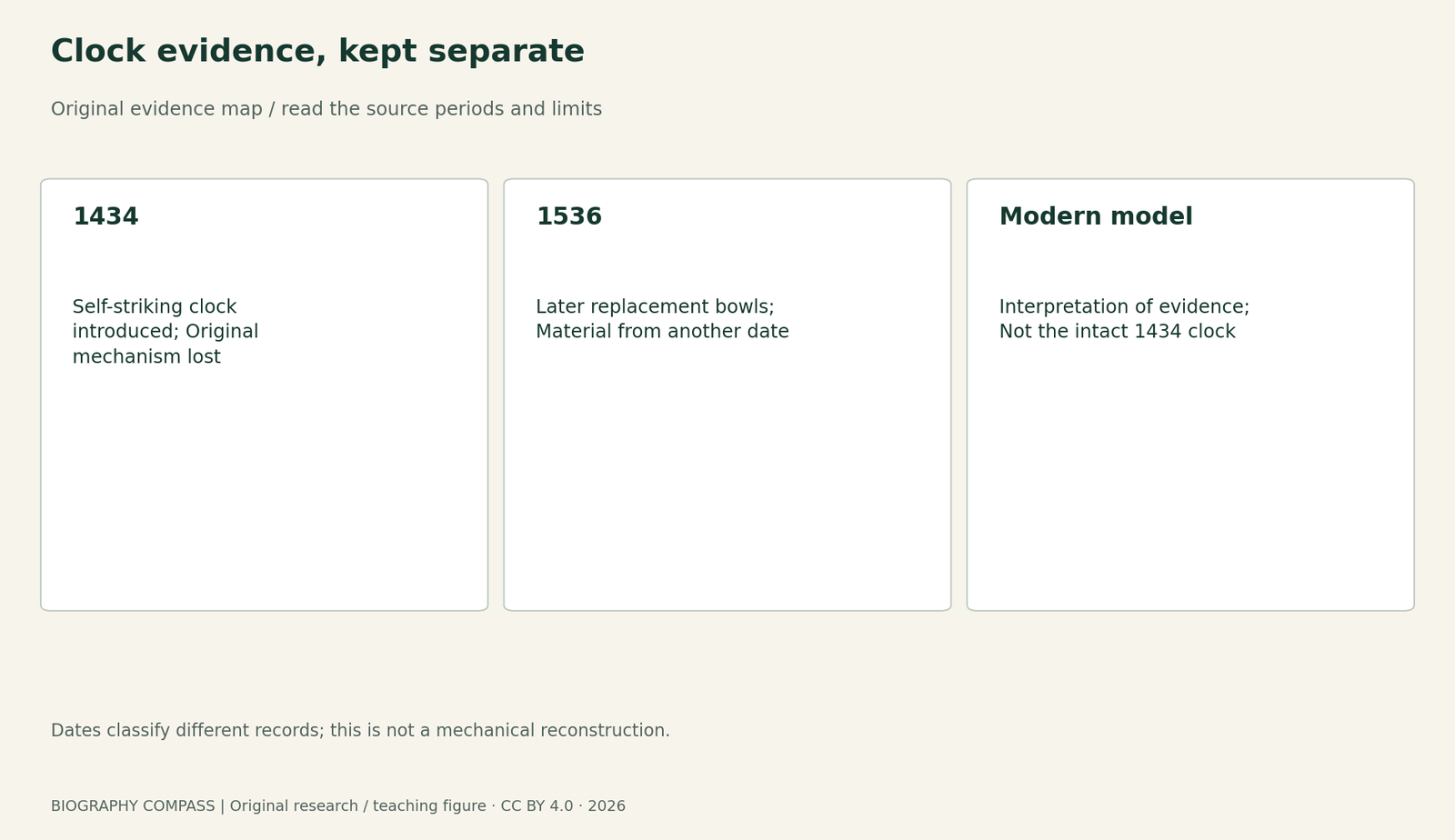
What exactly survives of the water clock associated with Jang Yeong-sil? This guide separates three records often compressed into one object: the 1434 invention, parts of a 1536 replacement and a modern restored model. A short exercise turns that distinction into a method for reading museum displays.
Original source comparison
Which claim belongs to which record?
Treat event dates, objects and interpretations as distinct.
| Country | What the evidence supports | What it does not establish |
|---|---|---|
| Museum record | 1434 official time standard; modern restored model | An intact 1434 machine |
| Historical study | Later 1536 bowls and lost earlier signalling parts | A present-day live location guarantee |
| Editorial figure | A new map of evidence categories | Original mechanical dimensions or test results |
Chronology
A timeline of the turning points
Official time standard
The museum dates Jagyeokru’s official use to 1434.
Later device
Park identifies a replacement whose major bowls survived.
Historical account
The selected paper describes material survival at its date of writing.
Restored model
The museum explicitly identifies its exhibit as a model.
Start with the object named by the museum
The National Palace Museum of Korea heads the relevant English exhibit text Restored Model of Jagyeokru, the Clepsydra. The wording identifies the displayed object as an interpretation of a historical machine. In the same account, Jagyeokru was produced under King Sejong’s orders, associated with Jang Yeong-sil and adopted as the national time standard in 1434. Those statements answer different questions: what the visitor sees and when the earlier device entered official use. A photograph of the display cannot, by itself, turn the model into the original. Start by copying the object category, historical date and any reconstruction label into separate fields.
Sources for this section: [2]
The 1434 achievement was self-striking timekeeping
Water clocks predated Jang. Park Seong-Rae’s 1997 historical paper discusses an earlier 1398 Joseon clock, while the museum places liquid timekeeping in a longer Korean history. Park identifies the 1434 device as the first self-striking water clock in Korean history. The innovation joined time measurement to a mechanism that announced time. The geographical and functional limits matter: first Korean self-striking clock is a supported description; first water clock ever is not. The court needed time to coordinate official and social routines. The museum therefore interprets the clock as an instrument of administration as well as a technical achievement.
A later replacement supplied the surviving bowls
On printed page 89, Park distinguishes the lost 1434 mechanism from a similar clock fabricated in 1536. Major bowls of the later device survived, while the original signalling components did not. This is a material-history claim, not a reason to dismiss the surviving objects. They provide evidence about a later stage of the technology. What they cannot do is prove that every visible part was cast for Jang in 1434. Record the date attached to each component before assembling a story about the whole machine. Park’s 1997 statement about display location is dated evidence, not a promise about the objects’ location on the day of a future visit.
Sources for this section: [1]
A functional diagram is not an engineering drawing
The original figure on this page sorts the evidence into invention, material survival and reconstruction. A separate functional summary is water movement, mechanical triggering and an audible time signal. That sequence explains the task without inventing missing dimensions, tolerances, calibration rules or a water-flow measurement. It is an editorial explanation, not a facsimile from a Joseon manual and not an independently tested reconstruction. To evaluate a detailed reconstruction, readers would need its designers’ documentation explaining which parts follow records, which use surviving objects and which are modern solutions. The selected museum account alone does not supply that complete technical dossier.
Source-comparison exercise
Consider three labels: A, national time standard introduced in 1434; B, major bowls from a similar clock made in 1536; C, restored model displayed by a museum. First, assign each to an event, a surviving object or a reconstruction. Second, identify which record can support the sentence all the displayed metalwork was made by Jang in 1434. Third, explain why evidence of earlier water clocks does not erase the specific significance of the 1434 self-striking mechanism. These are original reading questions based on the cited descriptions. They ask for a distinction between evidence types, rather than a guess about the machine’s complete lost geometry.
Reference answers and a reusable museum checklist
A is an event in the original clock’s institutional history; B concerns material surviving from a later device; C identifies a modern interpretation. None supports the claim that all displayed metalwork is Jang’s 1434 original. Earlier water clocks establish predecessors, while the self-striking mechanism is the particular improvement identified by these sources. For another technical exhibit, record five things: the claimed invention date, the date of surviving parts, the reconstruction date if supplied, the record supporting each and the uncertainties left unresolved. This method preserves the achievement while making the object’s history more intelligible. It also helps keep modern photographs, models and original artefacts from being treated as interchangeable evidence.
Continue the chronology
Related history guides
Biography context
Explore South Korea through connected lives
Connected biographies
People behind the work
Active in the 15th century
Jang Yeong-sil
Joseon engineer and astronomical-instrument makerJang Yeong-sil was an engineer associated with King Sejong’s scientific programme in fifteenth-century Joseon. His best-documented achievement is the self-striking water clock introduced in 1434. The surviving record also shows why an invention, later replacement parts and a modern museum reconstruction must be kept distinct.Read biography1896–1963
Yi Won-chol
Astronomer, educator and meteorological administratorYi Won-chol was a Korean astronomer and educator whose 1926 Michigan doctorate preceded a long career building scientific education and weather institutions at home. Published in English as David W. Lee, he studied Eta Aquilae through spectroscopy and later led the national observatory.Read biographyQuick answers
Common questions
- Was Jagyeokru the first water clock anywhere?
- No. The supported description here concerns the first Korean self-striking water clock.
- Does a model provide no historical value?
- It can explain a proposed mechanism, but its reconstruction choices need to be distinguished from surviving original evidence.
Primary and institutional sources
How this history was checked
Compare the identified original texts, participant accounts and institutional records; the teaching examples are separately labelled. This article was reviewed on 27 October 2026.