
The short answer
A controller patent and a research paper can refer to the same programme while proving different things. This guide reads Kapil Mukati and Babatunde Ogunnaike’s 2004 study alongside bibliographic patent information, then separates the published simulation from an original introductory exercise.
Original source comparison
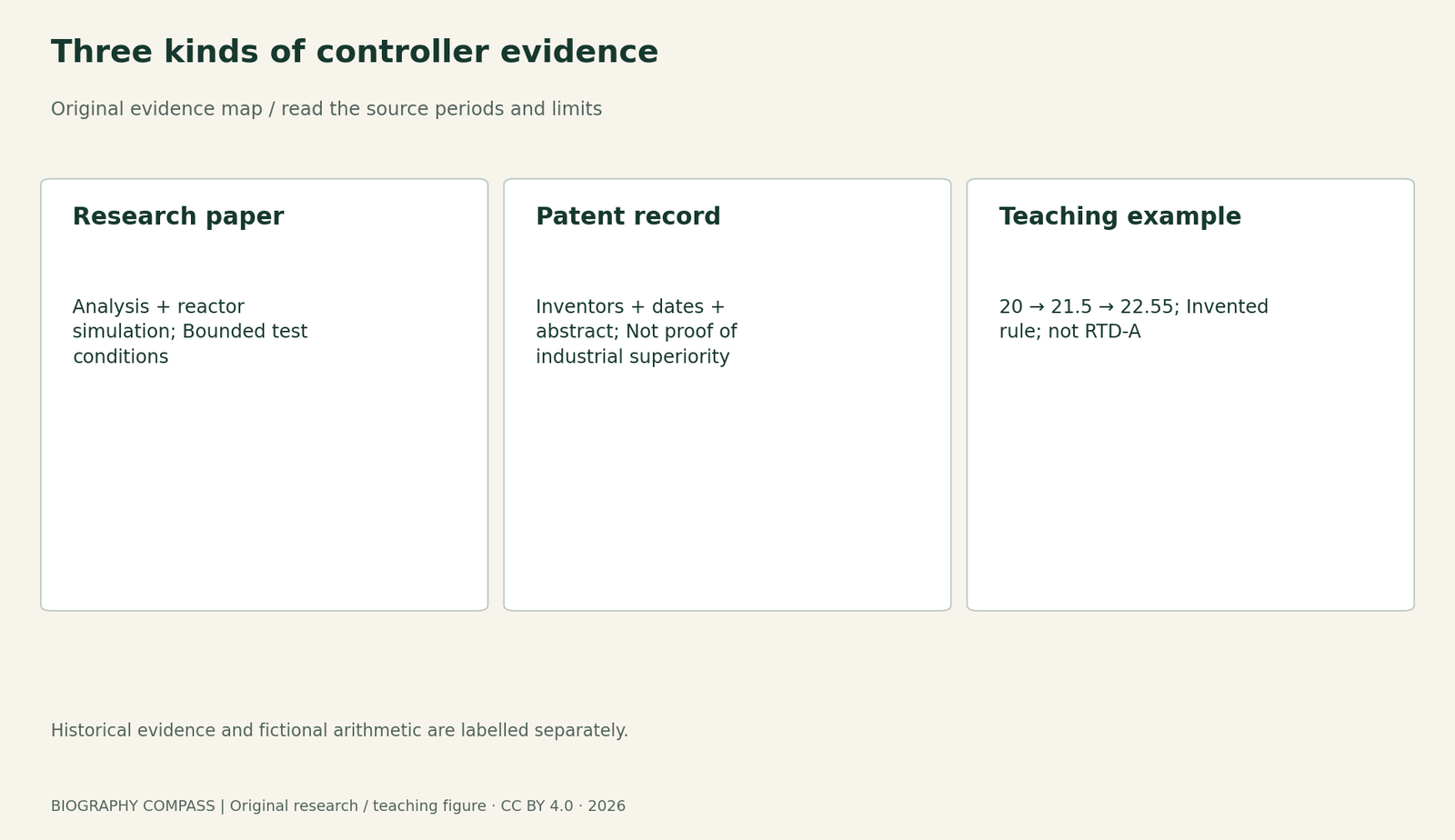
Evidence supports a bounded claim
Different records have different purposes.
| Country | What the evidence supports | What it does not establish |
|---|---|---|
| 2004 paper | Stability analysis and specified reactor simulation | Universal or independently replicated factory superiority |
| Patent header/abstract | Identified inventors, assignee, dates and described invention | A legal opinion or empirical performance certificate |
| Teaching arithmetic | Two checkable updates under invented assumptions | The historical controller or a general stability proof |
Chronology
A timeline of the turning points
Research paper
Mukati and Ogunnaike analyse tuning and illustrate it through simulation.
Patent filing
The bibliographic record identifies the application date.
Granted publication
US7203555B2 published.
Separate arithmetic
The fictional feedback rule is not the paper’s reactor or patent implementation.
Begin with the question and the coauthors
The 2004 paper Stability analysis and tuning strategies for a novel next generation regulatory controller names Kapil Mukati and Babatunde Ogunnaike, both at Delaware. It addresses the relation between controller tuning and desired behaviour. A controller compares what a process is doing with what is wanted, then changes an input. A useful design has to consider more than reaching a target quickly: it must also deal with disturbances and imperfect knowledge of the process. The authors describe a proposed RTD-A structure and analyse stability for model mismatch. Naming both authors and the particular problem gives a more accurate starting point than calling it one person’s universal replacement for existing industrial control.
Sources for this section: [1]
Four tuning ideas answer different questions
The paper distinguishes robustness, set-point tracking, disturbance rejection and an auxiliary aggressiveness parameter. Set-point tracking concerns the response to a changed target; disturbance rejection concerns changes acting on the process. Robustness concerns the consequences of a discrepancy between the assumed model and the process. These are related but distinct. In the selected example, tuning that gives faster disturbance rejection can approach a stability boundary and show oscillatory control action. The point is not that fast action is always desirable. It is that parameter choices need to be assessed against more than one feature of the response and within the conditions used in the analysis.
Sources for this section: [1]
The reactor example was simulated
Pages 4–5 illustrate the method using an isothermal polymerisation-reactor simulation, including a target change and a reduction in monomer concentration. The authors compare the proposed controller with two specified PID tuning approaches and report favourable results under those conditions. Their conclusion explicitly calls the illustration a simulation. That is evidence about the stated mathematical experiment, not a live factory trial, an independent reproduction or proof against every possible alternative. The selected pages also identify uncertainty conditions. A responsible summary preserves the test setting, comparison choices and limitations before generalising about practical performance. No reactor operating instructions are supplied here.
Sources for this section: [1]
A patent record has another job
The US7203555B2 bibliographic record names Ogunnaike and Mukati as inventors and the University of Delaware as original assignee. It records a 14 May 2004 filing and 10 April 2007 publication of the granted B 2 document. Its abstract describes adjusting a control signal using model prediction and tuning parameters. These metadata establish an identifiable patent document and its stated invention. They do not independently reproduce the simulation or certify performance across factories. This guide reads the record’s header and abstract, not every claim or the complete prosecution history; it draws no conclusion about present enforceability, permission to practise an invention or freedom to operate.
Sources for this section: [2]
Original exercise: a deliberately simpler feedback rule
Use fictional, dimensionless values with target r=25 and initial output y=20. Define error e=r−y; input u=min(10,max(0,1.5e)); and next output y_next=y+0.2u. First calculate the next output. Then repeat once using the updated output. Finally ask whether moving closer to the target twice proves stability for every starting condition, delay or disturbance. This rule is an editorial teaching device. It is not the RTD-A controller, not a fitted model of the authors’ reactor and not an implementation of the patent. The clipping and constants are supplied assumptions, so the calculation can be checked without manufacturing historical experimental measurements.
Sources for this section: [1]
Reference answers and a research-reading checklist
Initially e=5 and u=7.5, so the next output is 21.5. The next error is 3.5 and input 5.25, giving 22.55. Two improving steps do not prove the general stability claim: changing assumptions or initial conditions requires further analysis. For the historical study, ask what was modelled, which uncertainty was considered, which comparators were selected and whether the result was simulated or observed in equipment. For a patent, record inventors, assignee, dates and the scope actually consulted. These checks allow the biography’s technical achievement to remain specific and assessable, while giving the reader a small calculation they can verify independently.
Continue the chronology
Related history guides
Biography context
Explore United States through connected lives
Connected biographies
People behind the work
1956–2022
Babatunde Ogunnaike
Chemical engineer, process-control researcher and educatorBabatunde Ogunnaike was a Nigerian-born chemical engineer whose career joined university research, industrial practice and teaching. At Lagos, DuPont and Delaware, he investigated how models and measurements could help control complex processes, later applying engineering methods across disciplinary boundaries.Read biographyQuick answers
Common questions
- Was the original reactor example a live plant trial?
- The selected 2004 paper explicitly describes a simulation.
- Does the example on this page implement RTD-A?
- No. Its fictional rule is deliberately simpler and exists only to teach a checkable feedback calculation.
Primary and institutional sources
How this history was checked
Compare the identified original texts, participant accounts and institutional records; the teaching examples are separately labelled. This article was reviewed on 27 October 2026.
- Kapil Mukati and Babatunde Ogunnaike; University of Delaware; NTNU proceedings archiveStability analysis and tuning strategies for a novel next generation regulatory controller,ACC 2004
- United States patent record; Google PatentsPredictive regulatory controller,US7203555B2: bibliographic record
- University of Delaware College of EngineeringIn Memoriam: Babatunde Ogunnaike,March 2022