
The short answer
Why is a university’s founding date different from the work that kept it operating?
Evidence comparison
Read the records together
The records were created for different purposes and support different kinds of claims.
| Record | What it establishes | Question to keep open |
|---|---|---|
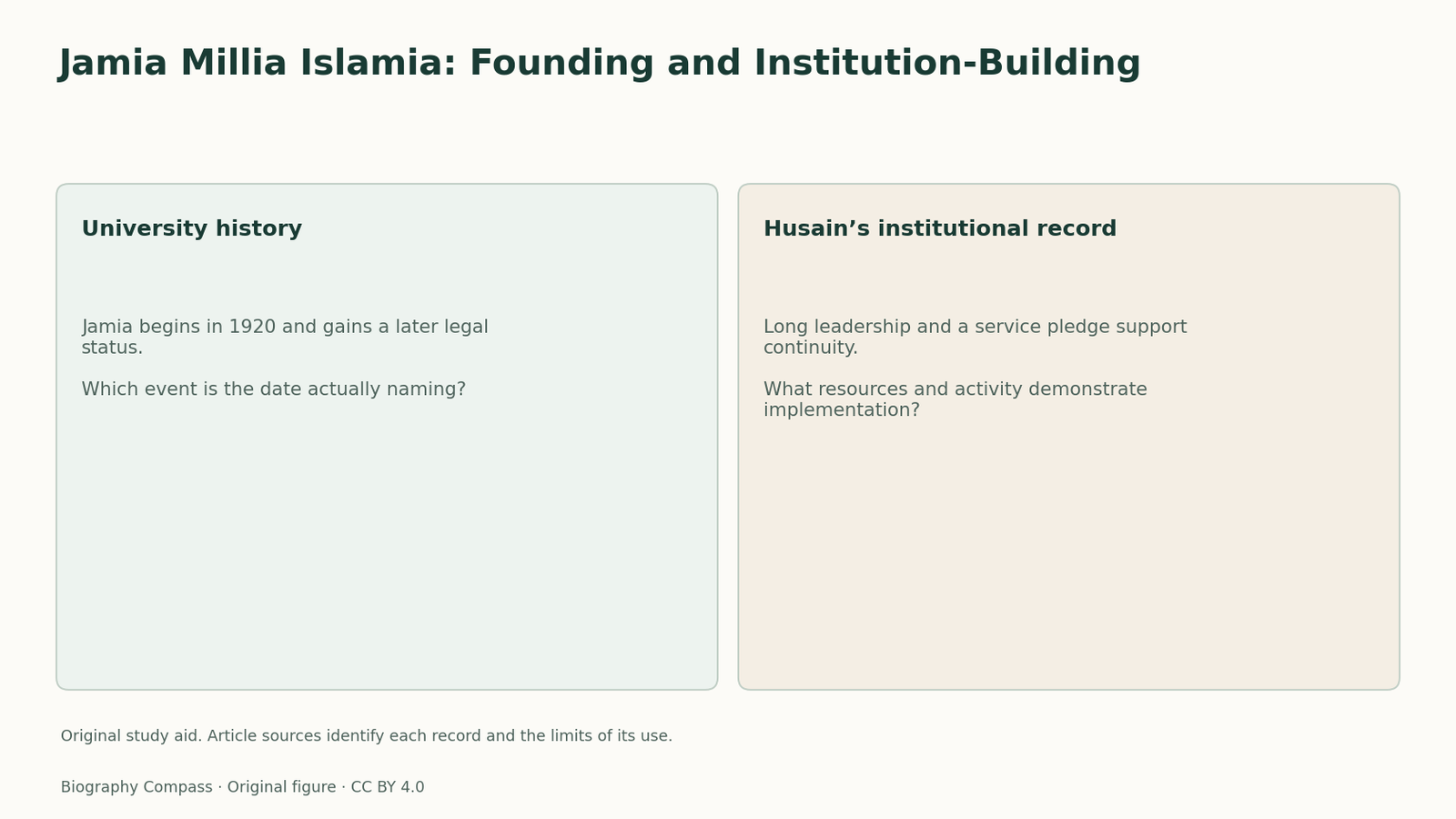
| University history | Jamia begins in 1920 and gains a later legal status. | Which event is the date actually naming? |
| Husain’s institutional record | Long leadership and a service pledge support continuity. | What resources and activity demonstrate implementation? |
Chronology
A timeline of the turning points
Institution established
Jamia begins at Aligarh.
Husain’s leadership
A long vice-chancellorship begins.
Leadership changes
Husain moves to Aligarh Muslim University.
Separate establishment from later leadership
Jamia’s history dates its establishment at Aligarh to 1920. Husain’s long period as vice-chancellor began in 1926. Both dates matter, but they describe different work. An institution can exist before a particular leader takes responsibility for sustaining it. A founding anniversary should therefore not be used as the beginning of every administrator’s tenure, nor should later achievements erase the people and decisions involved at the original establishment.
Read a commitment to service as an arrangement
The university record describes life members who pledged twenty years of service during a financially and ideologically difficult period. The pledge was an institutional response, joining individual commitment to the practical problem of continuity. It should not be mistaken for a guarantee that every financial problem immediately disappeared. To evaluate its operation, one would need evidence of staffing, resources and educational activity alongside the stated undertaking.
Sources for this section: [2]
Keep university status on its own timeline
Jamia’s later status as a central university dates to 1988, long after Husain’s vice-chancellorship and death. That legal development is part of the same institutional history but cannot be attributed to his direct administration. Similarly, his eventual presidency identifies a later public role without measuring all the work performed at Jamia. A useful chronology gives establishment, leadership and legal status separate positions rather than placing them under one undifferentiated founding label.
Build an institutional continuity chart
Create rows for initial establishment, leadership, pledged service and later legal recognition. Beside each write the people or body responsible and the evidence needed to assess continued operation. A strong answer can credit Husain’s role in sustaining Jamia while keeping its earlier founding distinct. The chart offers a practical way to understand universities as organisations maintained over time, instead of treating a single date or celebrated individual as the whole institution.
Continue the chronology
Related history guides
Biography context
Explore India through connected lives
Connected biographies
People behind the records
1897–1969
Zakir Husain
Educationist and third president of IndiaHusain built educational institutions before moving through constitutional offices to India’s presidency, serving from 1967 until his death in 1969.Read biographyQuick answers
Common questions
- Did Husain’s 1926 leadership mark Jamia’s original founding?
- No. Jamia was established in 1920; his long vice-chancellorship began six years later.
Primary and institutional sources
How this history was checked
Sources support the chronology and the record comparison. The reading exercise is original. This article was reviewed on 7 November 2026.