
The short answer
Why do the presidential totals exceed the number of individual electors?
Evidence comparison
Read the records together
The records were created for different purposes and support different kinds of claims.
| Record | What it establishes | Question to keep open |
|---|---|---|
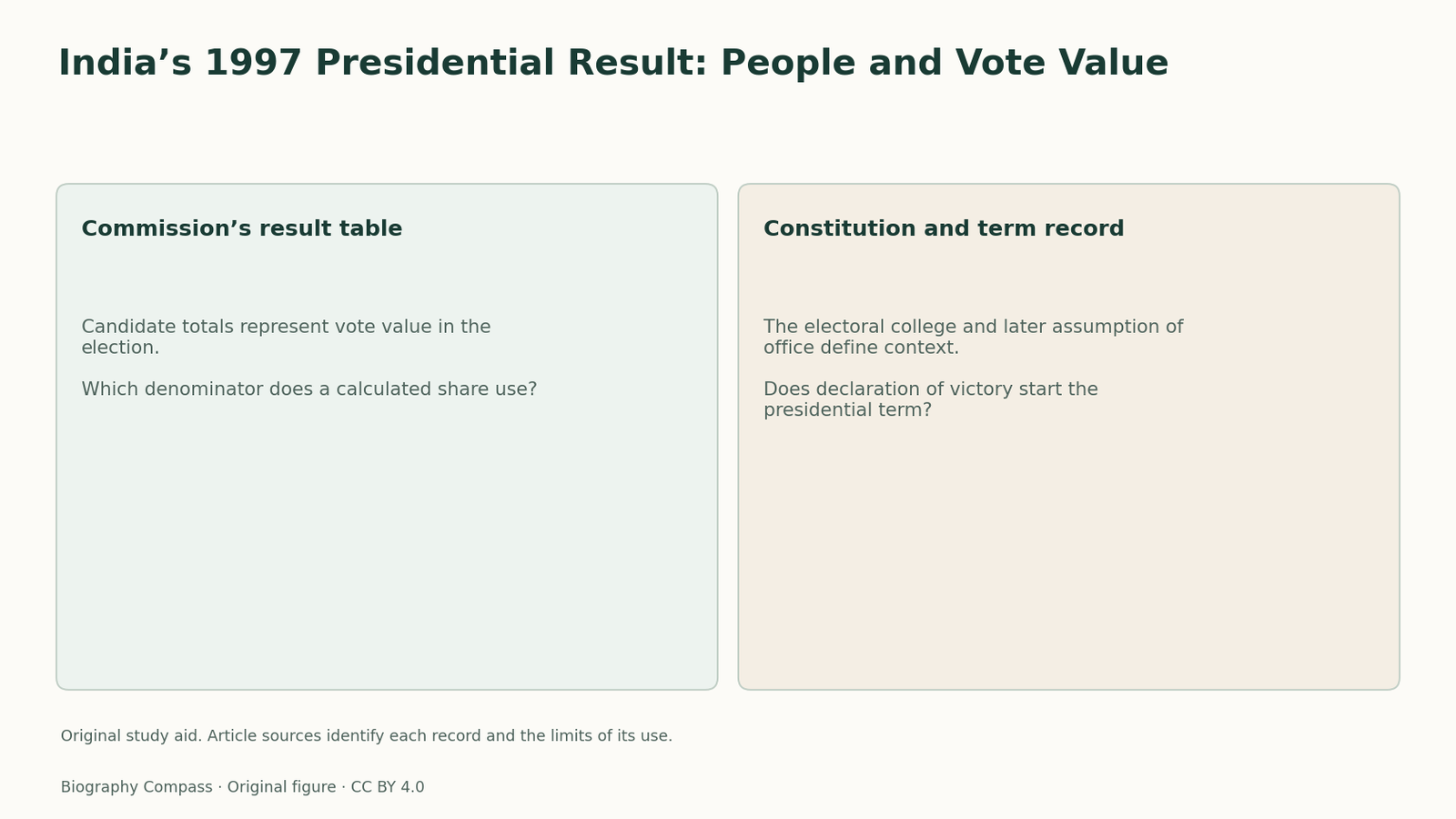
| Commission’s result table | Candidate totals represent vote value in the election. | Which denominator does a calculated share use? |
| Constitution and term record | The electoral college and later assumption of office define context. | Does declaration of victory start the presidential term? |
Chronology
A timeline of the turning points
Result declared
Narayanan is declared elected.
Office assumed
The presidential term begins.
Read the result’s unit
The Election Commission’s historical table gives Narayanan a total of 956,290 against 50,631 for T. N. Seshan. Those figures belong to a weighted presidential electoral system. They should not be described as that many citizens casting individual presidential ballots. Articles 54 and 55 identify the electoral college and the allocation of vote value, supplying the institutional context necessary to interpret the result’s apparently very large numbers.
Check a percentage with the same denominator
Adding the two reported totals gives 1,006,921. Dividing Narayanan’s figure by that sum produces approximately 94.97 per cent of the reported valid vote value. This is an original calculation from the table. The percentage describes the distribution of that value between the candidates. It does not establish the percentage of all Indian adults supporting him, nor can it reveal the choices of individual legislators without separate evidence.
Sources for this section: [3]
Preserve two dates
The table records declaration of the result on 22 July and assumption of office on 25 July 1997. These are different institutional events. A candidate may be declared elected before the term begins, so the declaration should not automatically be used as the opening day of the presidency. The official former-president record independently places the term from July 1997 to July 2002, connecting the electoral result with the period of constitutional service.
Write a unit label before a headline
Prepare a headline and a one-sentence explanation of the result, using the phrase vote value beside the total. Then add the declaration and office dates as separate annotations. A strong answer can communicate the scale of the victory without turning an indirect weighted election into a national popular poll. The exercise shows why an accurate number still needs an accurate unit, denominator and date before it becomes an accurate historical claim.
Continue the chronology
Related history guides
Biography context
Explore India through connected lives
Connected biographies
People behind the records
1920–2005
K. R. Narayanan
Diplomat, vice president and presidentNarayanan moved from scholarship and diplomatic service into Parliament and the vice presidency, becoming India’s first Dalit president in 1997.Read biographyQuick answers
Common questions
- Does 956,290 mean individual citizens voted directly for Narayanan?
- No. It is the reported vote value in an indirect presidential election, interpreted under the constitutional weighting system.
Primary and institutional sources
How this history was checked
Sources support the chronology and the record comparison. The reading exercise is original. This article was reviewed on 7 November 2026.