
The short answer
How are a depicted sporting event, a completed painting and its later Olympic award different records?
Read the evidence
Sources, interpretation and production roles
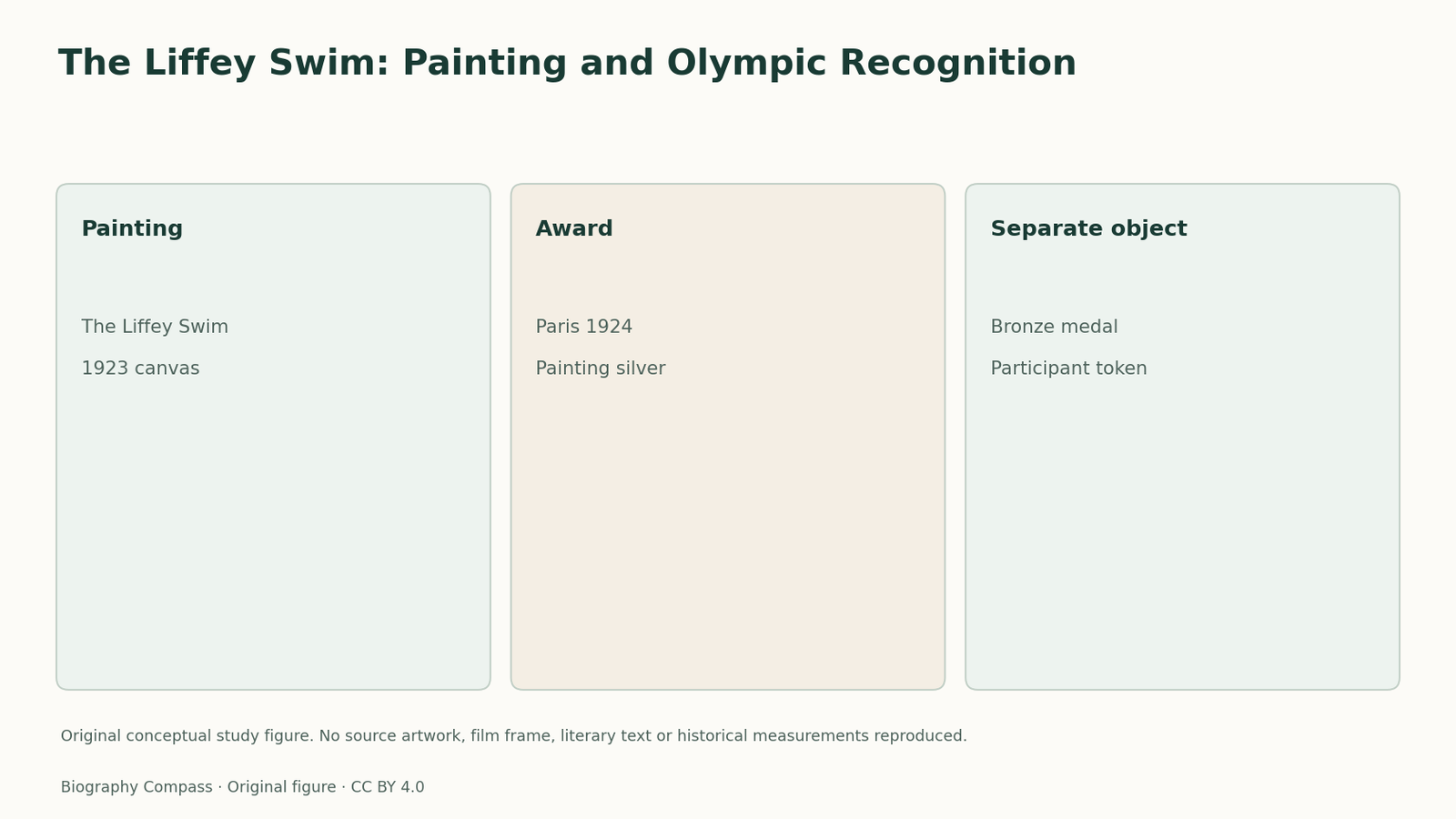
The records answer different questions about this work. The final exercise is an original teaching model.
| Record or question | Supported reading | Boundary or contrast |
|---|---|---|
| Canvas record | 1923 painting stages a view of swimmers and crowd. | It is an artistic arrangement, not a race-results table. |
| Silver medal entry | Award in the 1924 Olympic painting competition. | It is not a swimming medal. |
| Bronze participant entry | A separate object marks participation. | Its metal does not make it a third-place painting award. |
A sporting event becomes a painting
Jack B. Yeats painted The Liffey Swim in 1923. The National Gallery of Ireland describes spectators leaning towards the action and a diagonal organisation joining quay and river. The viewer is placed in relation to a public crowd, not offered a neutral overhead diagram of a race. The painting makes the occasion available through a designed viewpoint and an energetic surface.
Sources for this section: [3]
The 1924 award was for art
The gallery archive records a silver Olympic medal awarded for the painting in Paris in 1924. Its public script explains that Yeats submitted the work under the title Swimming, in a competition requiring an association with sport. These records make a precise connection between the canvas and the Olympic event. They do not make Yeats a silver-medal swimmer or turn the depicted race into an Olympic swimming final.
Two medals, different functions
The same archive describes a separate bronze Olympic participant’s medal. Its presence beside the silver award is an unusually useful piece of evidence: two objects from one event can commemorate different kinds of involvement. The painting itself has another history, acquired through the Haverty bequest arrangements and presented to the gallery in 1931. A viewer may therefore meet a canvas, an award and a participant token in one institutional story without those objects having the same function. The submission title Swimming also shows how a work could be identified for a particular competition. It retains a sporting connection while the gallery’s familiar title keeps the specifically Dublin event visible to later viewers.
Original exercise: write three accurate labels
Draft three short labels using only the inspected records. The first introduces the 1923 painting as an interpretation of Dublin’s river race. The second identifies the 1924 silver medal as an award in the painting competition. The third identifies the separate bronze object as a participant’s medal. A reference answer must keep the event, category and object clear; “Olympic medallist” by itself leaves too much unspecified. Next add one sentence connecting the work’s viewpoint with spectatorship: the gallery’s account supports saying that the composition invites a viewer into the crowd. It does not support inventing the identity of every painted person. This exercise shows how formal interpretation and administrative records can enrich each other. The catalogue explains how the occasion is pictured; the medal entries establish a particular later recognition. A final question asks whether the award determines the only valid interpretation of the canvas. A supported response says no: it records one public judgement while the painting still offers relationships of movement, colour and spectatorship that can be examined on their own terms.
Continue the chronology
Related history guides
Biography context
Explore Ireland through connected lives
Connected biographies
People and related creative practices
1871–1957
Jack B. Yeats
Irish painter, illustrator and writerJack B. Yeats moved from illustration and watercolour into an increasingly expressive painting practice informed by Irish places, performance and remembered encounters.Read biography1871–1909
John Millington Synge
Playwright and prose writerJohn Millington Synge brought musical and linguistic interests into prose and theatre. Travel, Irish-speaking communities and work with the Abbey helped shape a short career marked by artistic collaboration and public controversy.Read biography1876–1958
Paul Henry
Irish painterPaul Henry moved from Belfast and Paris into a career strongly associated with Achill and western Ireland, progressing from working figures to expansive landscapes.Read biographyQuick answers
Common questions
- Is the bronze archive medal a third-place award for the painting?
- The archive describes it as a participant’s medal, separate from the silver painting award.
Primary and institutional sources
How this history was checked
Sources include production records, institutional collections and the specifically identified passages discussed here. Interpretations and teaching models are distinguished from credits and publication facts. This article was reviewed on 8 November 2026.