
The short answer
How does cooperative work organise a landscape that later viewers may treat as only scenery?
Read the evidence
Sources, interpretation and production roles
The records answer different questions about this work. The final exercise is an original teaching model.
| Record or question | Supported reading | Boundary or contrast |
|---|---|---|
| Object record | 1910–11 painting on Achill, acquired 1968. | Acquisition and production are separate dates. |
| Gallery interpretation | A likely memory-based scene integrates figures with landscape. | The memory hypothesis is qualified, not an inspected studio record. |
| Original caption exercise | Compares action-led and atmosphere-led accounts. | Removing painted workers does not mean real inhabitants vanished. |
A named task in a named place
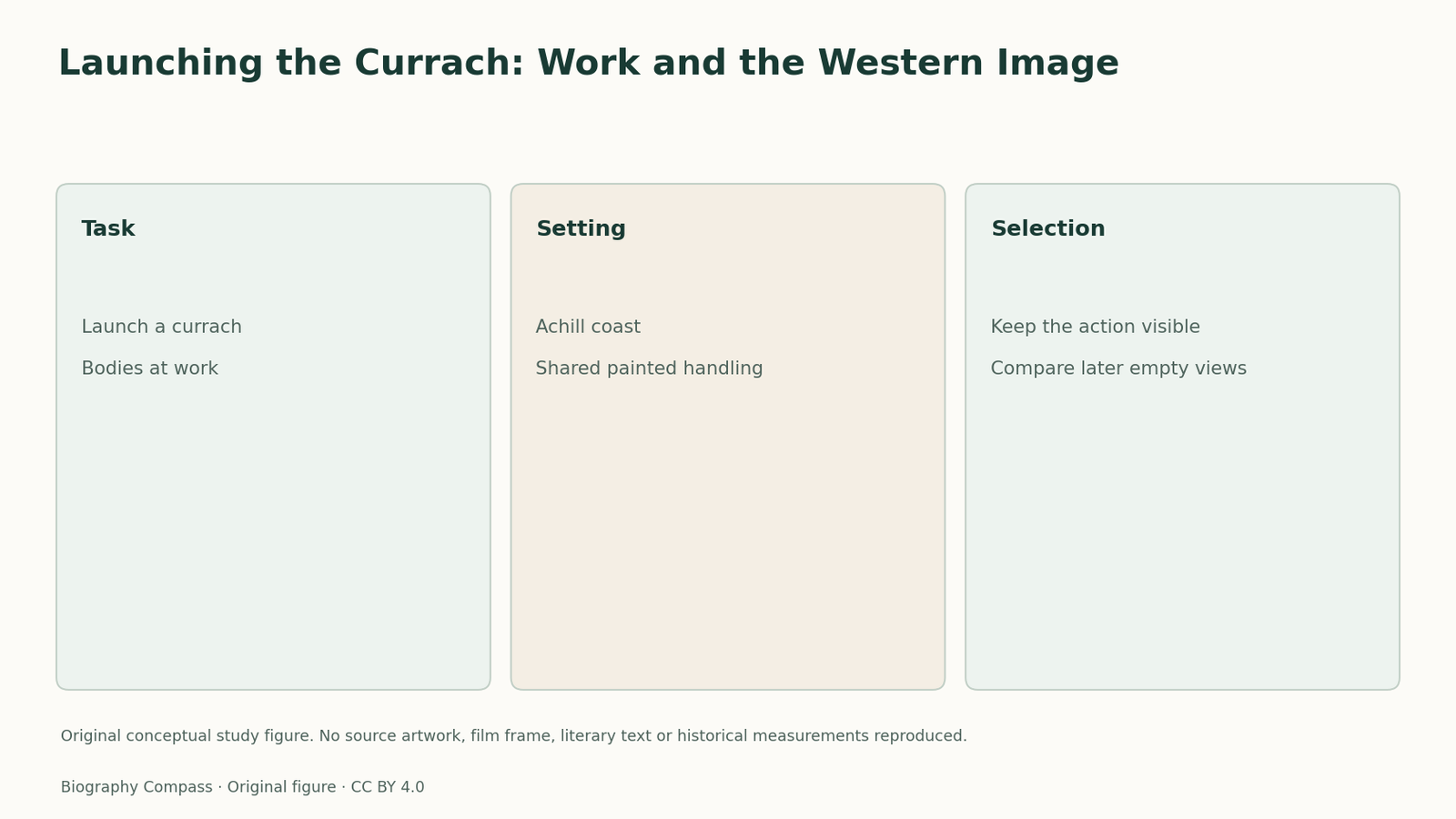
Launching the Currach is a 1910–11 oil painting set on Achill Island. The gallery’s object record identifies it with an early phase of Paul Henry’s engagement with figures. Its subject is an action: a group putting a light boat into the water. The West of Ireland resource describes fishermen handling the currach and its nets. Work gives the scene a bodily purpose beyond the general attraction of coast and sky.
Boat and bodies belong to the setting
The collection account explains the currach’s practical importance along the western seaboard. Its light construction allowed it to be launched and brought ashore with relative ease. In the painting, the figures and landscape are described through a similarly economical handling. That formal integration has an interpretive effect: people appear within the conditions of a place rather than as detached portraits placed in front of a scenic backdrop.
Sources for this section: [3]
Memory and the making of a western image
The gallery proposes that Henry likely composed the scene from memory, in a context where some residents did not wish to be sketched. That remains a qualified account, not evidence for an exact undocumented studio session. Henry later moved towards less populated landscapes. Comparing those phases changes the question from “what does the west look like?” to “which relation between people and landscape does this work choose to make visible?” The currach is thus both a named object and a reason for coordinated action. Keeping that action in the interpretation prevents the boat from becoming only a decorative emblem of a western coastline.
Original exercise: action and atmosphere
Write two original captions for an imaginary coastal painting without borrowing Henry’s layout. Caption A describes a task: people prepare a boat for the tide. Caption B describes an atmosphere: land and cloud appear quiet and spacious. A possible answer explains that both may fit one scene, but the first makes labour central while the second risks leaving the workers incidental. Now return to the documented currach subject and combine the captions in a sentence that preserves action and setting. Ask what would change if the figures were removed. A reference response says the work would no longer show the same human activity even if land and sky remained recognisable. The exercise does not supply a missing figure count or pretend to recover Henry’s own final intention. It gives a practical way to discuss selection in landscape painting. It also enables a comparison with his later unpopulated views: the difference concerns the pictured relation between people and place, not a claim that real inhabitants had disappeared from the west. The interpretation remains tied to the catalogue’s distinction between early figure subjects and later landscape emphasis.
Continue the chronology
Related history guides
Biography context
Explore Ireland through connected lives
Connected biographies
People and related creative practices
1876–1958
Paul Henry
Irish painterPaul Henry moved from Belfast and Paris into a career strongly associated with Achill and western Ireland, progressing from working figures to expansive landscapes.Read biography1871–1909
John Millington Synge
Playwright and prose writerJohn Millington Synge brought musical and linguistic interests into prose and theatre. Travel, Irish-speaking communities and work with the Abbey helped shape a short career marked by artistic collaboration and public controversy.Read biography1889–1977
Seán Keating
Irish painter and art teacherSeán Keating developed a realist painting career through William Orpen’s teaching, western Irish encounters, revolutionary subjects and art-school leadership.Read biographyQuick answers
Common questions
- Is the painting known to have been made entirely on the beach?
- No. The gallery suggests it was likely composed from memory; that qualification should be retained.
Primary and institutional sources
How this history was checked
Sources include production records, institutional collections and the specifically identified passages discussed here. Interpretations and teaching models are distinguished from credits and publication facts. This article was reviewed on 8 November 2026.