
The short answer
How can a crowded cultivated garden become a structured composition rather than untouched wilderness?
Read the evidence
Sources, interpretation and production roles
The records answer different questions about this work. The final exercise is an original teaching model.
| Record or question | Supported reading | Boundary or contrast |
|---|---|---|
| Museum object record | Identifies a 1916 painting and later collection history. | The 1937 gift is not the production date. |
| Studies and composition account | Documents strengthened relationships and emphatic colour. | A crowded subject does not imply a structureless picture. |
| Original density model | Keeps an inventory fixed while changing distribution. | It does not reproduce historical motifs or arrangement. |
A cultivated place, not untouched wilderness
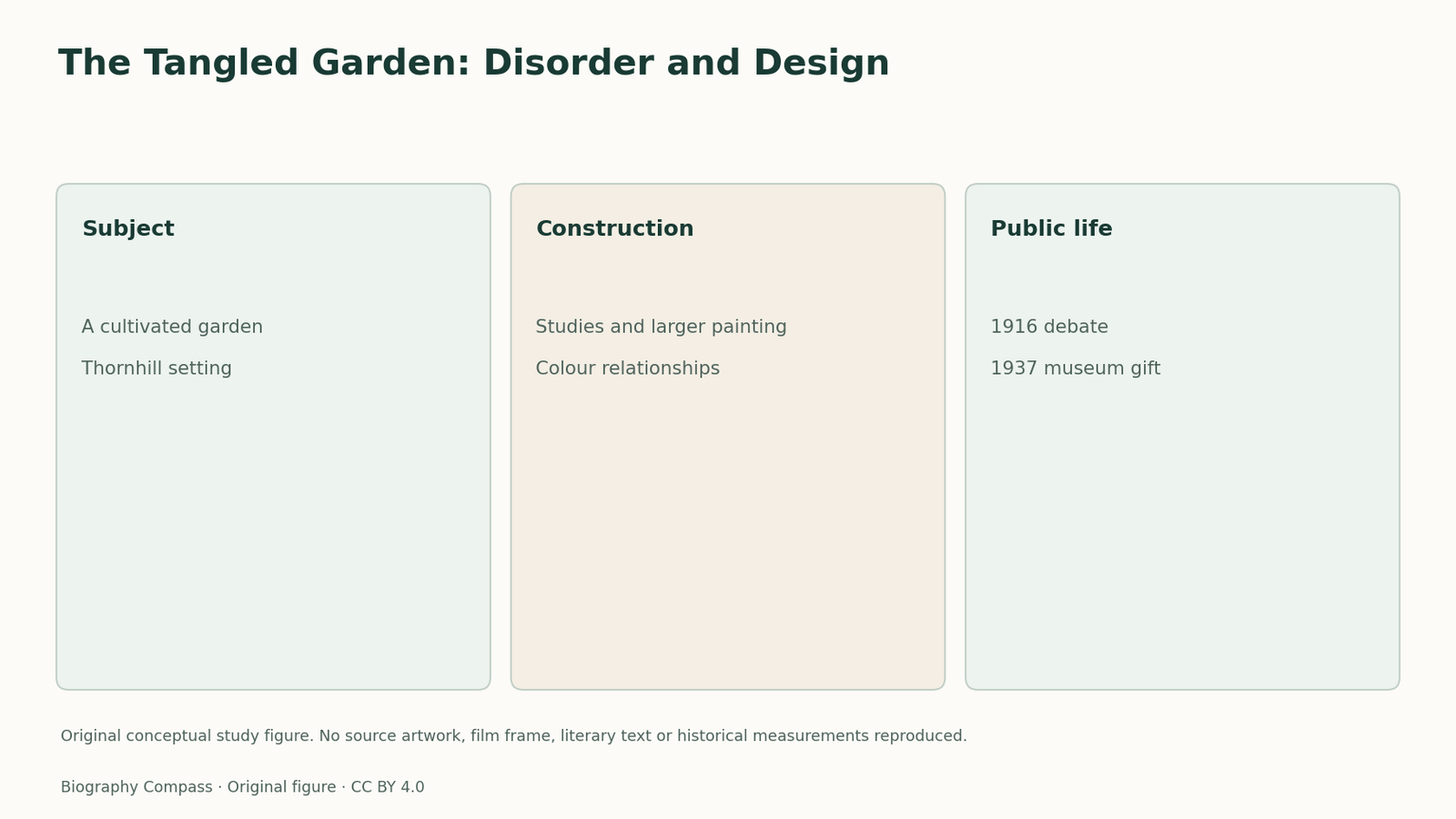
The Tangled Garden was painted in 1916 from MacDonald’s studies around his Thornhill home. The National Gallery’s contributed record identifies the large oil painting on beaverboard and its later Southam-family gift. The title can encourage a first impression of uncontrolled growth, but the documented subject is a cultivated garden. That distinction matters within the wider reputation of the Group of Seven: a modern Canadian painting could begin in a worked domestic setting rather than a remote landscape.
Abundance is made through arrangement
The biographical account describes MacDonald strengthening relationships among garden flowers and background elements when developing the larger work from studies. It identifies emphatic colour as a central feature. In this reading, apparent profusion is an artistic result, not evidence that the painter abandoned structure. A crowded surface can be organised through repeated forms, intervals and changes of colour. The garden’s abundance and the picture’s design are therefore related questions. Naming flowers or objects would not by itself explain how those relationships make the image operate.
Sources for this section: [2]
Reception becomes part of the work’s history
The picture provoked criticism when exhibited, and MacDonald answered publicly. That exchange is useful evidence of a contested visual language. It does not prove that every hostile viewer misunderstood the painting or that later recognition was inevitable. The stronger point is specific: bold colour and a departure from expected finish could become matters of public argument. MacDonald’s background in commercial design and his later decorative collaborations also help place the work within a practice that repeatedly organised many elements into a larger whole. They supply context, not a formula that mechanically explains each painted passage.
Original exercise: a garden can be dense and designed
Imagine a rectangular garden picture using three invented types of shape: a small circle, a branching line and a broad patch. Write one plan that scatters them evenly and another that groups them around two areas of attention. Keep the number of shapes the same. A reference answer explains how grouping and interval can change a sense of density without changing the inventory of objects. Now assign a contrasting colour to one group and describe the new route for the eye. The exercise does not copy MacDonald’s flowers or arrangement. It makes a useful proposition testable in words: a picture can look abundant because of decisions about distribution rather than because its maker recorded everything indiscriminately. Return to The Tangled Garden by relating that proposition to the documented development from smaller studies. Finally, separate the subject’s cultivation from the painting’s construction. The first concerns a place people worked; the second concerns an artist’s arrangement on a support. The work brings both together without making them the same activity.
Continue the chronology
Related history guides
Biography context
Explore Canada through connected lives
Connected biographies
People and related creative practices
1873–1932
J. E. H. MacDonald
Canadian painter, designer and art educatorJ. E. H. MacDonald brought commercial design, landscape painting, collaborative decoration and teaching into an influential Canadian career.Read biography1871–1945
Emily Carr
Painter and writerA Canadian painter and writer whose modernist landscapes and autobiographical books emerged through an uneven, late-recognised career.Read biography1882–1974
A. Y. Jackson
Canadian landscape painter and official war artistA. Y. Jackson connected Montreal and Toronto artistic circles before developing a long travelling practice and an influential role in Canadian landscape painting.Read biographyQuick answers
Common questions
- Was The Tangled Garden made in 1937?
- No. It was painted in 1916; 1937 dates the National Gallery gift.
- Does the title imply a lack of composition?
- No. The inspected account describes deliberate development and strengthened relationships.
Primary and institutional sources
How this history was checked
Sources include production records, institutional collections and the specifically identified passages discussed here. Interpretations and teaching models are distinguished from credits and publication facts. This article was reviewed on 8 November 2026.
- Dictionary of Canadian Biography, David P. SilcoxMacDonald, James Edward Hervey
- Roberts Gallery / National Gallery of Canada dictionary biographyJ.E.H. MacDonald
- National Gallery of Canada via AMICA / David RumseyThe Tangled Garden, NGC 4291
- Tom Thomson Memorial Art Gallery, archived by Library and Archives CanadaJ.E.H. MacDonald biography