
The short answer
An archive can end after a writer’s death, contain someone else’s criticism and file an outgoing reply with an incoming letter. These are ordinary descriptive possibilities, but each can produce a false biographical claim. Three Irish writers’ finding aids provide concrete examples for a practical reading method.
Original source comparison
What kind of count or date is this?
Keep the source’s descriptive unit and its limits attached to the claim.
| Record | Evidence supplied | Limit or next question |
|---|---|---|
| Flann date range | Works and later criticism occupy different series. | A late endpoint does not extend the author’s lifespan. |
| Bowen correspondence | Some outgoing replies survive on incoming-letter versos. | Folder direction is not a complete message count. |
| O’Casey scope and custody | A largely correspondence-based collection entered the NLI in 2001. | Twenty-four boxes do not imply all playscripts survive there. |
Chronology
A timeline of the turning points
Authors’ deaths
Flann O’Brien and Bowen’s lifespans do not match all later collection dates.
Critical material
The Flann inventory includes a separate Shea criticism series.
Ransom processing
The two finding aids identify their own processing dates.
O’Casey papers
Acquisition/donation and compilation are separate events.
A collection’s date range is not its creator’s lifespan
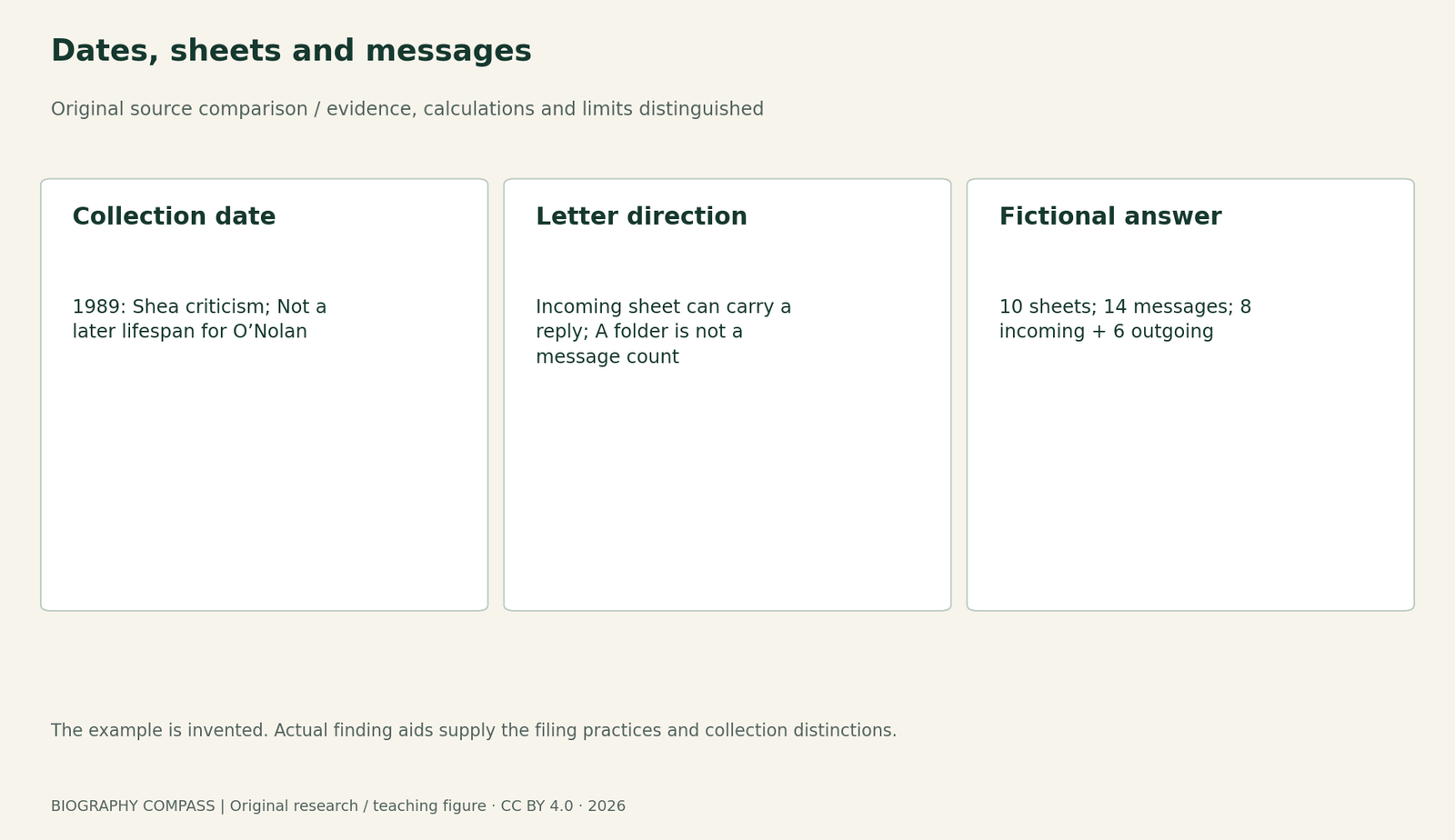
The Ransom Center gives the Flann O’Brien collection an overall range of 1934–1989, although O’Nolan died in 1966. The scope explains why: Works runs from 1934 to 1963, while Criticism contains a 1989 typescript by Thomas F. Shea, whose study was published in 1992. The overall range therefore includes another writer’s work about O’Nolan. It would be incorrect to extend O’Nolan’s life or personal writing activity to 1989. Read the series description before deciding whose action the last date records.
Sources for this section: [2]
Extent needs a unit and a level of description
The Bowen summary lists thirteen boxes, 5.42 linear feet and one galley folder. These are different descriptions of physical extent, not three numbers to add. O’Casey’s National Library introduction identifies twenty-four boxes, mainly correspondence, and expressly notes a shortage of playscripts and original autobiographical manuscripts. Two substantial collections can therefore answer different questions. A larger box count does not establish more novels, a complete personal archive or a greater literary achievement. The appropriate next step is to identify which series and material type address the research question.
Incoming storage can contain an outgoing message
Bowen’s finding aid says that some replies appear on the verso of incoming letters. It also describes two folders of outgoing letters; folders are not individual message counts. O’Casey’s introduction similarly describes copies of his letters and short replies noted on letters received. A researcher interested in his responses should therefore not search only a folder labelled outgoing. Arrangement by correspondent or subject can preserve an exchange across categories. Conversely, the description of a reply does not reveal its tone or establish agreement with the incoming writer. The actual document still needs to be read.
Custody and catalogue processing add further dates
The Ransom records describe purchases and gifts for Bowen across 1964–1995 and processing in 1998. Flann’s inventory lists acquisitions in 1965, 1970 and 1989 and processing in 1997. The O’Casey papers described by the National Library were bought and donated in 2001, with the collection list compiled in 2003. These dates track movement and description of material. They should not become publication dates for the authors’ books. Record creation, acquisition and processing in separate columns, retaining approximate or uncertain dates rather than forcing each object onto one biographical timeline.
Original exercise: count sheets and messages separately
Imagine ten fictional single-sheet documents arranged like the practices described above. Eight sheets are incoming letters; four of those carry a reply on the reverse. Two other sheets each contain one outgoing letter. Every described letter or reply is one complete message for this exercise. Calculate physical sheets, incoming messages, outgoing messages and all messages. Then explain why a catalogue date range ending in 1989 cannot, by itself, show that the named collection creator wrote a message in 1989. These invented quantities are not counts recovered from Bowen’s or O’Casey’s papers and are not the Bowen collection’s actual two-folder extent.
Reference answers: identify the unit before the inference
There are ten sheets, eight incoming messages and six outgoing messages: four verso replies plus two separate letters. The total is fourteen messages. There is no contradiction because a physical sheet can carry more than one message and more than one direction of communication. The 1989 endpoint identifies a date represented in the collection; the Flann example shows it can belong to another person’s criticism. Before writing a conclusion, record the collection, series, object, creator, direction and kind of date. This compact method turns a finding aid into a useful route to evidence while keeping the underlying documents, their interpretation and the limits of the catalogue distinct.
Continue the chronology
Related history guides
Dracula Records: Notes, Copies and Adaptations
Compare a distinct question about what literary and archival records establish.
Read the timeline1913 memoir; 1922 production; undated draft descriptionsCathleen ni Houlihan: Handwriting, Attribution and Theatre Credit
Compare a distinct question about what literary and archival records establish.
Read the timelineBiography context
Explore Ireland through connected lives
Elizabeth Bowen
Read the cited career and the context of the surviving records.
Explore the biographiesBiographyFlann O’Brien
Read the cited career and the context of the surviving records.
Explore the biographiesBiographySeán O’Casey
Read the cited career and the context of the surviving records.
Explore the biographiesConnected biographies
Writers and their records
1899–1973
Elizabeth Bowen
Novelist, short-story writer, essayist and broadcasterElizabeth Bowen was an Irish novelist and short-story writer whose life moved between Ireland and England. Stories, novels, reviews and broadcasts formed a varied career that cannot be represented by one house or one literary circle.Read biography1911–1966
Flann O’Brien
Novelist, columnist, dramatist and civil servantFlann O’Brien was a pen name of Brian O’Nolan, an Irish novelist, columnist and dramatist who also wrote as Myles na gCopaleen. His career crossed Irish and English, newspaper work and fiction, paid administration and literary experiment.Read biography1880–1964
Seán O’Casey
Playwright, autobiographer and correspondentSeán O’Casey was an Irish dramatist whose writing brought work, poverty, political conflict and family life into the theatre. The early Abbey successes were followed by later plays, autobiography and an extensive international correspondence.Read biographyQuick answers
Common questions
- Are ten sheets and fourteen messages real archive counts?
- No. They are explicitly fictional exercise inputs based on the described filing practices.
- Does open for research mean the complete collection is digitised?
- No. A finding aid’s access statement does not establish full digital availability or permission to publish.
Primary and institutional sources
How this history was checked
Read the specific catalogue, institutional or participant record before extending its claim; underlying literary works are not reviewed in full here. This article was reviewed on 27 October 2026.
- Harry Ransom Center, The University of Texas at AustinElizabeth Bowen: An Inventory of Her Collection
- Harry Ransom Center, The University of Texas at AustinFlann O’Brien: An Inventory of Manuscripts and Criticism
- Jennifer Doyle; National Library of IrelandSean O’Casey Papers: Collection List No. 75 (2003)