
The short answer
What does a library record establish when it describes notes for a novel, two copies of a book, a colonial issue and a later adaptation? The Rosenbach’s compact Stoker guide makes those distinctions visible. The research task is to identify the kind of record before deciding what sort of comparison is possible.
Original source comparison
Which event or object is being described?
Keep the source’s descriptive unit and its limits attached to the claim.
| Record | Evidence supplied | Limit or next question |
|---|---|---|
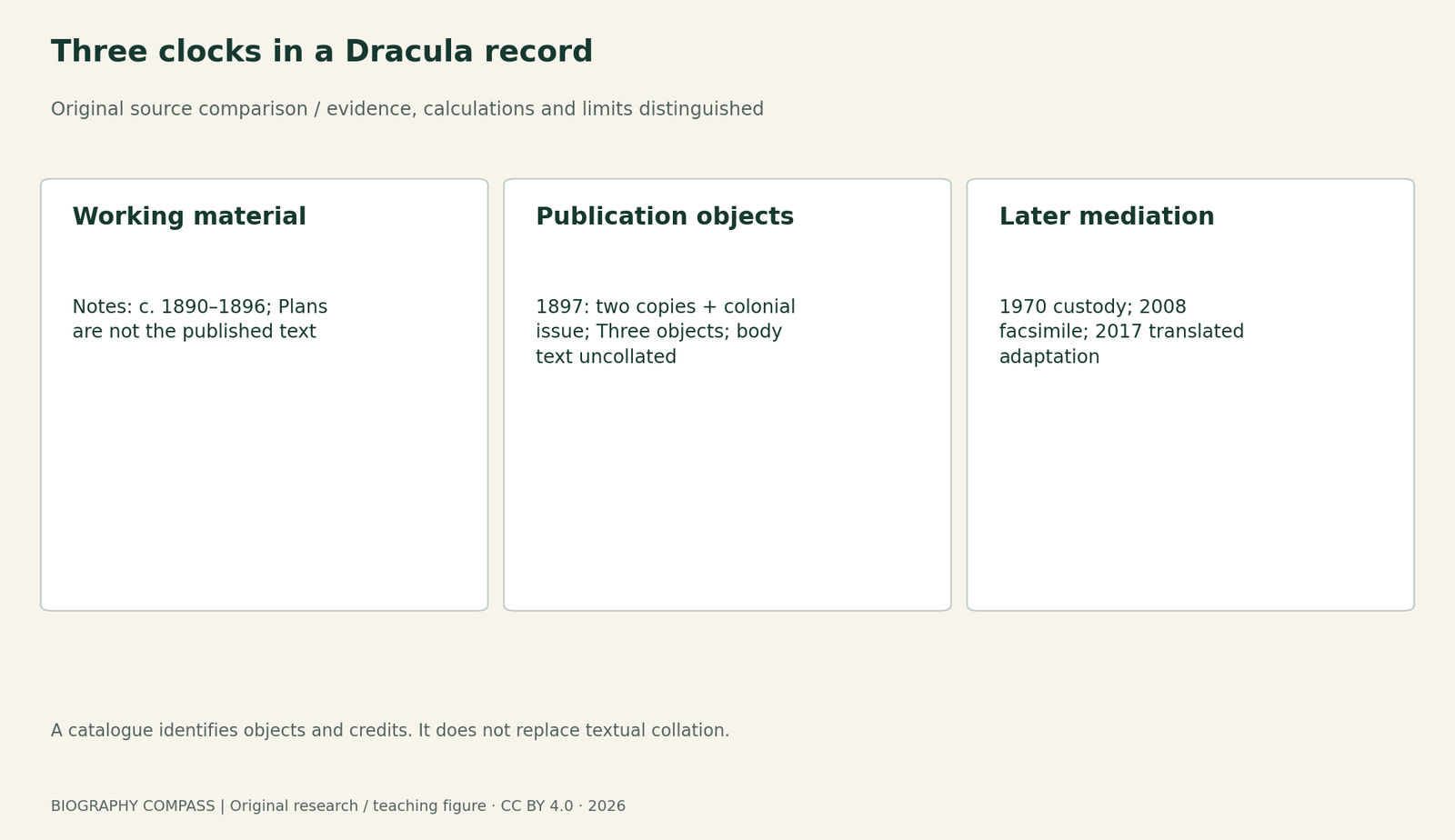
| Working notes | Planning and research material survives. | Not every proposed event necessarily entered the novel. |
| 1897 copies and colonial issue | Three objects with identified copy/issue features. | No claim of three distinct body texts without collation. |
| 2008 / 2017 volumes | A facsimile and a translated adaptation have their own credits. | Neither is silently substituted for the original 1897 text. |
Chronology
A timeline of the turning points
Working notes
Approximate range assigned to the notes and outline.
Book objects
The guide lists two Constable copies and a colonial issue.
Acquisition
The Rosenbach bought the working notes.
Later mediation
Facsimile and translated-adaptation records serve different purposes.
The guide describes a collection, not a continuous draft
The Rosenbach’s guide, dated 17 April 2024, describes manuscripts and books by Stoker in its holdings. It directs readers elsewhere for source and inspiration material. Its notes-and-outline entry is dated approximately 1890–1896 and includes manuscript and typescript material, photographs and a clipping. These are working objects with different purposes, including character lists, chapter planning and reading notes. The description does not establish that every idea survives in the published Dracula. This guide read the three-page collection guide, not the original notebooks or a complete novel.
Sources for this section: [1]
A copy, an issue and a new text are different claims
Two listed copies share the 1897 Archibald Constable imprint. One retains a dust jacket; the other is a presentation copy inscribed to Hallam Tennyson in July 1897. The guide separately records an 1897 Hutchinson colonial issue with a cancel title page. Those descriptions provide evidence about particular objects and publication presentation. They do not establish three independently written novels. To determine whether text differs, a researcher would need to collate the relevant passages and bibliographic features. Even a visibly different title page does not, by itself, prove that the body text was rewritten.
Sources for this section: [1]
Provenance and later mediation need separate clocks
The working notes entered the Rosenbach in 1970 after passing through dealers. That date concerns custody, not their composition. A complete facsimile edition with annotations and transcription appeared in 2008; the collection guide supplies its editors and publisher. Its 2017 Powers of Darkness entry describes an English translation of an Icelandic adaptation and credits Valdimar Ásmundarson as well as Stoker and translator Hans Corneel de Roos. The record therefore identifies mediation across languages and authorship. It does not license a claim that the 2017 volume is an unchanged transcript of Stoker’s original English novel.
Sources for this section: [1]
A career account gives a different scale of explanation
Trinity’s essay places the 1897 publication within Stoker’s theatre-management career and contrasts the later fame of Dracula with contemporary attention to his Irving memoir. That historical explanation is valuable, but it does not identify the variant readings of the Rosenbach copies. The two sources complement each other: a biographical essay explains a career and reception; a collection guide identifies surviving objects and access points. Begin a research note with both, then state the narrower object-level question that would require examination of a book or manuscript.
Original exercise: classify before counting
Using only the cited guide, make six record cards: notes dated approximately 1890–1896; the two Constable copies; the Hutchinson colonial issue; the 1970 acquisition; the 2008 facsimile; and the 2017 translation of an adaptation. The two Constable copies occupy one card but must retain separate copy identifiers. Assign each card to composition evidence, copy/issue evidence, custody or later mediation. How many physical 1897 book objects are listed? Does that count prove the same number of distinct body texts? Calculate the interval between 1897 publication and 1970 acquisition, explaining what the interval does not date.
Sources for this section: [1]
Reference answers: three objects do not prove three texts
The guide lists three physical 1897 book objects: two Constable copies and the Hutchinson colonial issue. Their description supplies two imprint/issue descriptions, without proving how many distinct body-text states exist. The notes card concerns working evidence; the acquisition card concerns custody; the facsimile and translated adaptation are later mediation. The interval is 1970 − 1897 = 73 years. It is neither the time taken to write Dracula nor the age of every piece of paper in the collection. Keep approximate manuscript dates approximate and leave uncollated textual differences as questions. A reproducible research note records what was inspected, the exact object identifier and what further comparison remains necessary.
Sources for this section: [1]
Continue the chronology
Related history guides
Cathleen ni Houlihan: Handwriting, Attribution and Theatre Credit
Compare a distinct question about what literary and archival records establish.
Read the timelineTwentieth-century literary papers; later acquisition and descriptionReading Irish Literary Archives: Dates, Units and Letter Directions
Compare a distinct question about what literary and archival records establish.
Read the timelineBiography context
Explore Ireland through connected lives
Connected biographies
Writers and their records
1847–1912
Bram Stoker
Novelist, theatre manager and criticBram Stoker was an Irish writer and theatre manager whose professional life extended well beyond Dracula. Civil-service work, criticism and decades at Henry Irving’s Lyceum Theatre formed the setting in which he wrote fiction.Read biographyQuick answers
Common questions
- Were the notes themselves read?
- No. The collection guide was read; the original notes and 2008 facsimile were not inspected.
- Does acquisition in 1970 change the novel’s publication date?
- No. Custody and publication are different events.
Primary and institutional sources
How this history was checked
Read the specific catalogue, institutional or participant record before extending its claim; underlying literary works are not reviewed in full here. This article was reviewed on 27 October 2026.