
The short answer
Was a tournament proposal the same as a governing body?
A worked comparison
What each part contributes
Use the specific distinctions developed in the study.
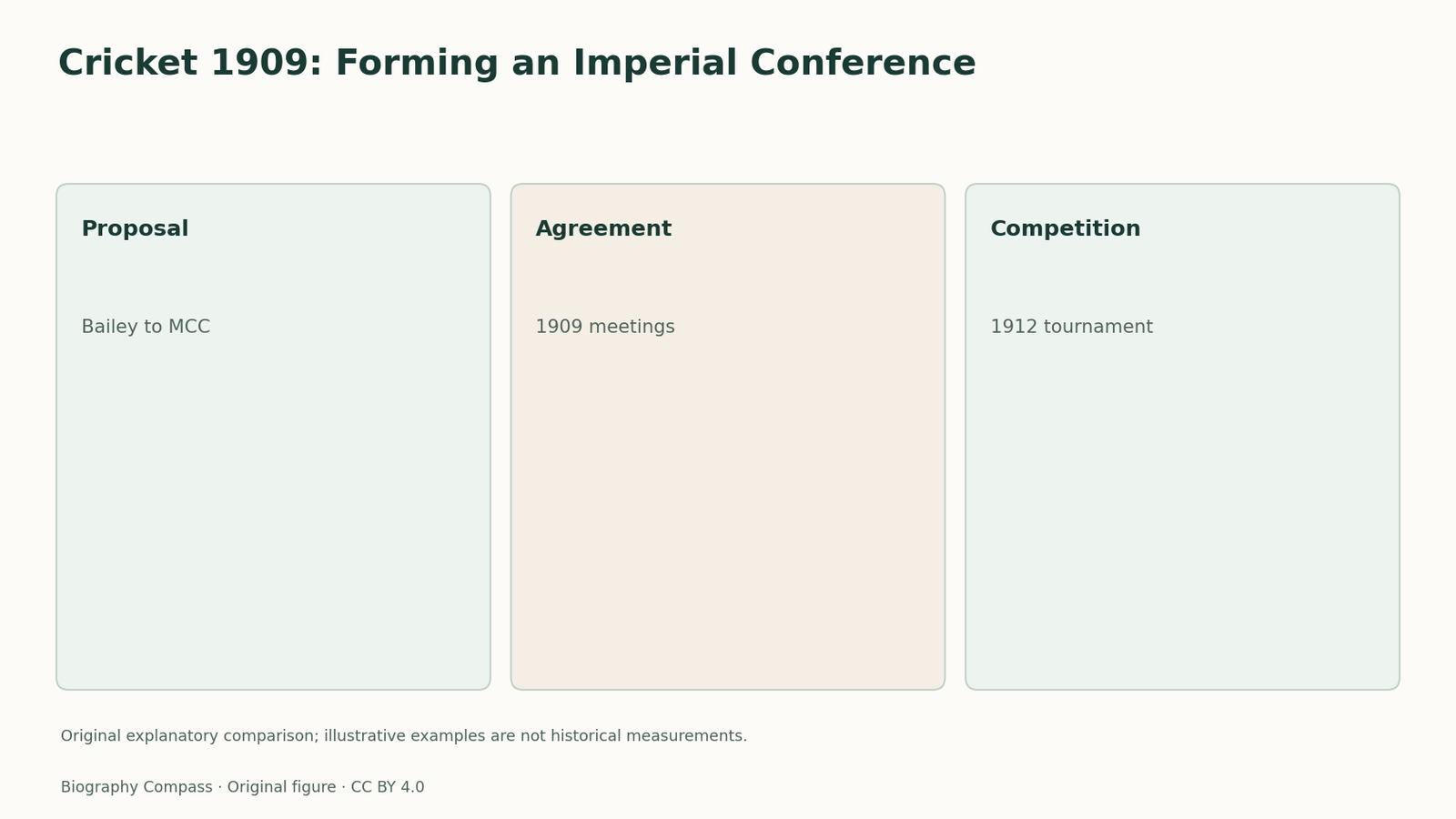
| Part or record | What it establishes | Why the distinction matters |
|---|---|---|
| 1907 proposal | Initiative and intended scheme | Not proof of agreement |
| 1909 meetings | Collective rules and arrangement | Not the tournament itself |
| 1912 event | Actual competition | Its outcome differs from institutional continuity |
Was a tournament proposal the same as a governing body?
Abe Bailey’s November 1907 approach to MCC joined two ideas: an imperial cricket organisation and a triangular Test competition involving England, Australia and South Africa. The eventual conference and the eventual tournament were related but distinct outcomes. This is the central question of the 1909 foundation story. A proposal could open negotiations, yet other governing bodies had to agree on participation and rules. The dated sequence is more useful than a single founder label because it identifies the work between an individual initiative and collective institutional action.
Australia’s response prevented an immediate competition
The ICC’s institutional account describes Australian resistance to sharing the proposed 1909 tour arrangement. Bailey continued to advocate the idea, but neither he nor MCC could simply turn the initial plan into a tournament without agreement. This exposes a practical feature of international sport: each participating authority had interests in schedules, finances and competition. The official narrative offers possible reasons, which should not be turned into independently proven private motives. What the sequence clearly establishes is that the first proposed timing did not become the actual tournament date.
Sources for this section: [4]
Two meetings supplied different parts of the settlement
Representatives met at Lord’s on 15 June 1909 under the Earl of Chesterfield. A second meeting the following month, chaired by Lord Harris, agreed rules governing Test cricket between the three countries. These stages separate agreement to hold a competition from the rules and continuing arrangement around it. MCC’s account also explains its close administrative connection to the conference. The organisation was not the worldwide body familiar today with its later membership and independent administration already in place. Its initial scope reflected the particular three-country and imperial setting.
The 1912 competition did not determine the institution’s whole future
The triangular tournament was held in England in 1912. The ICC account describes poor weather and problems affecting the Australian team, and judges the tournament unsuccessful. That result does not mean the 1909 meetings never occurred or that every part of the institutional arrangement ended with the competition. Conversely, the conference’s later growth should not be used to make the first tournament a success retrospectively. Event performance and institutional continuity are different measures, each requiring evidence from the period being discussed.
Sources for this section: [4]
Negotiation-timeline exercise and checked answer
Place these records in order: a 1907 proposal, agreement at the 1909 meetings and the 1912 competition. Which one proves that matches were actually played? The competition record. Which establishes the initiative? The proposal. Which identifies collective agreement and rules? The meetings. That is the checked answer. Now ask whether a disappointing tournament necessarily proves that an organising conference had no lasting role. It does not; the institution’s later records answer that separate question. This original exercise explains how sport administration can outlast a particular event while retaining the actual limits of its first agreement.
Continue the chronology
Related history guides
Biography context
Explore South Africa through connected lives
Connected biographies
People and wider context
1864–1940
Abe Bailey
mining financier, politician and cricket administratorAbe Bailey was a mining financier, politician and cricket administrator, known for South African mining interests and the initiative behind the Imperial Cricket Conference.Read biographyQuick answers
Common questions
- Did the triangular tournament take place in the year first proposed?
- No. Bailey proposed an earlier arrangement, while the tournament actually took place in England in 1912.
Primary and institutional sources
How this history was checked
The source notes distinguish original records, institutional descriptions and later historical interpretation. Exercises and comparisons are original editorial analysis. This article was reviewed on 8 November 2026.
- Abe Bailey TrustAbe Bailey biography and legacy
- University of Cape Town thesis repositorySir Abe Bailey: his life and achievements
- Bruce Murray, South African Historical Journal, 2008; AfricaBib recordAbe Bailey and the foundation of the Imperial Cricket Conference
- International Cricket Council1909–1963: institutional history
- Marylebone Cricket ClubThe Imperial Cricket Conference is founded at Lord’s