

The short answer
What did Ikeda’s paper identify, and how did a taste observation become a proposed seasoning? Follow the original Japanese scan, distinguish its types of evidence and work through a historical fraction without turning it into a universal sensory law.
Original evidence comparison
Follow the claim through its evidence
Chemical and sensory observations belong beside the patent and the later institutional accounts, without being interchangeable.
| Country | Documented proposition | Boundary |
|---|---|---|
| Isolation and chemical comparison | A material from kombu was investigated and identified as glutamic acid. | Not a complete account of every flavour component or its biological mechanism. |
| Salt and taste discussion | Preparations differed in physical properties and experienced taste. | Not a list of interchangeable food ingredients or a universal pleasure scale. |
| Threshold fractions on p. 828 | Four nominal reciprocal values can be compared arithmetically. | No universal human threshold, modern unit conversion or health ranking inferred. |
| Patent and marketed product | A process claim and a commercialisation stage existed. | Commercial success does not prove every scientific or nutritional proposition. |
Chronology
A timeline of the turning points
Process patent
The Japanese Patent Office records patent No. 14805.
Journal paper
New Seasonings appeared on pages 820–836.
Commercial product
The Suzuki enterprise marketed Ajinomoto.
Original paper exhibited
The University of Tokyo Library displayed the original journal issue during its Ikeda exhibition.
The original record is longer than the later label
New Seasonings appeared in the Tokyo Chemical Society’s journal in 1909, volume 30, pages 820–836. The seventeen-page scan preserves a much larger argument than a modern statement that Ikeda “discovered MSG.” Its first page begins below the end of another report; the journal context matters when identifying where his paper starts. This guide reads selected original pages, including the opening and printed pages 826–828. It does not claim a complete translation. The much later English translation is a separate publication record. Keeping the versions distinct makes quotations, page references and claims about what was actually inspected more reliable.
Begin with a familiar sensation and an unknown component
Ikeda was not proposing that nobody had previously enjoyed kombu broth. He treated the familiar savoury quality as a chemical problem: which material contributed to it, and how did that material behave? This moves the discussion from naming a dish to investigating a component. The National Diet Library’s historical account also complicates the usual story of one sudden domestic inspiration. It traces the kombu anecdote to a later explanation by Ikeda and names an assistant involved in the work. A remembered starting point can explain motivation without replacing the repeated laboratory work described in the research.
Chemical identification and a taste comparison are different evidence
On printed page 826, Ikeda describes a crystalline material, its properties and analysis, leading to identification as glutamic acid. The same discussion distinguishes the acid’s sensation from that of its neutralised salts. Page 827 then considers the properties of different salts. The logical steps are important: isolation provides a material to examine, chemical comparison supports an identity, and sensory comparison addresses the experienced taste of a particular preparation. No single observation performs all three jobs. The result does not imply that every salt is an interchangeable food ingredient, nor that the entire flavour of a broth is reducible to one substance.
Sources for this section: [1]
Why the sodium form mattered to the proposal
The paper examines solubility, crystallisation and the effect of the accompanying ion, alongside taste. These are practical concerns for a reproducible seasoning, not merely details about a new word. Ikeda’s 1908 process patent and the 1909 marketed product belong to a related but distinct chain: a scientific identification, an industrial preparation and an organised commercial enterprise. The Patent Office’s account credits the Suzuki business with commercialisation. That distinction keeps assistants, manufacturing decisions and business work visible. It also prevents a successful branded product from being treated as independent proof of every scientific or nutritional hope expressed by its promoters.
Read the historical fractions before drawing a ranking
Printed page 828 lists threshold comparisons as reciprocal concentrations: sodium glutamate at 1/3,000, sucrose at 1/200, sodium chloride at 1/400 and hydrochloric acid at 1/10,000. These are the paper’s historical observations and notation, not newly measured values. A larger denominator denotes a more dilute nominal fraction. It does not make unlike taste qualities interchangeable or establish a universal ranking of how pleasant foods are. Observer variation, mixture, preparation and the exact testing basis all matter before extending the values beyond this record. This page is not a current sensory standard or a set of instructions for recreating the tests.
Sources for this section: [1]
An original ratio exercise
Using only the two printed fractions, compare 1/400 with 1/3,000. Compute (1/400) ÷ (1/3,000). Then explain whether the answer proves that sodium glutamate is that many times healthier, more enjoyable or more effective in every food. A second question asks which is numerically smaller, 1/3,000 or 1/10,000. The calculation tests a reading of reciprocal concentration; it is not a modern comparison of receptors or a dose recommendation. No conversion to a mass-per-volume unit is needed to answer either question, so uncertainty about a generalised concentration convention need not be concealed.
Sources for this section: [1]
Reference answer and the missing inference
The first ratio is 3,000/400 = 7.5. Thus the paper’s nominal sodium-glutamate fraction is 7.5 times more dilute than its sodium-chloride fraction. That arithmetic says nothing by itself about health, pleasure or potency in a complex dish. The fraction 1/10,000 is smaller than 1/3,000, by a factor of 10,000/3,000, approximately 3.33. Again this compares numbers on the page, not the relative value of unlike tastes. Our figure redraws the four fractions and the distinction between identification, sensory observation and a manufacturing claim; it does not copy the archival layout or invent a new experiment.
Sources for this section: [1]
What the investigation opened, and what came later
Ikeda’s work linked a savoury experience to a chemical investigation and the proposal of umami as a taste category. It did not supply a complete modern account of taste receptors, every compound contributing to savouriness, or clinical nutritional outcomes. Those are later research questions. The university library’s exhibition and the National Diet Library’s account help situate the paper within his career rather than replacing it with a single celebratory origin story. A useful reading therefore connects the discovery to its material, co-workers and applied setting while retaining the limits of the inspected pages.
Connected biographies
People behind the work
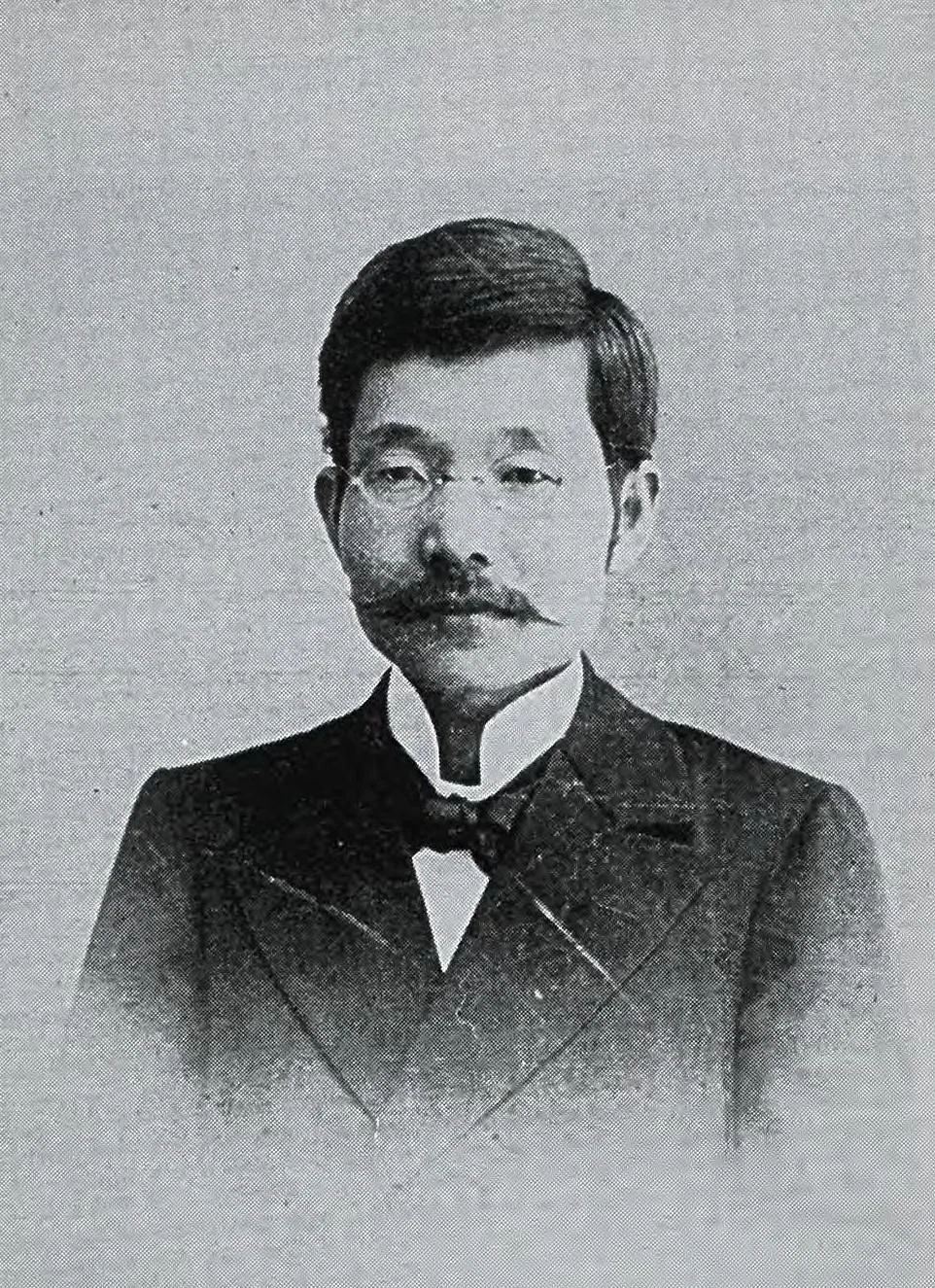
1864–1936
Kikunae Ikeda
Physical chemist and professorKikunae Ikeda investigated the chemical basis of the savoury taste of kombu broth. His laboratory work, 1908 patent and 1909 paper linked physical chemistry with a manufactured seasoning, through collaboration with assistants and the Suzuki business.Read biographyQuick answers
Common questions
- Is 1/3,000 a newly verified taste threshold?
- No. It is the value printed in the 1909 paper, discussed as a historical observation with limits.
- Does the guide claim to translate all seventeen pages?
- No. The full scan was acquired, and selected pages were visually inspected. The scope of the reading is stated explicitly.
Primary and institutional sources
How this history was checked
Read the identified historical documents and institutional accounts alongside the original evidence comparison and separately labelled teaching exercise. This article was reviewed on 27 October 2026.
- Kikunae Ikeda; Chemical Society of Japan / J-STAGENew Seasonings, Tokyo Chemical Society Journal 30(8), 820–836, 1909
- University of Tokyo Library SystemKikunae Ikeda: His Life and Achievements, 2022 library exhibition
- National Diet Library, JapanThe discovery of umami: Books Kaleidoscope, chapter 3
- Japan Patent OfficeKikunae Ikeda: Sodium Glutamate, ten Japanese inventors