
The short answer
Tatsuya Nakadai keeps one character recognisable as three films move him through different institutions. Their release structure is part of how the performance can be studied.
Evidence comparison
Keep the character and position in view
The synopsis gives three broad phases to compare during viewing.
| Phase | Kaji’s position |
|---|---|
| Opening phase | Labour supervisor in Japanese-occupied Manchuria |
| Middle phase | Conscript in the Japanese army |
| Later phase | Prisoner of war |
Three releases, six story parts
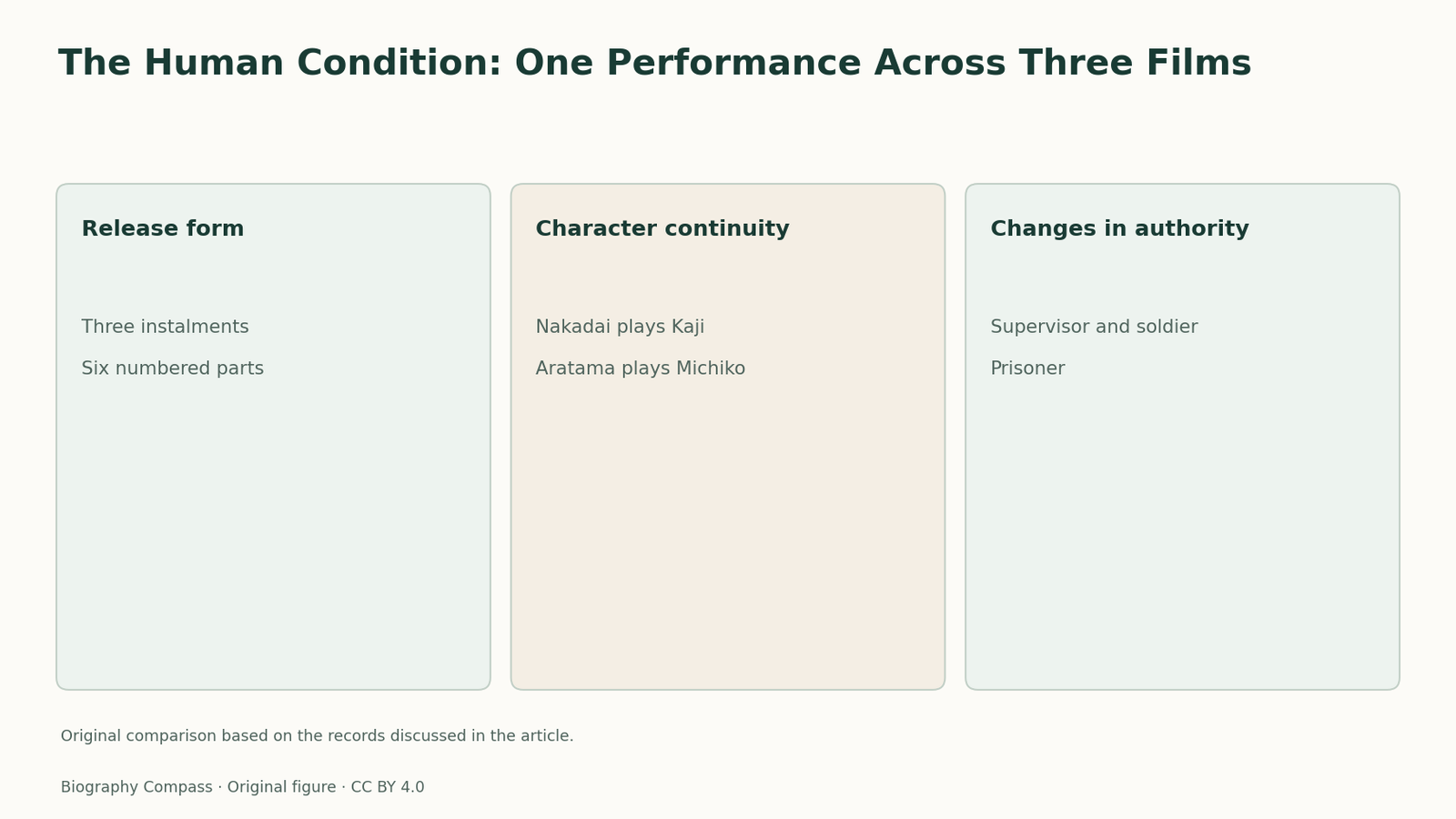
The Human Condition appeared in three instalments, each containing two parts, between 1959 and 1961. Criterion’s edition brings the entire project together in one listing. A later viewer can therefore encounter it as one extended film experience, but the release structure offers a way to divide viewing sessions. Keep three markers on a note page. Write which instalment is playing, which numbered part is on screen and what authority Kaji holds at that point. Those markers make observations easier to retrieve and give a comparison of performances more structure than a single running-time figure.
How a character’s formal position changes
The project follows Kaji from supervision at a labour site through conscription and imprisonment. A change of position alters who may give him orders and what power he has over anyone else. Those circumstances matter when assessing the continuity of Nakadai’s performance. A character can retain a principle while changing which actions are possible. A viewer who records his choices without recording his position may mistake limited power for a changed belief. Treat each new institution as a fresh set of constraints, and ask which decisions the character is still able to make.
The source novel and the film writing credits
Criterion credits the novel to Junpei Gomikawa and the screenplay to Masaki Kobayashi and Zenzō Matsuyama. Nakadai performs Kaji, while Michiyo Aratama plays Michiko, whose appearances are listed by part. Each credit identifies a different kind of continuity. The source novel supplies a literary narrative, screenwriting arranges a version for production, and performers embody characters through particular scenes. Listing these functions is helpful when considering an element that lasts across instalments. A recurring situation can belong to the adaptation’s structure, while the way an actor responds to it is available for separate observation.
Compare the accounts of a director and performer
Criterion’s career essay describes Nakadai observing Kobayashi closely as he developed the performance. That recollection gives the working relationship a specific method of communication beyond reading a script. It should be used as testimony from the collaboration, not as a transcript of every scene’s direction. The disc listing advertises later interviews, while the page itself gives a cast list and synopsis. A reader working with the page can identify what remains available for further research. A viewer with access to an actual interview can add what the participants say in that interview to the notes.
A viewing grid for the three sections of his life
After each instalment write one incident in which Kaji receives an instruction and one in which he attempts to influence somebody else’s action. Record who is present, which response he can realistically choose and what the performer makes observable. Finish with a single descriptive word you can test against the other two incidents, such as hesitation or insistence. If the word fits all three moments, ask how the surroundings make it look different. If it fits only one, the change may be a useful clue to what the performance does across the series.
Continue the chronology
Related history guides
Biography context
Explore Japan through connected lives
Connected biographies
People connected to the work
1932–2025
Tatsuya Nakadai
Film and theatre actorTatsuya Nakadai was a Japanese stage and screen actor who played Kaji in The Human Condition and held major roles in films by Masaki Kobayashi, Akira Kurosawa and other directors.Read biography1916–1996
Masaki Kobayashi
Film director and screenwriterMasaki Kobayashi made films that placed individuals against hierarchical power, moving between contemporary drama, period cinema, ghost stories and documentary.Read biographyQuick answers
Common questions
- How many films are in The Human Condition?
- The project was released in three instalments, each consisting of two numbered parts.
- Who wrote the source novel?
- Criterion credits Japanese novelist Junpei Gomikawa, whose given name also appears as Jumpei.
Primary and institutional sources
How this history was checked
Dates, legal milestones and historical claims are checked against the official and institutional records below. This article was reviewed on 13 November 2026.