
The short answer
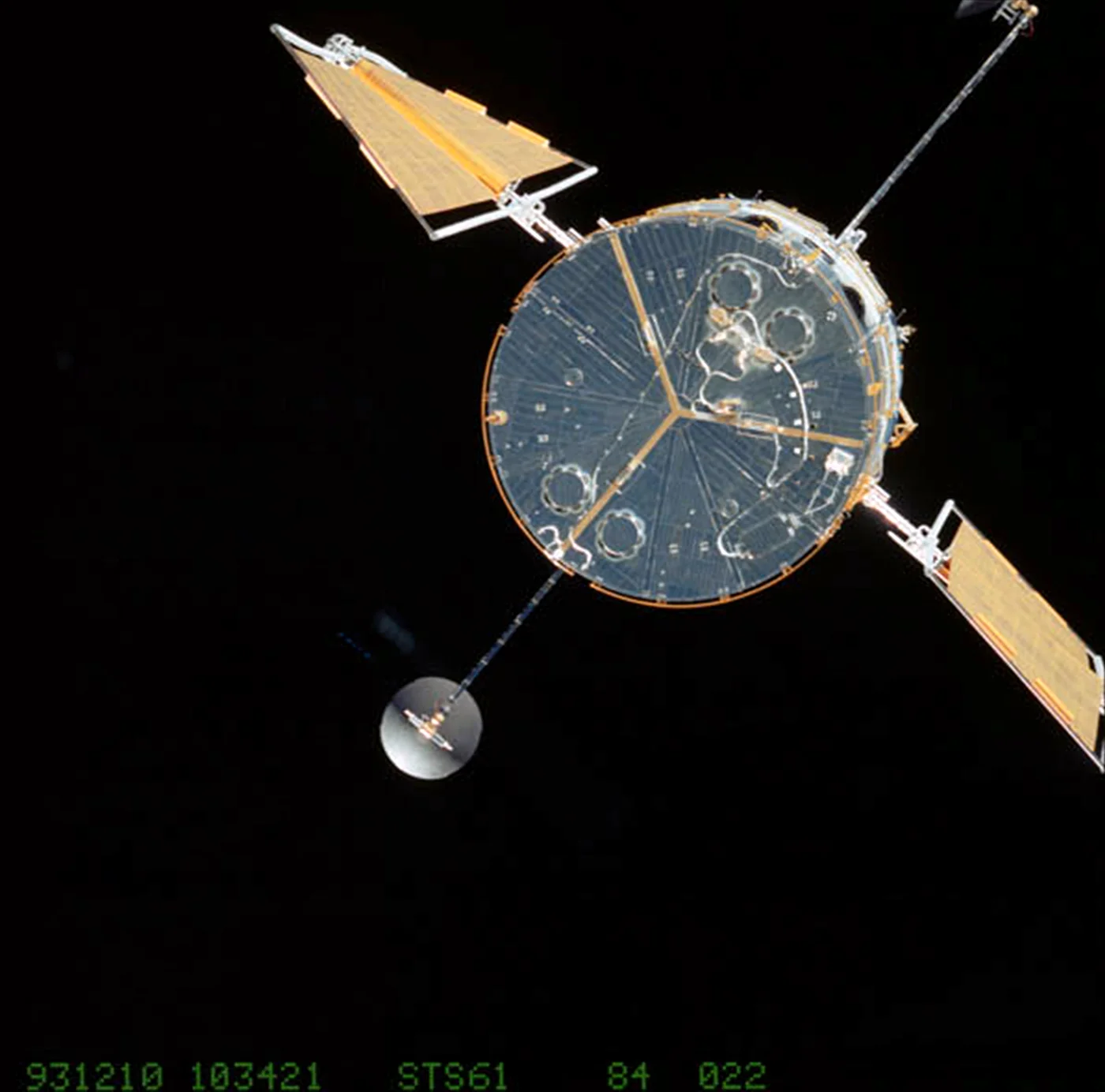
In December 1993, space shuttle Endeavour carried two ways of correcting Hubble’s optics. Astronauts replaced Hubble’s main camera with one that corrected the aberration internally. They also installed COSTAR, a separate system that corrected light on its way to several older instruments. The primary mirror stayed in place.
The engineering
What each part of the repair did
Follow the path of light and separate the changes to optics from the changes to pointing and power.
| Hardware | Where it acted | Effect |
|---|---|---|
| WFPC2 | Inside the new Wide Field and Planetary Camera 2 | Corrected the aberration for that camera’s observations. |
| COSTAR | In the light path to several original instruments | Sent corrected light to three named first-generation instruments. |
| New solar arrays | Outside the telescope | Supplied power with less thermally induced movement. |
| Replacement rate sensor units | Pointing system | Replaced failed or impaired equipment used to measure rotation. |
Chronology
A timeline of the turning points
Hubble’s images reveal a focus problem
The shape of the primary mirror produces spherical aberration.
Endeavour launches
The crew brings a replacement camera, corrective optics and other service hardware.
Spacewalkers install the hardware
The crew fits WFPC2 and COSTAR, replaces solar arrays and performs other maintenance.
Comparison images show the result
Early imaging of the galaxy M100 helps demonstrate improved focus.
How a fixed mirror could still produce sharp images
The primary mirror’s shape caused light arriving from different zones of the mirror to come to different foci. The team could design optics that compensated for the known aberration along the downstream light path. Instrument replacement during a servicing mission made that approach possible.
Wide Field and Planetary Camera 2 was designed with such correction built in. COSTAR used small mirrors on deployable arms to correct the beam for the Faint Object Camera, Faint Object Spectrograph and Goddard High Resolution Spectrograph. Think of these as separate paths through the observatory rather than interchangeable names for the repair.
What the astronauts changed besides the optics
NASA’s chronology names five spacewalks. Kathryn Thornton and Thomas Akers worked on COSTAR installation. The mission also replaced solar arrays whose motion as the telescope entered and left sunlight could disturb pointing. Two rate sensor units went into the spacecraft during the same service call.
An optical correction addresses the shape of a point of light in focus. Improvements to pointing help keep an object where the instrument expects it during an exposure. An observation can benefit from both kinds of work even though the two problems have different causes.
What the M100 photographs demonstrate
NASA shows views of the same galaxy made with the original camera and its replacement. Keeping the astronomical target fixed helps a reader see why concentrated points of light and more distinct structure are evidence of better imaging. The pictures communicate the practical effect of the repair more directly than a photograph of the installed hardware.
The comparison is an imaging demonstration, while the Hubble Key Project used observations and calibrations to make a scientific measurement. Reading the two accounts in sequence separates the instrument’s restored capability from the evidence used to estimate the expansion rate.
Continue the chronology
Related history guides
Connected biographies
People connected to this history
Quick answers
Common questions
- Did astronauts replace Hubble’s primary mirror?
- The mirror stayed in the telescope. WFPC2 and COSTAR provided correction farther along the optical path.
- Were COSTAR and WFPC2 the same instrument?
- They served different light paths. The new camera corrected its own beam. COSTAR provided corrected light to three older instruments.
Primary and institutional sources
How this history was checked
Dates, legal milestones and historical claims are checked against the official and institutional records below. This article was reviewed on 19 November 2026.