
The short answer
A result about how a particle forms cannot answer every question about what it does. The HPV record gives readers a way to follow those questions from laboratory to clinical studies.
Evidence at a glance
What does a particle-assembly result establish?
Read each observation alongside the particular inference it supports.
| Record or example | Observation | Interpretation |
|---|---|---|
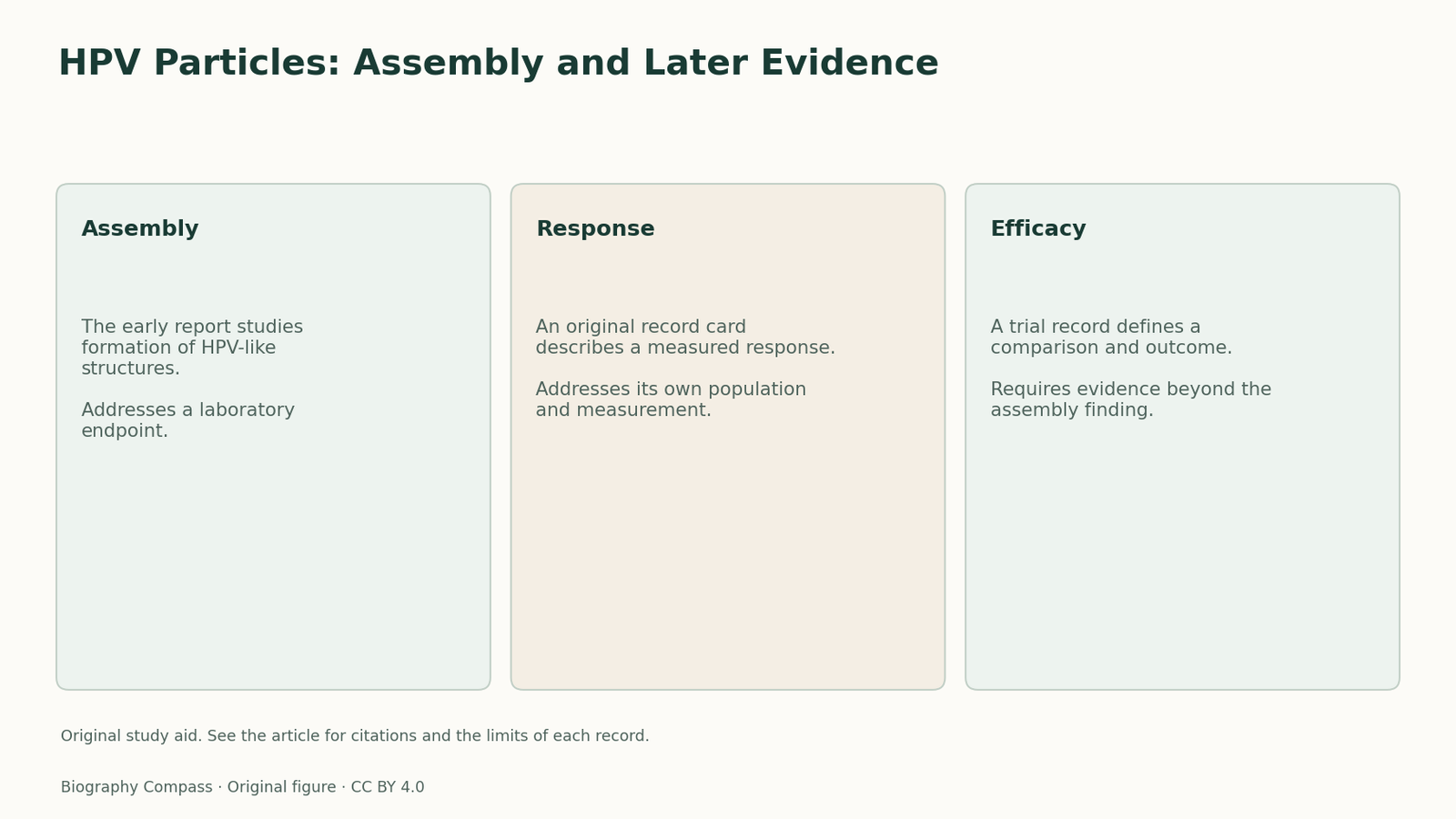
| Assembly | The early report studies formation of HPV-like structures. | Addresses a laboratory endpoint. |
| Response | An original record card describes a measured response. | Addresses its own population and measurement. |
| Efficacy | A trial record defines a comparison and outcome. | Requires evidence beyond the assembly finding. |
Give the 1991 record its own question
The Virology paper by Zhou, Sun, Stenzel and Frazer describes assembly of HPV type 16 virion-like particles when two viral structural proteins were expressed in their experimental system. The selected finding concerns a resemblance and the formation of a particle in that system. It gives researchers material for further questions about recognition, response and whether a product could be useful.
Sources for this section: [2]
Keep a claim ledger through development
Start a ledger with the object studied, the comparison, and the outcome. An assembly paper can describe the appearance or formation of a structure. An immune-response study measures a response in the setting studied. An efficacy trial compares defined outcomes in groups over time. The University of Queensland and NHMRC histories describe work across these stages; the appropriate source depends on the specific statement being checked.
Practice with three invented cards
Card A says that a prepared sample contained structures with the expected appearance. Card B says that a response measure changed in a studied group. Card C compares a prespecified outcome between study groups during follow-up. In this invented worksheet, A belongs under assembly, B under response, and C under efficacy. None of the cards reproduces trial data, and a label by itself says nothing about the study’s quality.
Use the right document for credit
The first paper’s author list records the team responsible for that publication. A later account describes the clinical, institutional and commercial steps involved in development. For a precise historical claim, write down both the contribution and the source that names its contributors. This prevents a discovery account from treating a multi-stage development process as a single laboratory experiment.
Continue the chronology
Related history guides
Biography context
Explore Australia through connected lives
Connected biographies
The researcher behind the records

born 1953
Ian Frazer
Immunologist and physicianFrazer worked with Jian Zhou and colleagues on the problem of studying HPV particles.Read biographyQuick answers
Common questions
- Did the 1991 paper itself establish clinical efficacy?
- It reported particle assembly. Later clinical studies were needed for efficacy evidence.
Primary and institutional sources
How this history was checked
The notes distinguish period evidence, later interpretation, and original exercises. This article was reviewed on 5 November 2026.
- University of Queensland, 2022 interviewLife change for life changer
- Jian Zhou, Xiao-Yi Sun, David J. Stenzel and Ian H. Frazer, Virology, 1991Expression of vaccinia recombinant HPV 16 L1 and L2 ORF proteins in epithelial cells is sufficient for assembly of HPV virion-like particles
- Australian National Health and Medical Research CouncilGardasil: The HPV vaccine