
The short answer
How do money, social reputation and constrained employment interact in Lily Bart’s choices?
Read the evidence
Sources, interpretation and production roles
The records answer different questions about this work. The final exercise is an original teaching model.
| Record or question | Supported reading | Boundary or contrast |
|---|---|---|
| Placement negotiation | Friends and customer connections help Lily obtain a position. | An introduction is not evidence of occupational training. |
| Workroom and season | Employment involves skills, conditions and limits of demand. | Social familiarity does not guarantee a lasting livelihood. |
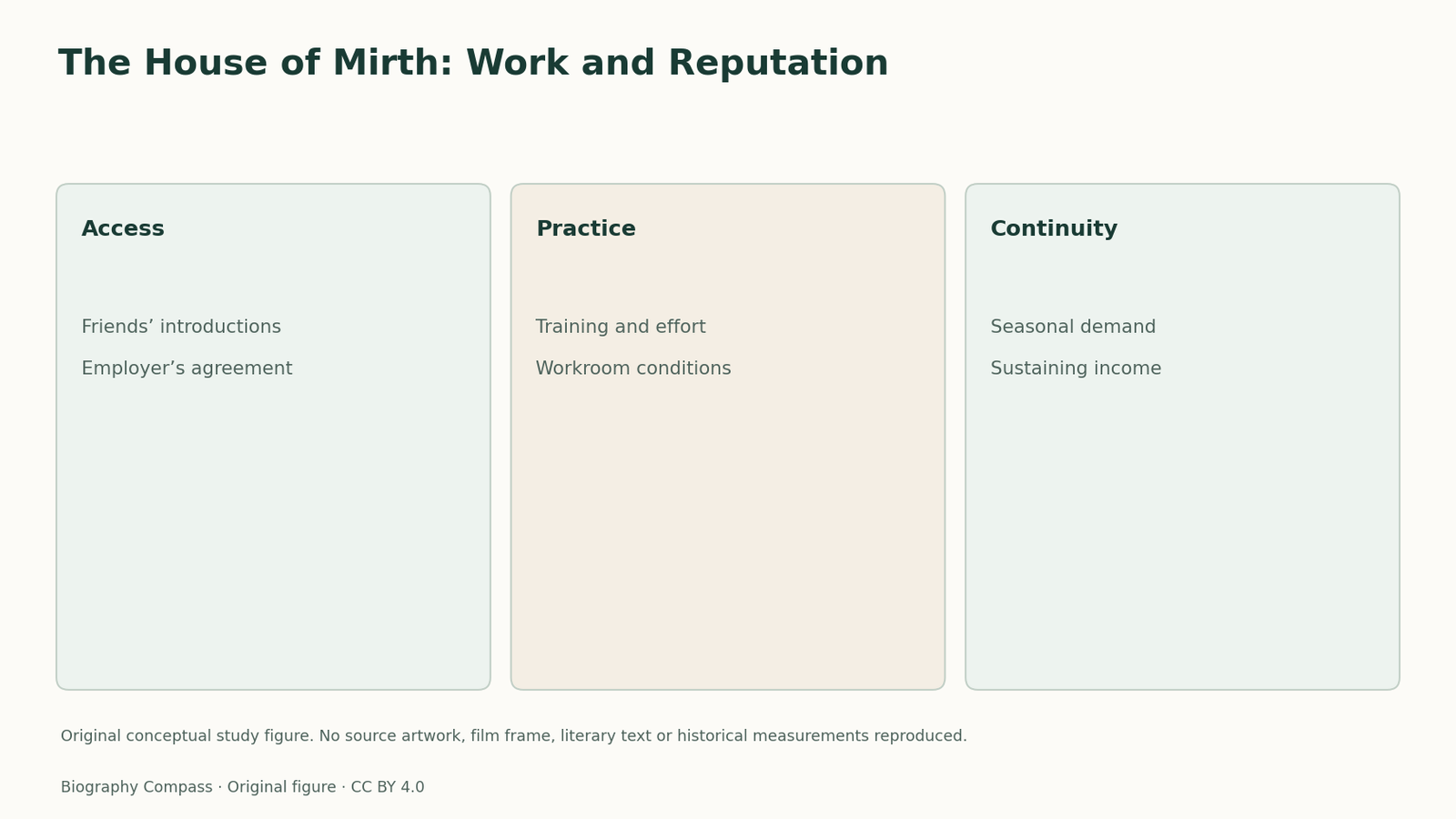
| Original test | Separate access to work from ability to sustain it. | The diagram is a reading aid, not historical employment statistics. |
From social position to the workroom
The House of Mirth was published in 1905. One useful way into its account of Lily Bart is to study her attempt at millinery employment in Book II. The episode joins worlds that can otherwise seem separate: fashionable consumption and the labour that produces fashionable objects. Lily has experience of the social world in which hats circulate, but familiarity with appearance is not identical with the practical ability to make them under workroom conditions.
Sources for this section: [2]
Getting the position
Mrs. Fisher and Gerty help arrange Lily’s placement with Madame Regina. The proprietor is reluctant to accept an untrained worker and yields partly because of social obligations connected with her customers. This is an unusually precise account of influence. Friends can help open a door, while the employer still has a reason to care about training and performance. The novel does not present the appointment as a neutral competitive examination or as proof that Lily already possesses an established trade.
Sources for this section: [2]
Work has a different rhythm
The millinery passages bring bodily strain, concentrated attention and the season’s limits into the account of employment. The women around Lily are workers with routines, not decorative background figures. Later, when her services are no longer required, the end of the season gives her days a new emptiness. The contrast is not simply between wealth and poverty. It concerns the difference between social knowledge and usable occupational skill, and between getting a position and sustaining an independent livelihood through it.
Sources for this section: [2]
An original two-stage test
Create two headings: access to work and ability to continue it. Under the first put introductions, the employer’s obligations and an available place. Under the second put training, performance, health and the season of demand. Which heading best explains why a social connection alone cannot ensure lasting employment? A supported answer names the second: access is only one stage. The categories are an original reading aid, not a modern labour-market dataset or an assertion that every factor has equal weight in Lily’s experience.
Sources for this section: [2]
What reputation can and cannot buy
The episode helps explain why the novel’s social judgements are also material pressures. A reputation can provide access to people, yet that access can change, and it does not automatically supply the competence a new occupation requires. Read the workroom alongside a scene of fashionable sociability and ask what each setting rewards. This comparison keeps the article focused on the novel’s construction of dependence. Wharton’s design career supplies context for her attention to material environments, but the fictional episode supports the interpretation rather than serving as an anecdote about the author.
Continue the chronology
Related history guides
Biography context
Explore United States through connected lives
Connected biographies
People and related creative practices
1862–1937
Edith Wharton
Novelist, short-story writer and designerEdith Wharton wrote about wealth, reputation and constrained choices while working across fiction, architectural design and wartime relief.Read biography
1775–1817
Jane Austen
Novelist and author of fiction, letters and youthful satiresJane Austen was an English novelist whose six completed novels turned courtship, money, family expectations and errors of judgement into sharply observant fiction.Read biography1873–1947
Willa Cather
Novelist, journalist and editorWilla Cather moved from journalism and magazine editing to fiction that reshaped remembered landscapes and immigrant lives through narrative form.Read biographyQuick answers
Common questions
- Why focus on millinery?
- It makes the difference between social knowledge, introductions and occupational skill visible.
- Is Lily’s employment arranged entirely on merit?
- The passage describes introductions and customer influence alongside the proprietor’s concern about untrained assistance.
Primary and institutional sources
How this history was checked
Sources include production records, institutional collections and the specifically identified passages discussed here. Interpretations and teaching models are distinguished from credits and publication facts. This article was reviewed on 7 November 2026.