
The short answer
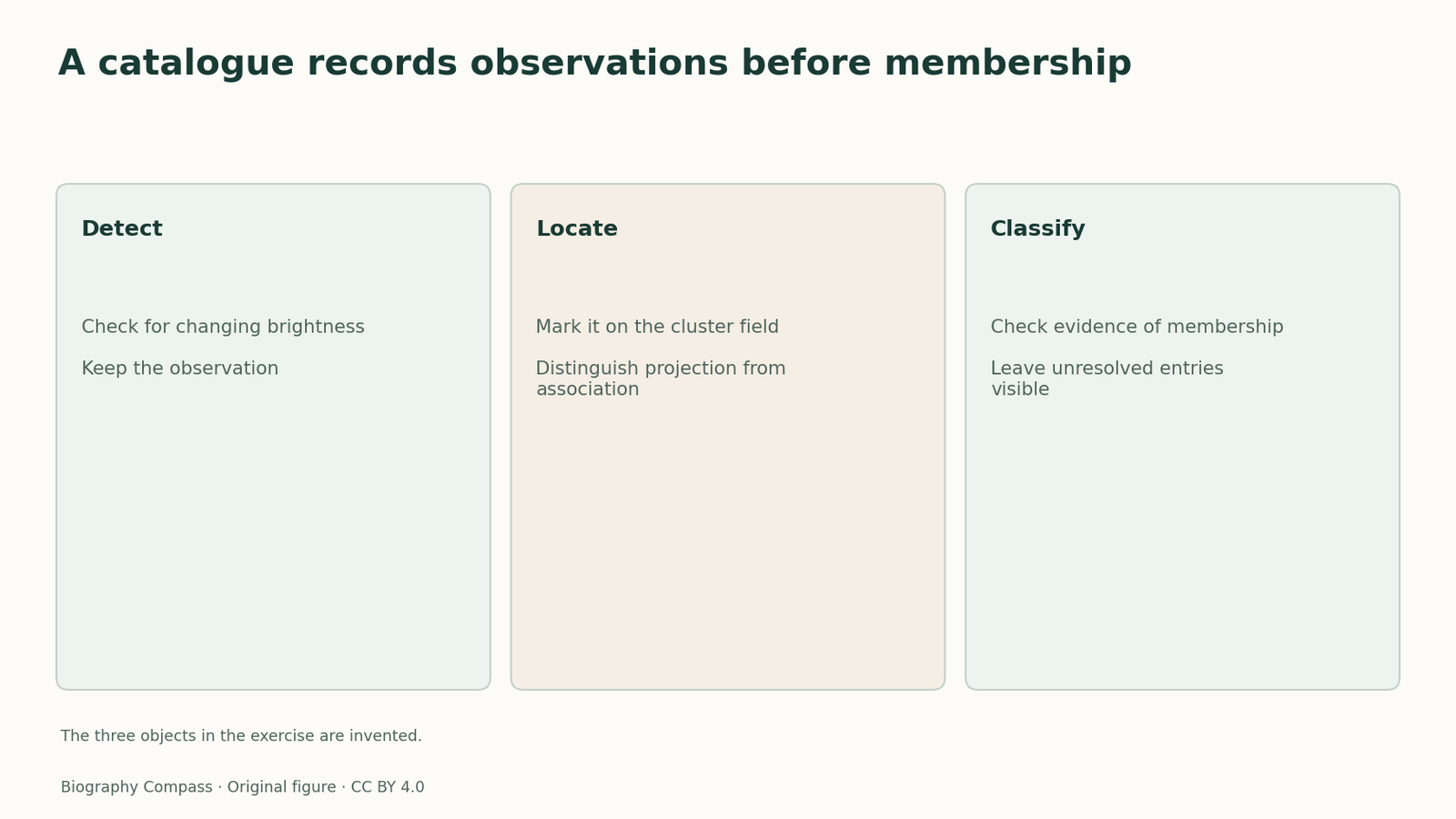
A star can appear close to a cluster on a photograph without belonging to it. Cataloguing the field preserves the observation while leaving the membership question open.
Reading the evidence
Three judgments that belong in separate columns
Record the evidence that supports each judgment.
| Stage | What has been established | Next question |
|---|---|---|
| Variable | Brightness changes over repeated observations. | Is it in the photographed field? |
| Field object | The source appears in the relevant area of sky. | Is it physically associated with the cluster? |
| Member candidate | Some evidence supports association. | What measurements could test it further? |
Read the scope of the catalogue
Hogg’s third catalogue follows earlier publications from the David Dunlap Observatory. Its introduction discusses how the known numbers changed as information accumulated. A reader should distinguish a count of entries from a count of physical members. A field record may include a variable worth following up even when the evidence for membership is weak.
The text identifies variables near NGC 6397 that were considered field stars. That example shows how the author could document detections without treating every one as a member of the cluster.
Separate three questions about one star
First ask whether repeat observations establish variation. Then ask whether the variable is located in the area shown by the cluster photographs. Finally ask whether other observations connect the object physically with the cluster. These questions can have different answers. A reliable measurement of a period does not settle location in depth or common motion.
A catalogue with explicit uncertainties makes later comparisons easier. It leaves a way to revisit an entry when more precise position or motion measurements become available.
Sources for this section: [2]
Try an invented three-star field
Suppose three variable stars are seen in the same photographed field. One has a measured motion consistent with the cluster, one has markedly different motion, and the third has no useful motion measurement. Keep all three observations on the worksheet. Count one candidate with supporting motion evidence, one likely field object, and one unresolved case. The worksheet makes clear why an observing count need not equal a membership count.
Continue the chronology
Related history guides
Biography context
Explore Canada through connected lives
Connected biographies
People in the records
1905–1993
Helen Sawyer Hogg
Astronomer and globular-cluster researcherHogg used repeated photographs and published catalogues to study variable stars near globular clusters.Read biographyQuick answers
Common questions
- Does an entry in a cluster-field catalogue establish membership?
- No. An entry can record a variable found in that field while leaving its physical association unresolved.
Primary and institutional sources
How this history was checked
Dates, legal milestones and historical claims are checked against the official and institutional records below. This article was reviewed on 5 November 2026.