
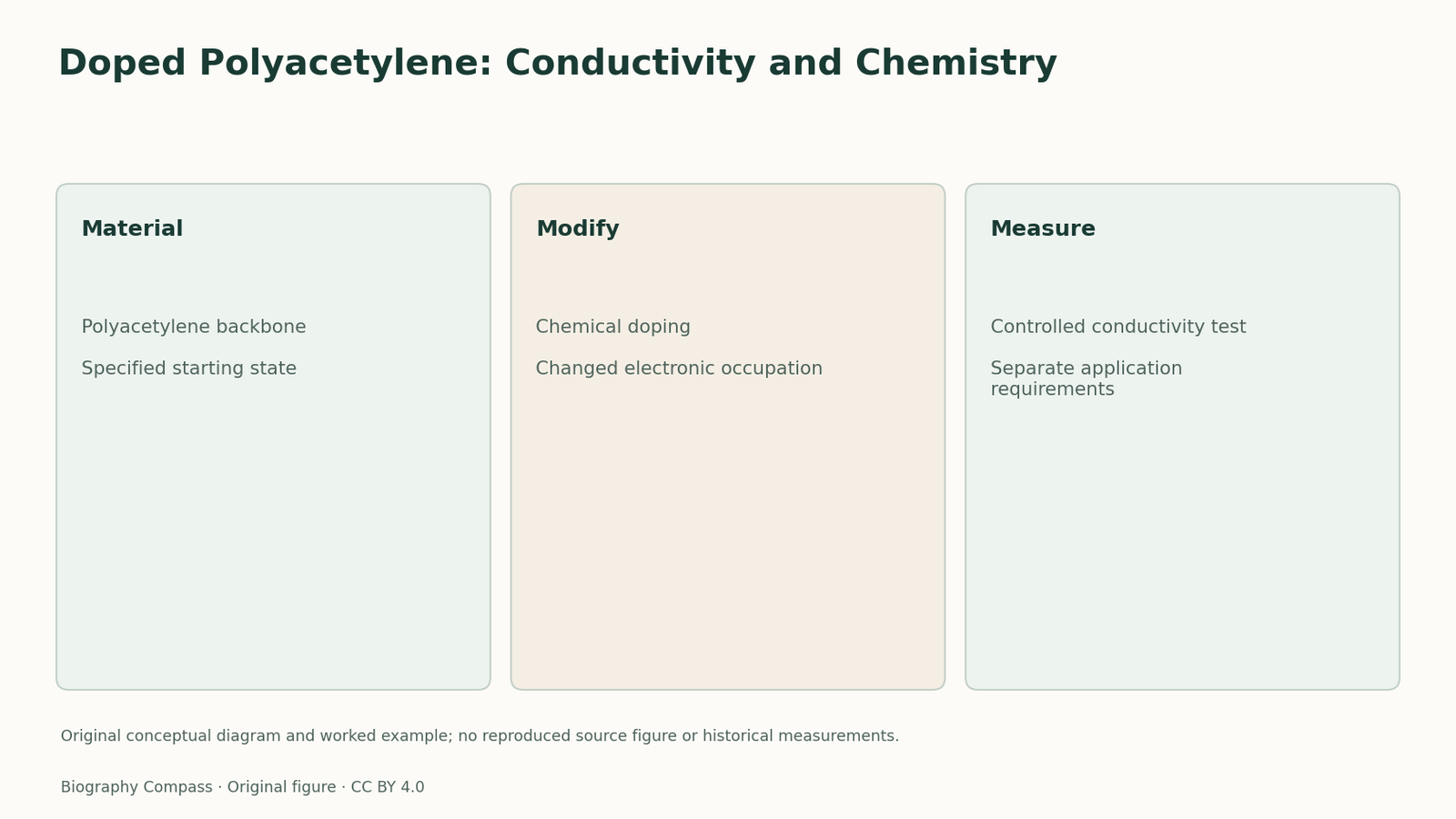
The short answer
How did chemical doping change conductivity without making a polymer identical to an ordinary metal?
Read the evidence
Different records within the same investigation
The following comparison distinguishes the specific questions answered by the inspected records.
| Record or test | What it establishes | What remains different |
|---|---|---|
| Polymer structure | Defines the starting molecular material. | Conjugation alone does not guarantee metallic conduction. |
| Chemical doping | Changes electronic occupation and charge balance. | Needs an actual measured material response. |
| Device assessment | Tests performance in a specified application. | Is not established by conductivity alone. |
The 1977 paper concerned a specified material and treatment
Shirakawa, Louis, MacDiarmid, Chiang and Heeger reported electrically conducting halogen derivatives of polyacetylene. The change depended on chemical treatment of a particular conjugated polymer. This was not a demonstration that every familiar plastic was inherently metallic. The primary result connected material preparation with measured conductivity, establishing a new research direction at the boundary of polymer chemistry and condensed-matter physics. The complete author list also makes the collaboration visible within that result.
Sources for this section: [1]
A conductivity result is not a finished-device specification
The early paper established an important material behaviour, while the later programme investigated wider polymer properties and applications. A device additionally requires suitable geometry, contacts, stability and performance under its intended conditions. Those are further questions rather than automatic consequences of observing a large conductivity change. Reading the original report alongside the lecture makes the progression useful: discover a controllable material property, develop an account of it, then test whether that property can serve a particular technological purpose.
An original before-and-after exercise
Imagine a fictional polymer specimen whose measured resistance falls after treatment. What would be needed to compare its conductivity before and after? The measurement must account for specimen geometry and contact effects, rather than treating every change in resistance as an identical change in the material’s intrinsic conductivity. Now suppose the treated sample conducts well but becomes unstable under a proposed operating condition. That does not erase the conductivity result, but it changes the device assessment. These invented qualitative cases are not measurements from the 1977 paper. Their supported answer separates chemical modification, a controlled material-property measurement and an application test. A good response also states which sample and conditions were compared instead of generalising the result to every polymer or every form of the same chemical backbone.
Biography context
Explore United States through connected lives
Connected biographies
Researchers and related approaches
1936–
Alan Heeger
Experimental physicist and conducting-polymer researcherAlan Heeger connected condensed-matter physics with polymer chemistry, helping show how chemical doping could transform polyacetylene’s conductivity.Read biography
1923–2020
Philip Anderson
Condensed-matter theoretical physicistPhilip Anderson developed condensed-matter theory through Bell Laboratories, Cambridge and Princeton, connecting microscopic models with collective material behaviour.Read biographyQuick answers
Common questions
- Do all plastics conduct because of this discovery?
- No. The result concerned specified conjugated materials and treatments.
- Is resistance identical to intrinsic conductivity?
- No. Geometry and contacts must be considered in interpreting a specimen measurement.
Primary and institutional sources
How this history was checked
The references below distinguish the original study from later explanations. The worked exercise and comparison are newly written for this article. This article was reviewed on 8 November 2026.