
The short answer
A prominent example can disprove an absolute exclusion while leaving the distribution of opportunity unresolved.
Record and inference
Keep the questions separate
Each input establishes a different kind of evidence.
| Input | What follows | What does not follow |
|---|---|---|
| One documented office-holder | An absolute no-exceptions claim is false. | Equal access for everyone is not established. |
| Attributed organisational position | The speaker attributes a position to her organisation. | Every woman’s agreement is not established. |
| Evidence of opportunity | Define access, population and comparison. | A prestigious outcome alone is insufficient. |
Chronology
A timeline of the turning points
Objectives Resolution
Mehta supported the Objectives Resolution.
Read the bounded passage
In the 19 December 1946 debate, Mehta mentioned Sarojini Naidu as an example of high status while arguing that exceptional women did not represent women’s general position.
The indexed parliamentary passage is the inspected record. The native PDF request failed; this is not a claim to have read the entire session or inspected an autograph. The modern transcript offers a second access route to the same speech, not a separate independent witness.
Sources for this section: [1]
An original argument-repair task
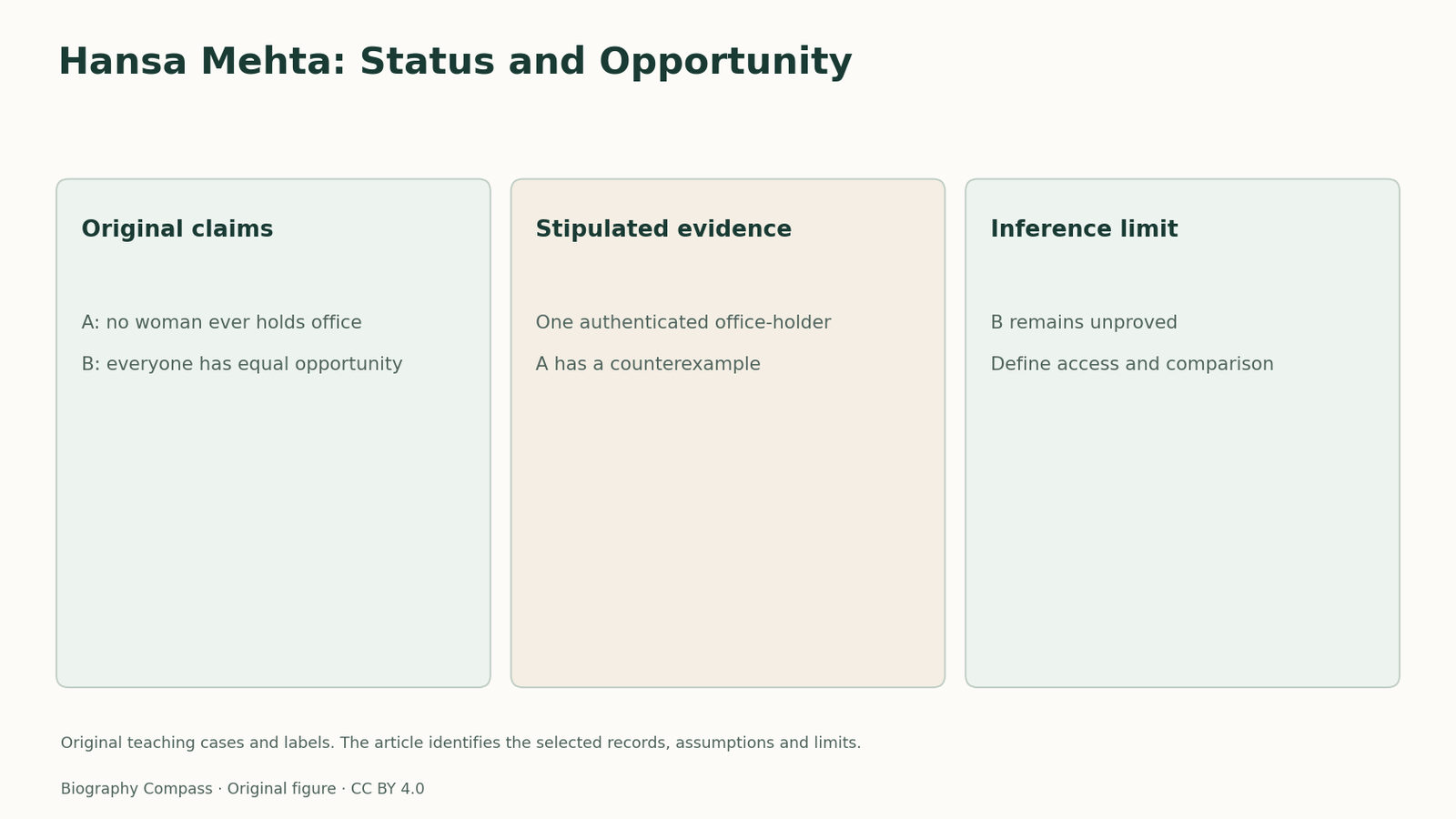
Consider two invented claims: A, no woman can ever hold public office; B, every woman enjoys equal opportunity to enter public office. Suppose an authenticated record establishes that one woman held office. Which claim does it refute, and which does it fail to prove?
Now add the sentence: this example proves that recruitment, education and social constraints are equal for everyone. Rewrite that conclusion so it says only what the stipulated record establishes.
Sources for this section: [1]
Reference answer
The one example refutes A, because A permits no exception. It does not prove B: an observed outcome for one person supplies no comparison of everyone’s opportunities. A defensible revision says that at least one woman held office and leaves the general conditions open.
No invented sample size or percentage is needed. The error concerns the scope of a claim. A stronger inquiry would define the opportunity being compared, the population and the evidence of access before making a general conclusion.
Sources for this section: [1]
Identify the speaker’s constituency
She states that her organisation had never asked for reserved seats, quotas or separate electorates.
That is evidence of a stated organisational position in a particular debate. It is not a survey of every woman, a description of every later campaign or a present-day ruling on constitutional arrangements. Readers can assess the argument without silently enlarging the group for which it speaks.
Sources for this section: [1]
Continue the chronology
Related history guides
Biography context
Explore India through connected lives
Connected biographies
The related public career
Quick answers
Common questions
- Are A and B quotations from the debate?
- No. They are our original contrasting claims, used to test the scope of an inference.
Primary and institutional sources
How this history was checked
Selected original records, retrospective testimony and invented exercises are identified separately. This article was reviewed on 31 October 2026.