
The short answer
A fundraising song can have several collection routes. This study checks which works and income categories the publisher actually pooled before asking what can be attributed to one song.
Compare the records
Different records establish different things
Keep the object, date and scope of a statement together.
| Record | Supported reading | Unsupported leap |
|---|---|---|
| Project abstract | Purpose and a researcher’s account. | An independently verified welfare effect. |
| Sales report | Interpret the stated collection category. | A separate amount for each title. |
| Royalty report | Preserve the date and qualifications. | All yearly income was distributed. |
Chronology
A timeline of the turning points
Sales report
Retain the combined-work basis.
Royalty report
Retain the partial-income qualification.
An intention and an assessment are not the same record
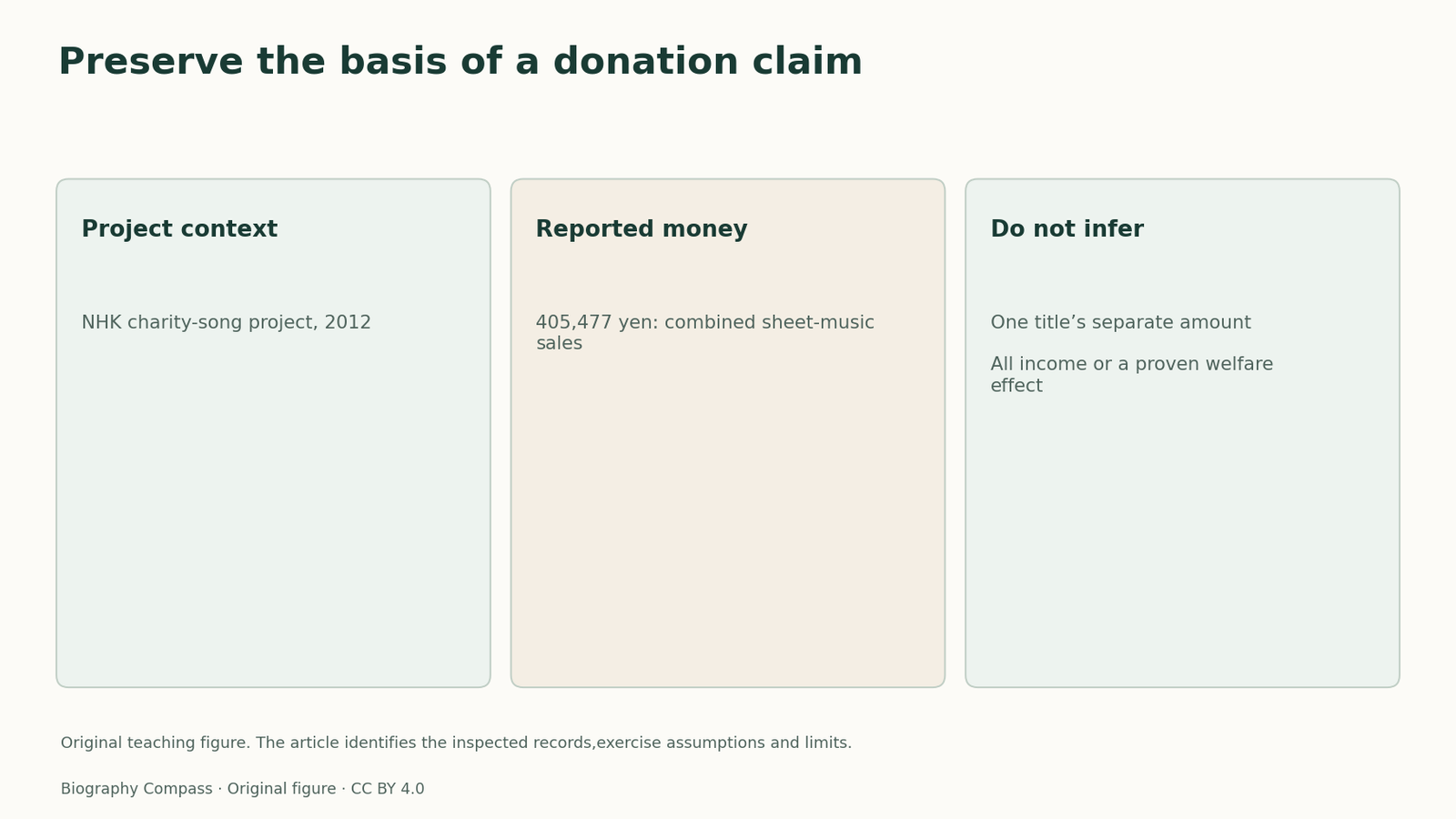
The 2014 conference abstract describes NHK’s 2012 charity-song project and asks how it supported people affected by the 2011 disaster.
That is a stated research and public-support context. It is not a recipient’s financial audit, and the inspected abstract does not supply a basis for independently measuring every claimed benefit. Keep a song’s intended purpose separate from proof of an outcome.
Sources for this section: [1]
The publisher identifies a change of channel
The office report says the NHK-linked donation project ended in March 2021, while Kanno’s direct donations would continue. Its February 2021 entry reports 405,477 yen from sheet-music sales across Hana wa Saku, Ray of Water and Journey to Harmony. A December entry instead describes 3.2 million yen from royalties, with some income carried forward.
The dates and collection bases matter. The first sum is not identified as one song’s proceeds. The later sum is not described as every yen of that year’s income. Adding or comparing them without preserving those qualifications would create a claim the report does not make.
Sources for this section: [2]
Exercise: decide which statements the record supports
An invented summary makes four claims: A, the first amount came entirely from one song; B, the later amount exhausted all income; C, the end of the earlier channel ended every donation; D, the report alone proves improved welfare for all intended beneficiaries. For each, identify the missing or contradictory evidence and write a cautious replacement.
Reference answer: A needs a work-by-work allocation; B needs a complete income and carryover reconciliation; C needs evidence about the later channel; D needs outcome evidence beyond a financial self-report. Describe the amounts at their stated combined-work scope and collection basis, retain the channel change, and leave unsupported causal conclusions open.
Equal division among the listed works would be a new assumption, not a recovered fact. Likewise, a list of recipients is not a set of independently checked receipts or a measure of how each recipient used the money. A more complete investigation would seek matching records without silently filling those gaps.
A useful accounting boundary
This is a historical reading exercise, not a claim about present donation arrangements or an organisation’s current finances. Its useful result is a clearer description: who reported the money, what generated it, which works were pooled, and what period or exception was stated. None of those fields can be replaced by the popularity of the song.
Sources for this section: [2]
Continue the chronology
Related history guides
Biography context
Explore Japan through connected lives
Connected biographies
The wider career
Quick answers
Common questions
- Can a combined total be assigned equally to its titles?
- Only as an explicit invented assumption. The total does not establish the actual division.
Primary and institutional sources
How this history was checked
These are selected production, publishing or contextual records. The access notes identify what was actually inspected. This article was reviewed on 31 October 2026.