
The short answer
Foundation has a magazine history, a book history and an awards history. Attaching each date to its bibliographical object resolves apparent contradictions without pretending that a story, a volume and a series are the same thing.
Compare the records
Different records establish different things
Keep the object, date and scope of a statement together.
| Record | Supported reading | Unsupported leap |
|---|---|---|
| Magazine history | An earlier serial appearance. | The date of every book edition. |
| Book catalogue | A particular publishing record. | Evidence of every earlier appearance. |
| Award record | A category and an event year. | A novel’s first publication date. |
Chronology
A timeline of the turning points
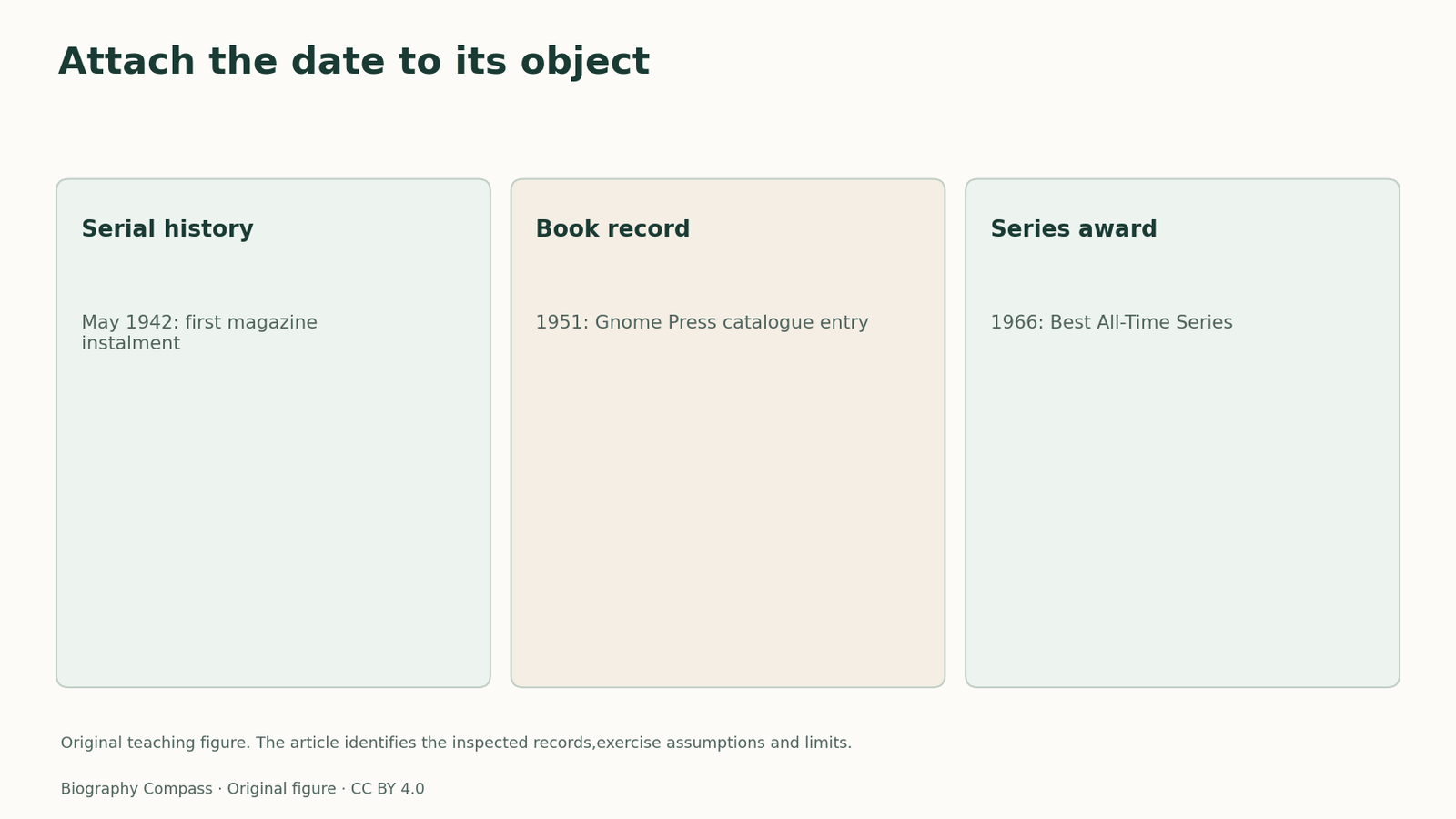
Magazine history
A serial instalment has its own date.
Book record
A publisher and a bound work are identified.
Series recognition
Keep the category attached to the award.
Identify what was published
The Encyclopedia of Science Fiction identifies Foundation’s first magazine instalment in the May 1942 Astounding and describes the later book assembly.
The inspected Google Books catalogue record lists Gnome Press and 1951 for Foundation.
A magazine instalment and a book assembled from related material are different bibliographic objects. Giving the earlier date as though it identified every later bound volume would erase that distinction. The catalogue was inspected as metadata, not as a reading of the novel.
Identify what won the award
The official 1966 Hugo record lists the Foundation series under Best All-Time Series. Its Best Novel category instead has joint winners Dune and …And Call Me Conrad.
The category is part of the fact. A series award is neither a novel’s publication date nor a Best Novel award for one volume. The same familiar title can refer to a story, a particular book or a larger sequence.
Sources for this section: [3]
Exercise: repair three catalogue sentences
An invented catalogue says: A, “the book edition was published on the first magazine date”; B, “the first book won Best Novel in the series-award year”; C, “all later volumes must share the first book’s publication date.” Repair each sentence using only the supplied records, and state what remains unknown about a particular copy on a shelf.
Reference answer: A should separate the serial appearance from the identified book record. B should name the series and the actual award category. C needs each later volume’s own record. Dating a particular copy still requires its edition or impression evidence; a work’s early history is not enough.
A useful record has separate fields for work, publication or edition, date, and event type. It can then retain several dates without treating them as rivals. The exercise does not require a fictional chronological calculation or a judgment about which version a reader should prefer.
When a contextual source disagrees
The consulted encyclopedia narrative says the series Hugo was for 1965, while the official award record places it in 1966. This study follows the awarding body’s record for the event year and retains the discrepancy in its notes.
That is a limited correction, not a reason to discard the source’s separate bibliographical work. It demonstrates why the claim being checked should determine which record is decisive. No stories, novels or television adaptations were consumed for this study.
Continue the chronology
Related history guides
Biography context
Explore United States through connected lives
Connected biographies
The wider career
Quick answers
Common questions
- Can one work have several legitimate dates?
- Yes, when the dates refer to different publications, editions or events. State the object rather than forcing one date to do every job.
Primary and institutional sources
How this history was checked
These are selected production, publishing or contextual records. The access notes identify what was actually inspected. This article was reviewed on 31 October 2026.