
The short answer
A performance can begin in sync and gradually slip, or begin late and remain consistently late. Those faults need different remedies, even when both feel like a mismatch between a mouth and a voice.
Compare production decisions
Separate the stages of the work
Use the distinctions to plan an action or explain an editorial choice.
| Stage | Decision to identify | A mistake to avoid |
|---|---|---|
| Performance | Does the filmed action match the intended recording? | Giving apparatus invention credit for every creative role. |
| Start | Are corresponding events initially aligned? | Using a start shift to claim a speed fault is cured. |
| Running rate | Does the difference grow through time? | Calling every mismatch a fixed delay. |
Chronology
A timeline of the turning points
Synchronised productions
Phonoscènes for the Chronophone.
A filmmaker inside a technical system
The Smithsonian account describes Guy-Blaché filming performers lip-syncing to a disc recording for Gaumont’s Chronophone. It credits Gaumont’s apparatus rather than treating the director as its inventor.
The Library of Congress guide identifies her production and supervision of synchronised-sound films alongside silent work.
Those roles distinguish making a screen performance from designing the mechanism and operating a screening. A successful apparatus still needs a performance that suits its timing, while a convincing filmed performance can be undermined by poor playback alignment.
Production and exhibition are different tests
McMahan’s chronology records early Chronophone production and later American promotion, including technical difficulties. It describes both filmmaking and attempts to make the system work for exhibitors.
These records do not supply one universal error rate for the equipment. Instead, use them to ask where a problem arises: was the filmed action made against the intended recording, did the two start together, and do they keep the same pace? Changing the beginning cannot necessarily cure an error that grows throughout playback.
Sources for this section: [3]
Original exercise: two invented faults
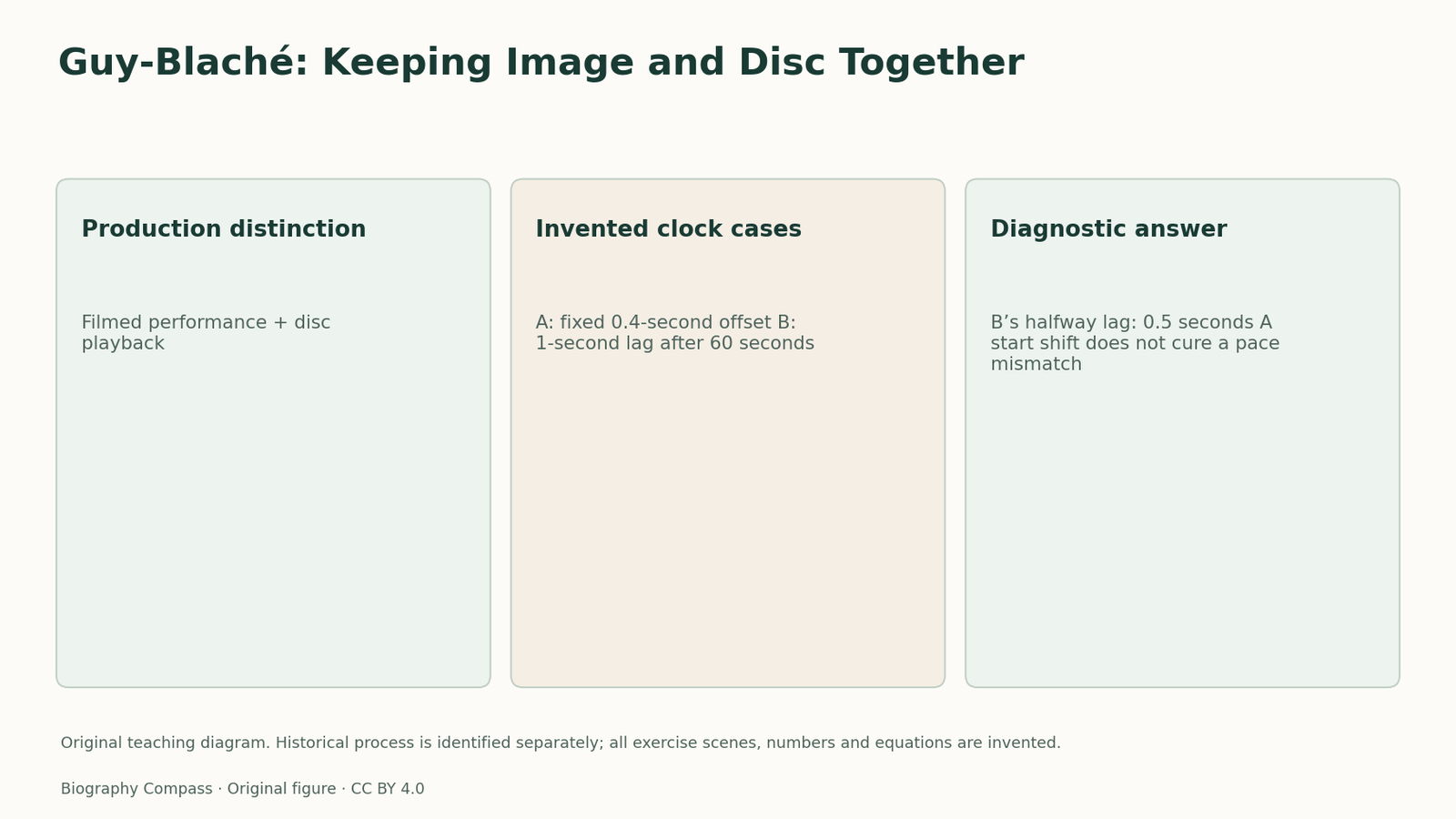
Case A has image and disc running at the stipulated same speed, but the image starts 0.4 seconds late. Case B starts aligned; by the time the disc reaches 60 seconds, the corresponding image event arrives at 61 seconds on the same observation clock. Treat that one-second lag as accumulating uniformly. Which case has fixed offset, which has drift, and how large is B’s lag at 30 seconds under the assumption?
Propose a separate remedy for each. Do not infer a historical machine speed, frame rate, amplification level or disc specification from these invented values.
Reference answer: do not repair the wrong stage
A has a constant 0.4-second offset under the assumptions. Starting the image 0.4 seconds earlier relative to the disc would align its events. B has a growing lag: half the stipulated interval gives 0.5 seconds at 30 seconds. A start adjustment can align one point in B but leaves the pace mismatch.
B therefore needs a running-rate correction or another way of maintaining coordination. The two-point observation is enough for the stipulated linear model, not a diagnosis of a real projector. A real test would check repeated events and the complete playback chain. A loud recording, a persuasive performance and well-aligned timing address different difficulties; solving one does not establish that the others have been solved.
Continue the chronology
Related history guides
Biography context
Explore United States through connected lives
Connected biographies
The maker’s wider career
Quick answers
Common questions
- Are the error values measured from a surviving screening?
- No. They are invented clock observations for distinguishing a start offset from uniform drift.
Primary and institutional sources
How this history was checked
Institutional production descriptions are compared with a scholarly chronology. No phonoscène or disc recording was played; numerical faults are stipulated. This article was reviewed on 31 October 2026.