
The short answer
An electronic line is material for a film, not a finished sequence. Its shape, duration, framing and treatment can be chosen at different stages of production.
Compare production decisions
Separate the stages of the work
Use the distinctions to plan an action or explain an editorial choice.
| Stage | Decision to identify | A mistake to avoid |
|---|---|---|
| Generate | What form does the chosen input permit? | Treating an illustrative equation as the historical circuit. |
| Record | Which interval and framing are kept? | Assuming a trace specifies its own screen duration. |
| Compose | How do colour, sequence and sound relate? | Calling every later intervention automatic. |
Chronology
A timeline of the turning points
Film catalogue date
Abstronic.
Written explanation
Abstronics.
Read the maker’s sequence of operations
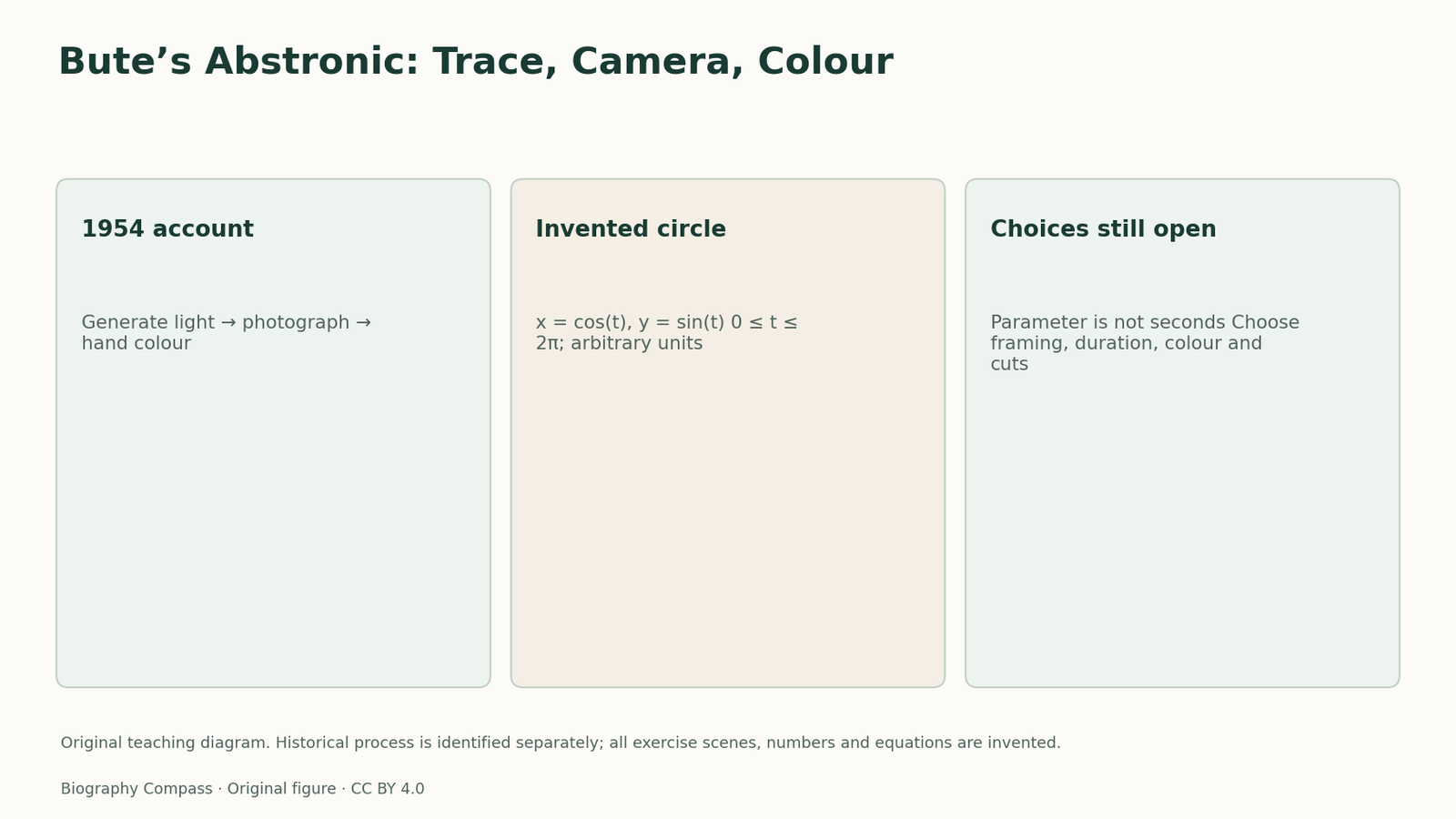
In her 1954 account, Bute says an oscilloscope’s light forms were photographed on film, and that the imagery in Abstronic was coloured by hand. She presents electronic control as a way to develop a repertoire of moving forms, not as the disappearance of every other technique.
The archive catalogue dates Abstronic to 1952. The later article is a retrospective explanation, not its release announcement.
The distinction guards against a misleading story in which a new device instantly replaces animation labour. Generating a trace, choosing what to record and deciding how colour enters remain separate creative acts.
The archive explains the intermediate work
CVM’s account describes camera capture followed by optical printing with other imagery and colour filters. It names cinematographer Theodore Nemeth’s technical contributions. The source’s repeated 1954 quotation belongs to Bute’s own article rather than a second witness.
A production chain can combine an immediate gesture at a control board with later selection and revision. Calling the image electronic tells us something about its origin, but not its final duration, hue or place in an edited film. Do not infer a literal colour–pitch code from the phrase visual music.
Sources for this section: [3]
Original exercise: one invented moving trace
For a purely mathematical design sketch, set x(t) = cos(t), y(t) = sin(t) for 0 ≤ t ≤ 2π, with arbitrary screen units. At t = 0, π/2, π, 3π/2 and 2π, list the coordinates. Then propose a three-stage plan: generate that trace, record a selected interval, and apply an original colour decision. Explain one decision the equations do not settle.
This is an invented circle model. It is not Bute’s circuit, a measured trace, an audio signal or a film frame. No source artwork is reproduced, and no claim is made that the formula reconstructs Abstronic.
Reference answer: the curve does not edit the film
The coordinates are (1, 0), (0, 1), (−1, 0), (0, −1) and (1, 0). They trace a unit circle counterclockwise as the parameter increases. The parameter range does not by itself specify seconds; a conversion from parameter to playback time must be chosen.
One plan records two slow circuits, then keeps the first neutral and changes the second from blue to amber. That is an original proposal, not the film’s colour scheme. The equations settle the curve’s geometry but not framing, duration, exposure, colour treatment, musical relationship or cut order. The reference answer therefore preserves the artist’s decisions after generation instead of mistaking an interesting source image for a completed composition.
Continue the chronology
Related history guides
Biography context
Explore United States through connected lives
Connected biographies
The maker’s wider career
1906–1983
Mary Ellen Bute
Experimental filmmaker and directorShe shaped light as moving imagery.Read biographyQuick answers
Common questions
- Does the circle reproduce a surviving electronic trace?
- No. It is an invented mathematical sketch used to separate generation from later film decisions.
Primary and institutional sources
How this history was checked
Bute’s four-page transcribed article is read beside the archive’s process description and catalogue. Its claims about future physics are not treated as tested science. This article was reviewed on 31 October 2026.