
The short answer
Why can two keys both operate a lock while still having different authority?
The records answer different questions
Keep the measures separate
The question changes when the object, unit or reporting period changes.
| Record or measure | What it establishes | What it does not establish |
|---|---|---|
| Ordinary key | Operates the lock. | Changing access not assigned. |
| Check key | Operates and changes access. | A physical procedure supplied here. |
| Model O/C | Explicit permissions. | A specification for modern products. |
Chronology
A timeline of the turning points
Manufacture
Lock production begins.
Application
Springless patent stage.
Grant
Later reported patent stage.
The distinction is functional
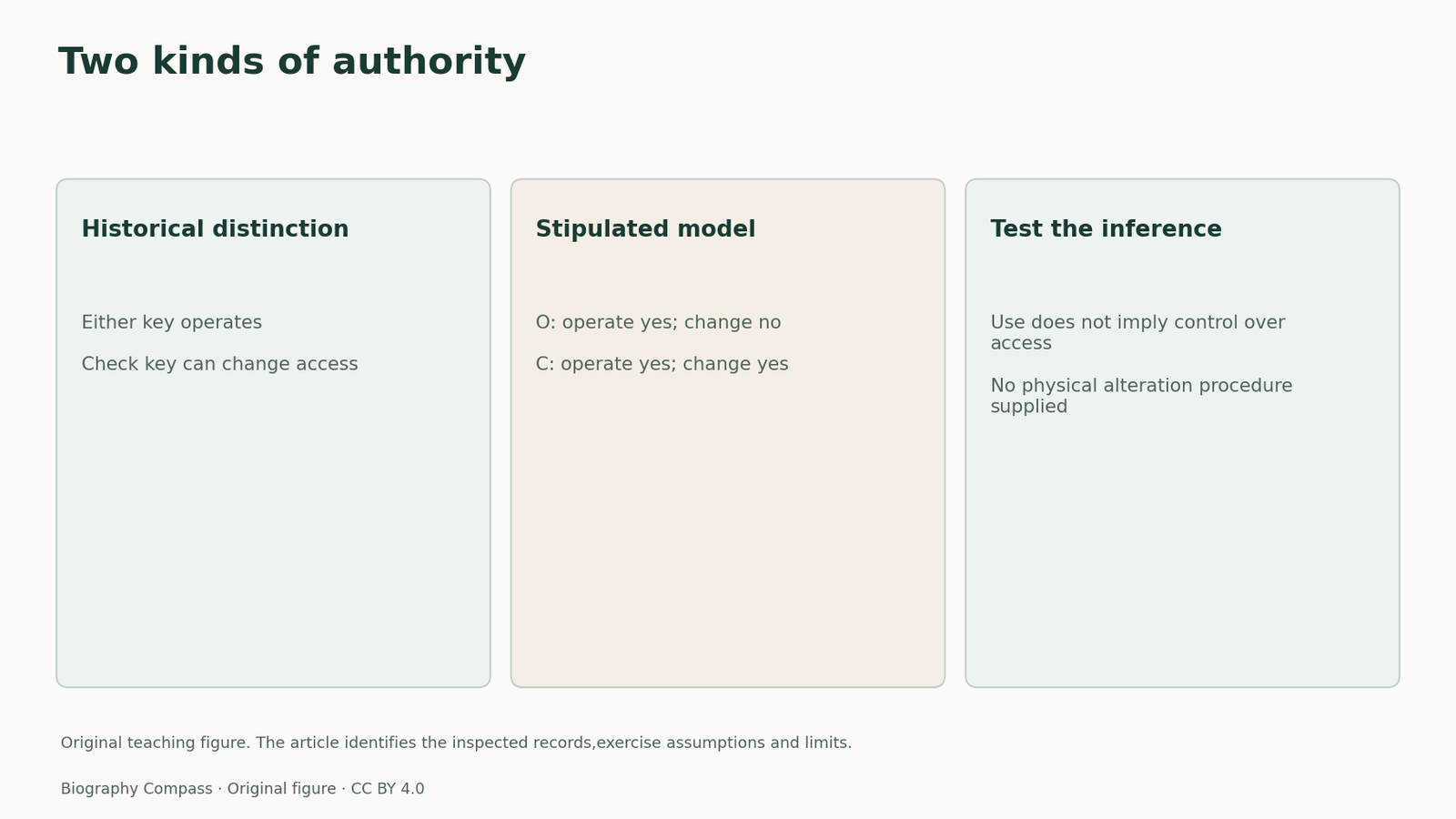
The archive-supplied description says both keys could lock and unlock the Gordian lock. The check key could also modify which other key remained useful.
The distinction is between exercising an existing permission and changing an authorisation relationship. Two holders can share one capability without sharing all of them. This is a conceptual reading of a historical object description, not instructions for altering or bypassing a lock.
Sources for this section: [1]
Keep the neighbouring object stories distinct
The same exhibition separately labels a springless-lock patent.
The company biography discusses Ardeshir and Pirojsha together.
The later newspaper account distinguishes the 1908 application from the 1909 grant and says the certificate credits Pirojsha.
The original certificate was not inspected here. The supported conclusion is that a founder biography, a patent story and a functional description should not be fused into a single sole-inventor claim. Nor does a security product’s historical promotion independently prove an absolute performance guarantee.
Original task: complete a permission matrix
In this stipulated classroom model, ordinary means operate; check means operate and change access. Use columns “operate” and “change access”, and rows O and C. Fill each cell with yes or no. The labels are abstractions of the stated distinction, not a modern product specification.
Test three proposed sentences: A, “O may operate”; B, “only C may operate”; and C, “O may change access because O may operate”. Identify which follows from the supplied model. Do not add a physical procedure, a guessed key shape or a claim about every lock with two keys.
Sources for this section: [1]
Continue the chronology
Related history guides
Biography context
Explore India through connected lives
Connected biographies
The connected careers
1868–1936
Ardeshir Godrej
ManufacturerGodrej made locks and safes. His life distinguishes starting a venture from sustaining and extending it.Read biographyQuick answers
Common questions
- Does a two-key arrangement necessarily give both holders equal authority?
- No. That inference requires a statement of permissions; counting the keys does not supply it.
Primary and institutional sources
How this history was checked
Read these dated records together; the original task states its own assumptions and separates them from reported facts. This article was reviewed on 31 October 2026.