
The short answer
Two outputs can respond differently to the same change of an input. Read the historical equations as a paired argument, then compare relative changes without proposing any practical operating settings.
Historical record and original analysis
Compare the responses
The entries are calculated ratios, not operating points.
| Scenario(a, b) | r new/r old | W new/W old |
|---|---|---|
| A(1,2) | 0.5 | 0.25 |
| B(0.8,1) | 0.8 | 0.512 |
| C(2,2) | 1 | 2 |
Chronology
A timeline of the turning points
Lecture
Nucleation bound and its assumptions.
Original analysis
Dimensionless ratios only.
The detector problem and its idealisation
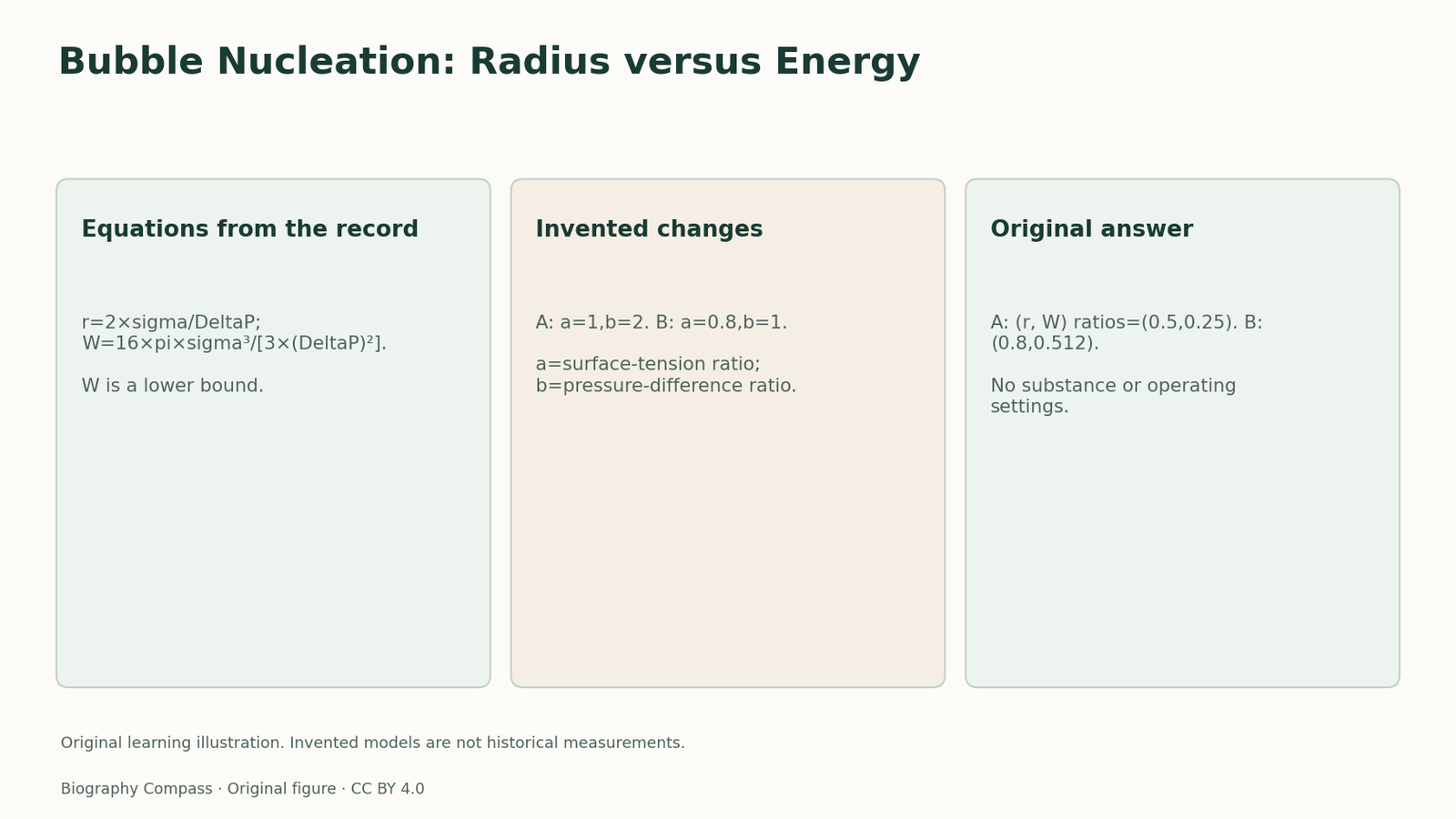
Glaser sought dense material in which particle tracks could be photographed, with rapid cycling. His lecture gives critical radius r=2×sigma/DeltaP and reversible-formation energy W=16×pi×sigma³/[3×(DeltaP)²]. It calls W a lower bound.
The equations are a preliminary physical argument, not a complete account of how deposited energy creates an observable track. Glaser questions the microscopic mechanism.
Sources for this section: [1]
Define dimensionless changes
Here sigma is liquid–vapour surface tension and DeltaP is internal vapour pressure minus applied external pressure.
Compare only positive values. Let a be the new-to-old surface-tension ratio and b the new-to-old pressure-difference ratio. From the inspected equations, the radius ratio is a/b and the energy-bound ratio is a³/b². The exercise supplies ratios only, with no actual substance, temperature, pressure or radiation source.
Sources for this section: [1]
Two invented changes, two different responses
Scenario A keeps surface tension fixed and doubles the pressure difference: a=1,b=2. Scenario B reduces surface tension to 80% and leaves the pressure difference fixed: a=0.8,b=1. Find both output ratios. A draft answer says that halving radius necessarily halves W. Is it correct?
Reference answer: A gives radius ratio 1/2 and W ratio 1/4. B gives radius ratio 0.8 and W ratio 0.512. The draft claim is false: the two outputs involve different powers of the inputs. Their response cannot be inferred from the radius change alone.
As a further consistency check, choose a=2,b=2. Radius is unchanged, but W doubles. Keeping one output constant therefore does not fix the other. All these numbers are invented sensitivity cases derived from the stated idealisation.
Sources for this section: [1]
A bound is not an efficiency measurement
Even a correct relative calculation does not say that a real particle deposits sufficient useful energy, that the process follows a reversible path or that a visible track will form. Do not relabel W as measured detection efficiency. The lesson concerns what two equations imply under stated assumptions, and why experiments remain necessary beyond that implication.
Sources for this section: [1]
Continue the chronology
Related history guides
Biography context
Explore United States through connected lives
Connected biographies
The researcher behind the record
1926–2013
Donald Glaser
Experimental physicist and biologistBubble chambers, biology and vision.Read biographyQuick answers
Common questions
- Is W the energy a real track necessarily deposits?
- It is a lower bound, not measured efficiency.
- Can these ratios specify a detector setting?
- No. No actual operating inputs or practical implementation are provided.
Primary and institutional sources
How this history was checked
Selected original records are identified below. Invented inputs and calculations are labelled separately from historical observations. This article was reviewed on 31 October 2026.