
The short answer
A film can address a political rupture through a family, a workplace or an obstructed journey. This guide asks how an archive’s grouping and a critic’s account support that kind of historical interpretation without turning fiction into a factual chronicle.
Evidence and interpretation
What each record adds
Compare the production task and the authority behind its description.
| Record | Supported finding | Further question |
|---|---|---|
| Archive programme | Thematic grouping around Partition. | What historical problem connects the works? |
| Critical account | An image can embody a broken connection. | How does a formal choice create dramatic pressure? |
Chronology
A timeline of the turning points
A film in the grouping
The Cloud-Capped Star.
Another film in the grouping
E-Flat.
Archive programme
Harvard grouped the films through politics and melodrama.
A grouping makes an argument
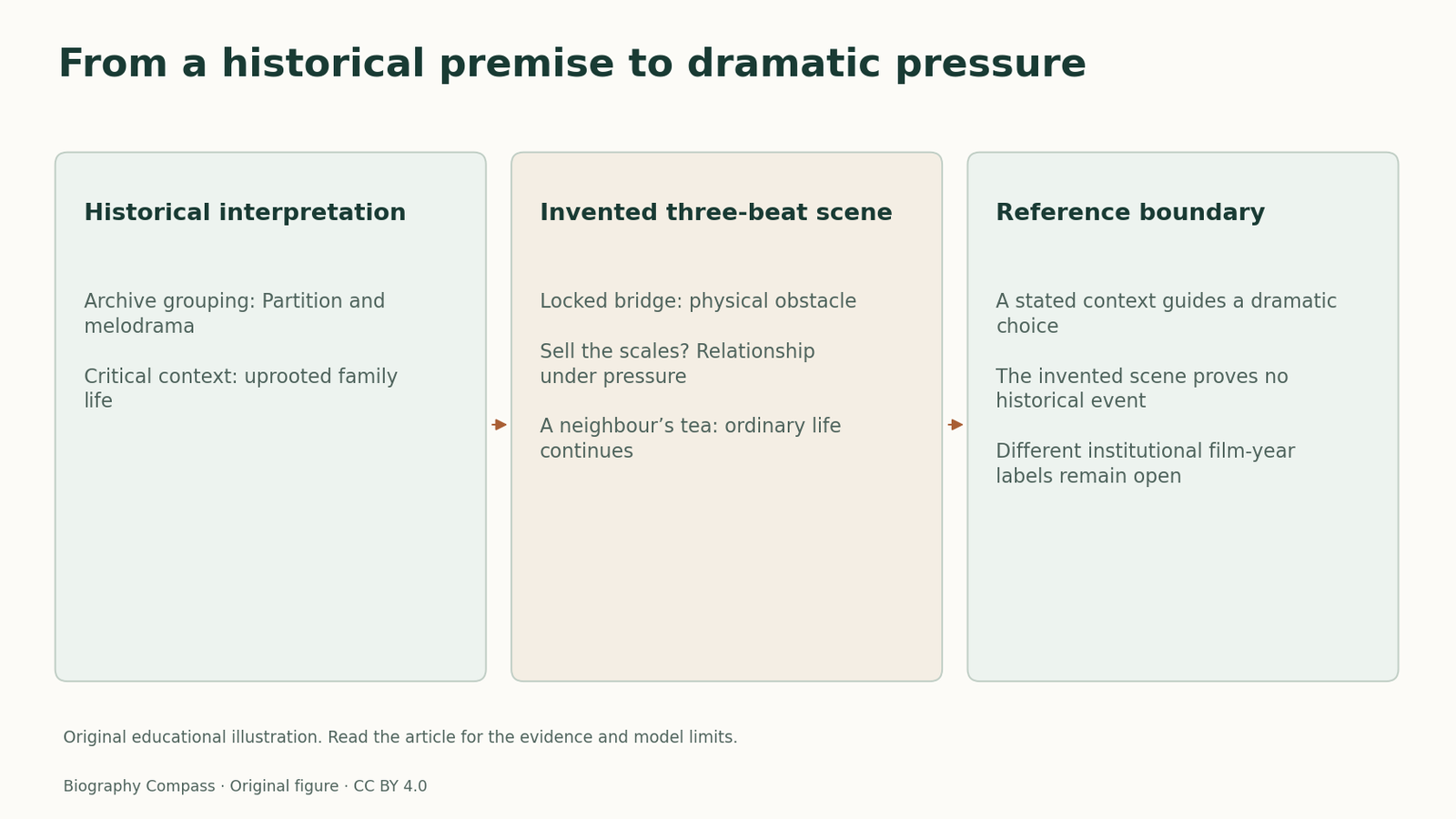
The 1947 Partition divided Bengal and displaced families. Harvard’s 2008 programme describes The Cloud-Capped Star, E-Flat and The Golden Line as films sometimes called a Partition trilogy. It connects Ghatak’s activism with melodrama, song and dance, and with characters who have been uprooted.
Sanghita Sen’s BFI account similarly identifies the grouping and describes the refugee family at the centre of The Cloud-Capped Star. The agreement supports a thematic connection. It does not mean the films are three documentary instalments recording successive stages of one event.
Form and a difficult archival comparison
Megan Carrigy quotes Ghatak’s statement about a severed railway route raising a character’s distress, with a reference to his “My Films” essay. That is mediated testimony: the selected quotation and its citation were read here, not the whole essay or the corresponding film passage.
Harvard labels The Golden Line 1962, whereas the BFI article uses 1965 for Subarnarekha. The records do not state enough to resolve these labels into exact completion, certification and release events. The difference remains open. It does not invalidate the distinct finding that both institutions connect the work to Partition.
Original history-to-drama exercise
Invented context: a border has interrupted a family’s ordinary route to market. A new permit office operates in another town. Write a three-beat scene with one physical obstacle, one relationship under pressure and one sign of continued ordinary life. Do not add a speech explaining the entire political history. Then distinguish the contextual premise from what the scene itself could establish.
Reference answer: first, a trader arrives at a bridge whose gate is locked. Next, an adult child asks whether they should sell the family scales to pay for the longer journey, while the trader refuses to answer. Finally, a neighbour offers tea and asks to borrow the scales for the following morning. The locked route and money problem connect the supplied border premise with choices inside a relationship; the offer keeps ordinary life present. The scene is invented and establishes no actual permit system, border event or Ghatak shot. Its value is the reasoning from a stated context to concrete dramatic pressures, not a claim that emotion alone proves historical fact.
Continue the chronology
Related history guides
Biography context
Explore Bengal and its diasporas through connected lives
Connected biographies
Creative lives behind the records
1925–1976
Ritwik Ghatak
Filmmaker, writer and teacherGhatak brought theatre, political commitment and formal experimentation into Bengali cinema.Read biographyQuick answers
Common questions
- Does historical interpretation make a fictional scene documentary evidence?
- No. A supported context can guide interpretation, but a fictional event does not establish that its equivalent happened. The supplied exercise is wholly invented.
Primary and institutional sources
How this history was checked
Read the linked credits and participant accounts alongside the original task. Dates identify the stated object or event; the exercise inputs are invented. This article was reviewed on 31 October 2026.