
The short answer
What can a painting preserve about a place before a later history changes its public meaning?
Read the evidence
Sources, interpretation and production roles
The records answer different questions about this work. The final exercise is an original teaching model.
| Record or question | Supported reading | Boundary or contrast |
|---|---|---|
| City collection account | Documents the 1940 JAG acquisition and its local first. | The claim is specific to that institution. |
| Career/archive records | Show other cities and a long French practice. | One early painting does not define all later work. |
| Original two-path model | Connects pictured environment and collecting history. | It is not a reconstruction of every resident’s life or every display. |
A street enters a collection
Yellow Houses, A Street in Sophiatown is a 1940 work by Gerard Sekoto. The City of Johannesburg identifies its purchase as the first acquisition of a work by a Black artist for Johannesburg Art Gallery. That is a specific institutional claim. It should not be expanded into an unsupported assertion about every museum in the world, or treated as proof that collecting became equitable from that moment onward.
Sources for this section: [3]
The pictured place and the collecting event
The title identifies Sophiatown, a setting important to Sekoto’s early urban painting. The purchase identifies a different setting: a public collection with its own history of selection and exclusion. Holding the two together produces a richer account than either a simple street description or a congratulatory acquisition milestone. An artist’s depiction of a lived place becomes an object through which an institution can change, preserve or narrow its account of modern art.
One early picture within a changing career
Sekoto later worked in Cape Town, Pretoria and France. His foundation stresses the difference between pre-exile and later production, while the Wits collection preserves drawings across many years. Yellow Houses should therefore be introduced as a particular early work, not a permanent formula to which everything he made must conform. The changing career also explains why later catalogue and archive work matters: public familiarity may centre on only a small portion of the surviving art. The later recovery of photographs of early works adds another audience: the artist himself could look back across exile at an earlier practice. That encounter differs from an assumption that his style simply remained unchanged abroad.
Original exercise: write two connected histories
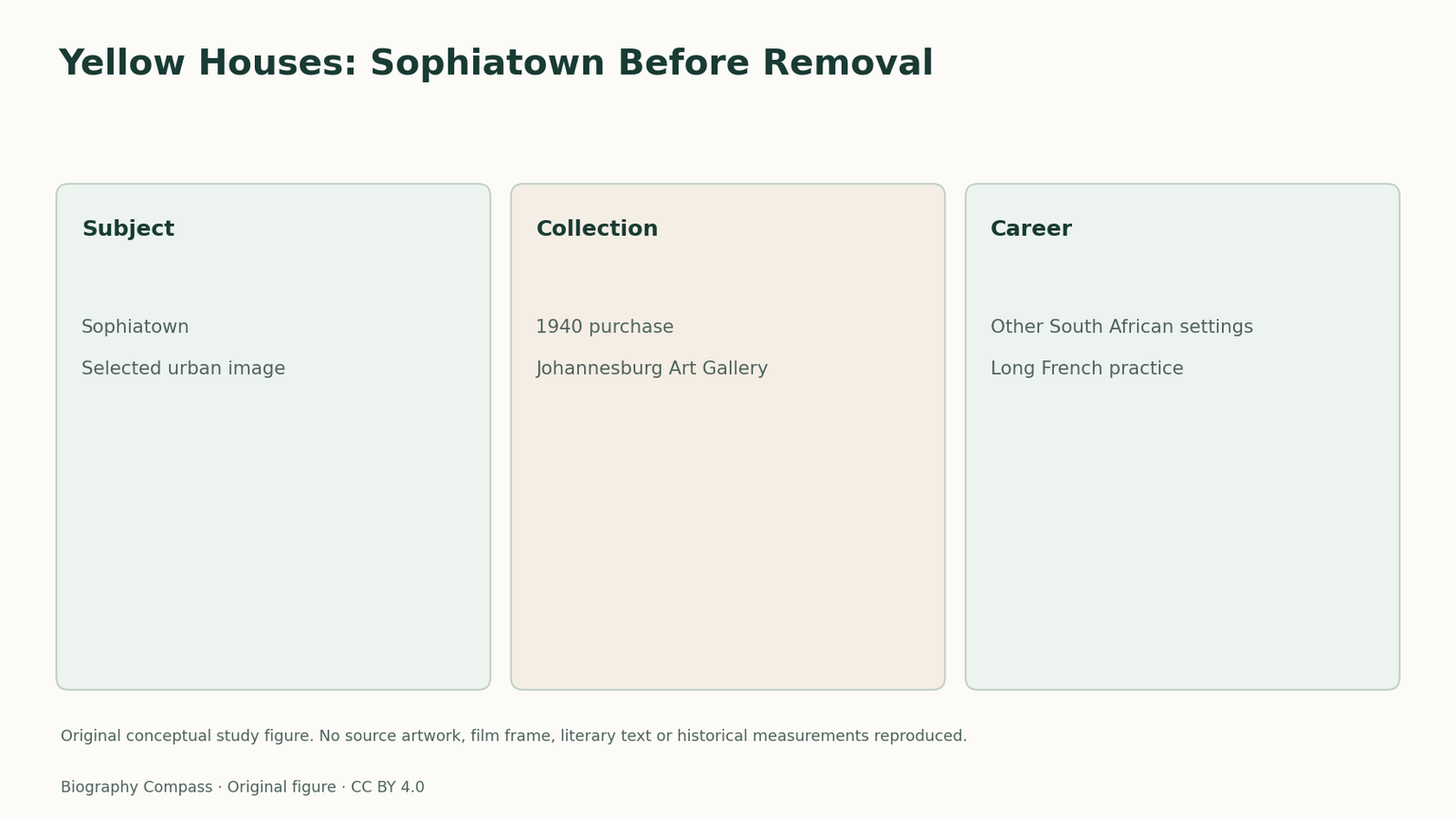
Make two text-only paths. The first follows a place as represented: Sophiatown, a selected street subject, a painted image. The second follows an institutional decision: an artist’s work, a 1940 purchase, later public interpretation. At their meeting point put the title Yellow Houses. A reference answer explains that the painting connects these paths without making them identical. Ask which claim each source can support. The city record establishes the acquisition; biographical sources explain the artist’s changing places and career; the foundation helps situate the early work within a longer practice. Add one sentence about what remains outside the model: it does not reconstruct every inhabitant’s experience or the exact moment at which every visitor saw the painting. The exercise’s main result is positive: a single object can preserve a relation between lived environment, artistic selection and public collecting. It also makes comparisons with later South African artists more precise, because similarities in urban subject matter need not mean identical access to institutions or the same working conditions.
Continue the chronology
Related history guides
Biography context
Explore South Africa through connected lives
Connected biographies
People and related creative practices
1913–1993
Gerard Sekoto
South African painter and musicianGerard Sekoto left teaching for painting, developed important urban images in South Africa and continued making art and music after moving to France.Read biography1930–2018
David Goldblatt
PhotographerA South African photographer who examined everyday places as material evidence of social and political structures.Read biography1904–2002
Ernest Mancoba
South African artist working in sculpture, painting, drawing and printErnest Mancoba moved from carved figures in South Africa into a long European career, developing an independent practice across sculpture, painting and drawing.Read biographyQuick answers
Common questions
- What “first” is documented for Yellow Houses?
- The municipal account identifies it as the first work by a Black artist acquired by Johannesburg Art Gallery.
Primary and institutional sources
How this history was checked
Sources include production records, institutional collections and the specifically identified passages discussed here. Interpretations and teaching models are distinguished from credits and publication facts. This article was reviewed on 8 November 2026.