
The short answer
How do yellowwood, a Christian commission and an African figure meet in Mancoba’s1929sculpture?
Read the evidence
Sources, interpretation and production roles
The records answer different questions about this work. The final exercise is an original teaching model.
| Record or question | Supported reading | Boundary or contrast |
|---|---|---|
| Catalogue inscription | Supports 1929 and identifies the yellowwood object. | A conflicting 1928 profile date is not silently adopted. |
| Commission/provenance | Connects chapel, later transfer and 1994 museum purchase. | A museum setting does not replace the original commission history. |
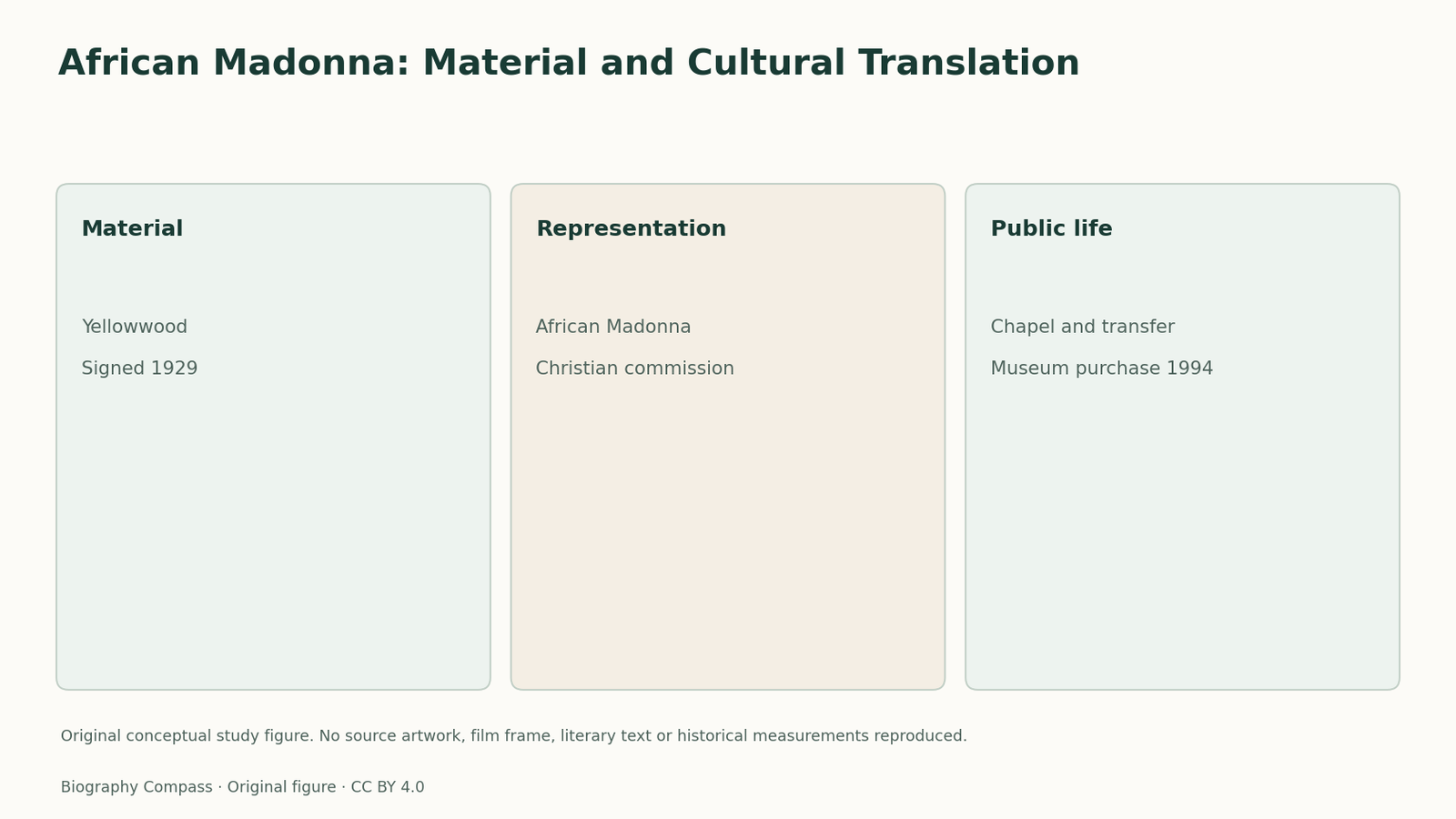
| Original three-box model | Separates material, representation and audience. | It reproduces no sculpture and invents no undocumented symbolism. |
A dated sculpture, not an approximate legend
The catalogue raisonné identifies African Madonna as a 1929 yellowwood sculpture and records a dated inscription on the base. It also lists Bantu Madonna and Black Madonna among titles used for the work. This object-specific evidence is stronger for dating than a later exhibition profile’s isolated 1928 reference. The distinctions matter because the sculpture’s importance should not depend on a repeated but unstable origin story.
A Christian commission with an African figure
The recorded first setting was St Mary’s Chapel at Grace Dieu Diocesan Training College. The curatorial account explains the significance of presenting the Madonna as an African woman and using local yellowwood. Material and figure therefore participate in a translation within a Christian commission. The work is not adequately described either as a European model in different wood or as an object outside the religious setting for which it was made.
A changing public location
The catalogue traces a transfer around 1953 to the Anglican Sisters of the Holy Paraclete in Manzini and a 1994 purchase by Johannesburg Art Gallery. Those movements alter the audience and the kinds of questions brought to the sculpture. The image can become a museum work associated with African modernism while retaining its chapel history. A change in institutional setting does not erase the previous role; it adds another chapter to the object’s public life. The dated inscription is another physical relationship between making and later cataloguing. It anchors the early object even when its title and institutional setting change, letting the reader distinguish those histories rather than collapse them.
Original exercise: three translations
Create three text boxes labelled material, figure and setting. Under material place yellowwood; under figure place African Madonna; under setting place chapel, then later museum. A reference answer explains that the first concerns the physical medium, the second the representational choice and the third the work’s use and audience. Ask which relationship would be lost by describing the object only as “religious sculpture”. A supported response says that the general label leaves out the specific material and the cultural terms of representation. Now ask what is lost by calling it only a museum masterpiece. That label leaves out the commission and earlier community setting. The model makes the sculpture’s achievement concrete without copying its form or assigning an undocumented intention to every carved fold. It also allows a comparison with Mancoba’s later abstraction: the continuity can be a concern with human relation rather than a requirement that all later work retain the Madonna’s figure or material. The sculpture is an early, specific solution within a much longer practice.
Continue the chronology
Related history guides
Biography context
Explore South Africa through connected lives
Connected biographies
People and related creative practices
1904–2002
Ernest Mancoba
South African artist working in sculpture, painting, drawing and printErnest Mancoba moved from carved figures in South Africa into a long European career, developing an independent practice across sculpture, painting and drawing.Read biography
active since the 20th century
Esther Mahlangu
Painter and muralistA South African artist who took skills learned in Ndebele house painting into murals, exhibitions and commissions on new surfaces.Read biography1913–1993
Gerard Sekoto
South African painter and musicianGerard Sekoto left teaching for painting, developed important urban images in South Africa and continued making art and music after moving to France.Read biographyQuick answers
Common questions
- Why use 1929 for the sculpture?
- The catalogue records a 1929 inscription on the base, providing object-specific support for that date.
Primary and institutional sources
How this history was checked
Sources include production records, institutional collections and the specifically identified passages discussed here. Interpretations and teaching models are distinguished from credits and publication facts. This article was reviewed on 8 November 2026.
- Ferlov Mancoba FoundationErnest Mancoba
- Ferlov Mancoba Foundation, catalogue by Winnie SzeAfrican Madonna, S.001
- Pitzer College, Ntongela MasilelaErnest Mancoba: A New African Artist
- Södertälje KonsthallA citizen of the world long before globalization?
- Centre PompidouErnest Mancoba 2019 exhibition
- Fundação Bienal de São PauloErnest Mancoba profile