
The short answer
How do the 1960 and 1971 paintings stage different relationships between a returning son and his family?
Read the evidence
Sources, interpretation and production roles
The records answer different questions about this work. The final exercise is an original teaching model.
| Record or question | Supported reading | Boundary or contrast |
|---|---|---|
| 2018 loan list | Identifies the 1960 watercolour as a distinct object. | It is not the 1971 oil painting. |
| University close reading | Contrasts authority, supplication and open-armed welcome. | Qualified emotional readings remain interpretations. |
| Original staging study | Compares two possible moments within a return. | It does not reproduce either painting or infer an unsupported personal conversion. |
One story, two painted arrangements
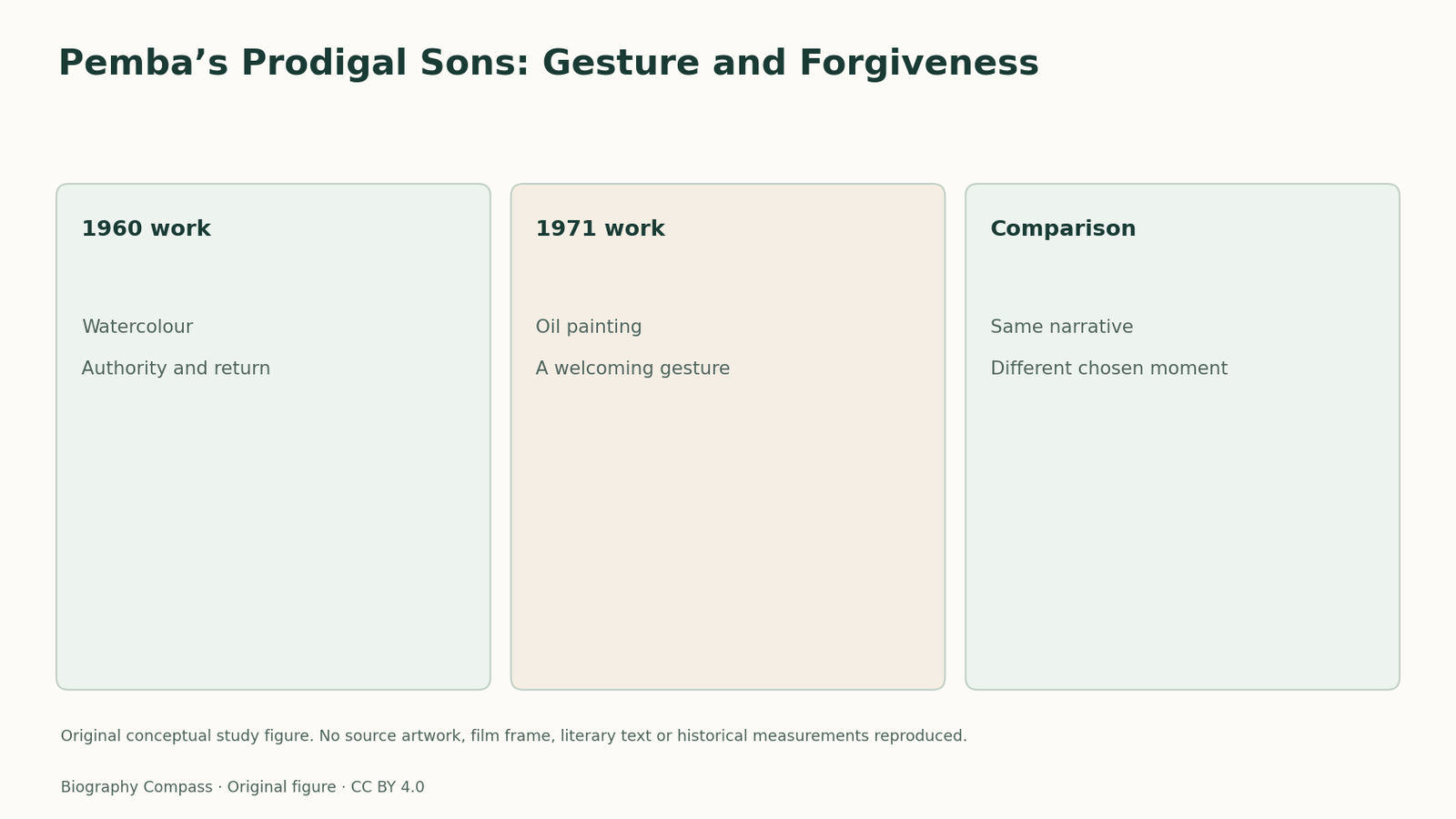
George Pemba returned to the prodigal-son theme in different works. The University of Fort Hare loan list identifies The Return of the Prodigal Son of 1960 as a watercolour. Andrew Mulenga’s university essay compares it with a 1971 oil painting. The titles connect them with the biblical story, but the different dates, media and arrangements make them separate works rather than interchangeable reproductions of one composition.
Authority before welcome
In the essay’s account of the 1960 work, the returning figure appears before older male authority. The relationship is not described as an already completed embrace: reprimand and possible forgiveness remain in tension. This is a useful reading of how a familiar narrative can be staged at a particular emotional moment. Recognising the source story does not remove the need to examine which part of a return the painter makes visible.
Sources for this section: [3]
The 1971 family group
The later painting is described through the father’s outstretched arms, the son’s supplicatory posture and other family members awaiting the encounter. The essay treats some identifications and emotions as possibilities, not recovered statements from each depicted person. The comparison therefore supports a concrete distinction between different gestures of authority and welcome. It does not establish a simple claim that the artist’s own beliefs changed in exactly the same direction between 1960 and 1971. The two media also make this a comparison between objects, not a before-and-after sequence of photographic frames. A changed gesture belongs to a newly made work, whose relation to the earlier image needs to be described.
Sources for this section: [3]
Original exercise: stage the next moment
Write a short plan for two imaginary scenes using only plain stick figures or words. In Scene A a returning person stands before seated authority; in Scene B someone reaches towards the returner. Ask what each arrangement leaves unresolved and what action could follow. A reference answer says A may keep judgement open, whereas B offers a visible movement towards welcome, while neither supplies the whole story by itself. Relate the model to the essay’s specific comparison without copying Pemba’s figures, furniture or colour. Then add the medium and date to each real work’s label. The exercise connects interpretation with object identity: a viewer can explain a difference in gesture while remembering that watercolour and oil are separate material works made eleven years apart. A final question asks whether the title alone proves that the same emotional moment is pictured. A supported answer says no. A shared narrative can support several moments, relationships and degrees of resolution, and Pemba’s repeated theme makes those differences available for comparison.
Continue the chronology
Related history guides
Biography context
Explore South Africa through connected lives
Connected biographies
People and related creative practices
1912–2001
George Pemba
South African painter, teacher and playwrightGeorge Pemba sustained a painting career through teaching, family support and racial exclusion, making portraits and social, religious and everyday scenes.Read biography
1955–
William Kentridge
Visual artist, filmmaker and theatre and opera directorWilliam Kentridge moves between drawings, projected images and live performance. His Johannesburg background informs work about apartheid, colonialism and memory, but an erased charcoal mark or an unresolved theatrical scene often complicates the story rather than delivering a single political message.Read biography1913–1993
Gerard Sekoto
South African painter and musicianGerard Sekoto left teaching for painting, developed important urban images in South Africa and continued making art and music after moving to France.Read biographyQuick answers
Common questions
- Are the 1960 and 1971 prodigal-son pictures the same painting?
- No. The inspected records identify a 1960 watercolour and a separate 1971 oil painting.
Primary and institutional sources
How this history was checked
Sources include production records, institutional collections and the specifically identified passages discussed here. Interpretations and teaching models are distinguished from credits and publication facts. This article was reviewed on 8 November 2026.