
The short answer
How did a privately funded school’s foundation differ from later government support?
Read the records together
Contributions,evidence and scope
Different records illuminate different parts of this particular undertaking.
| Record | What the record establishes | What remains distinct |
|---|---|---|
| Founder’s institutional history | Explains migration and the 1885 educational initiative. | Commemoration is not independent proof of every anecdote. |
| School governance account | Separates land, building, trustees and 1938 takeover. | Public assistance and public operation are not identical. |
| Heritage marker | Confirms foundation and later premises. | Its namingdate differs from another schoolsummary. |
Foundation and a new building were different events
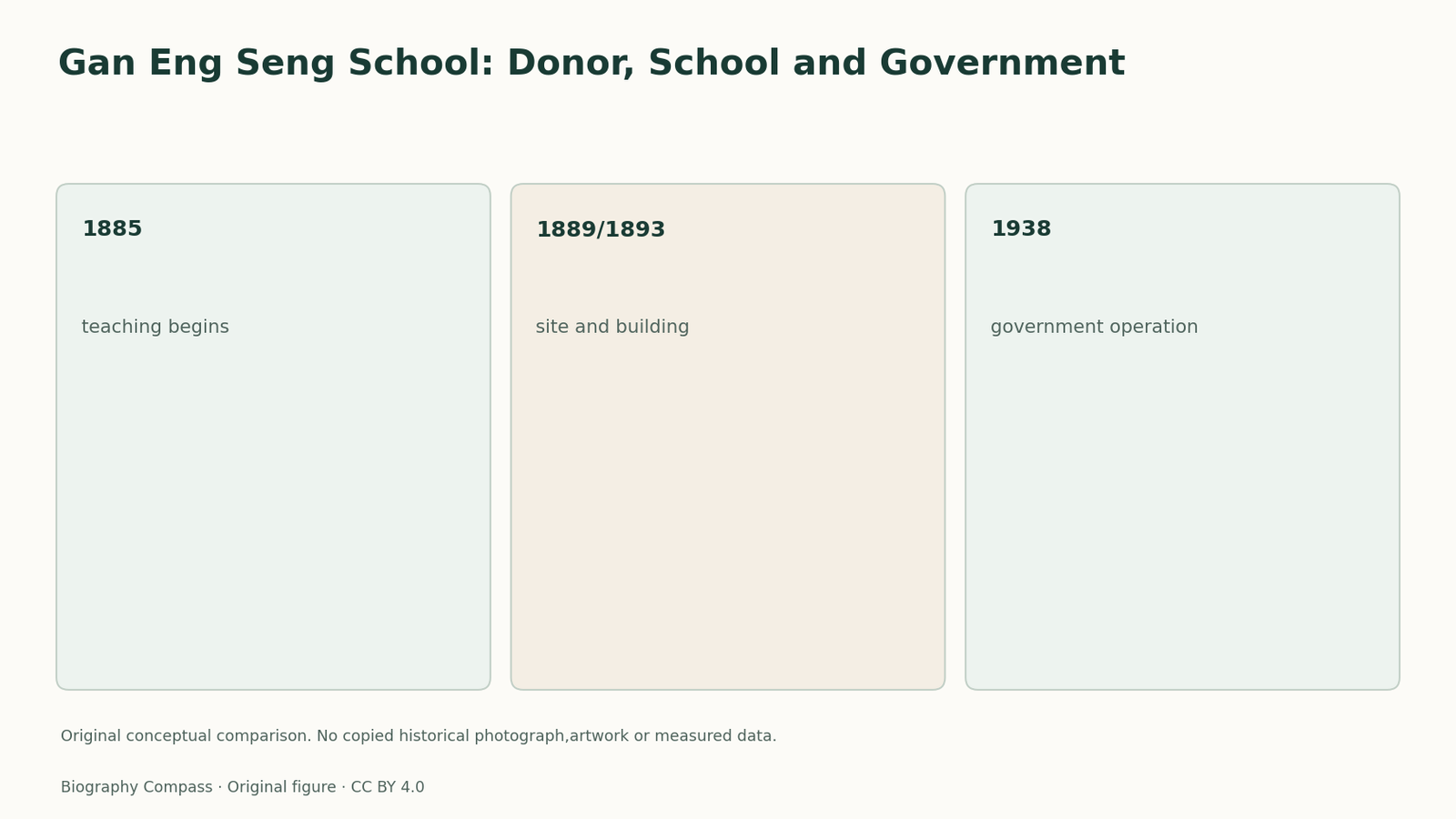
Gan’s free school began in 1885 in shophouses in Tanjong Pagar. In 1889 the government provided a site at Telok Ayer Street, and Gan paid for a new building that opened in 1893. This sequence makes the partnership specific. A privately initiated school could receive public land without immediately becoming a government-operated institution. The difference is easy to miss if every milestone is reduced to the year on a later commemorative plaque. Here, the foundation concerns the start of teaching, the site concerns land, and the opening concerns new premises.
Free bilingual teaching was an operating arrangement
The school’s history describes English and Chinese teaching during the founder’s lifetime. It also records later changes, including the charging of fees after financial difficulties. Free education therefore depended on continuing resources rather than on a name alone. A donor’s decision to make schooling accessible could begin an institution, but staff, materials and premises still had recurring costs. This explanation connects the recorded changes without asserting that every pupil’s experience was identical. It also distinguishes the language of instruction from the question of whether families paid fees: they are separate features of a school’s operation.
Government takeover followed a later financial problem
The school account states that trustees could not finance major urgent repairs in 1937, and government operation followed in 1938. That was a different kind of public involvement from the earlier grant of a site. It should not be assigned to Gan, who had died decades earlier. The distinction provides a useful institutional history: private foundation, public assistance, trustee management and government operation can be successive or overlapping arrangements rather than one simple category. The separate naming-date disagreement in heritage summaries is retained as unresolved; it does not prevent the better-supported funding and governance sequence from being explained.
Use four milestone cards
Write 1885 foundation,1889 site,1893 building opening and 1938 government operation on separate cards. Match each to the decision or resource it describes. The checked answer to “did the 1889 site grant make every subsequent school decision a government decision?” is no: the later trustee history and 1938 transition remain distinct. Next, compare teaching language with fee policy in two columns. This original exercise introduces no invented pupil numbers, budget or classroom experience. It shows why a school’s value cannot be explained by its founder’s biography alone: continuing teaching required changing institutions and resources long after the original gift.
Continue the chronology
Related history guides
Singapore Medical School 1905: Petition and Funding
Follow the petition, subscriptions and public support behind Singapore’s 1905 medical school, distinguishing founding gifts from recurring operating funds.
Read the timeline1890s–1900sStraits Chinese Association: Membership and Service
Explore the Straits Chinese British Association’s founding and activities, keeping its work distinct from related magazines, schools and later organisations.
Read the timelineBiography context
Explore Singapore through connected lives
Connected biographies
People behind this work
1844–1899
Gan Eng Seng
Merchant and educational philanthropistGan Eng Seng is remembered for founding Singapore’s Anglo-Chinese Free School, the institution later known as Gan Eng Seng School.Read biography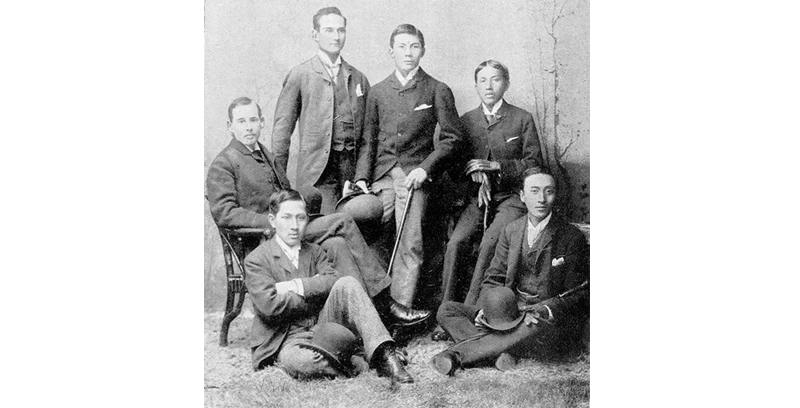
1869–1957
Lim Boon Keng
Straits Chinese physician, entrepreneur and educational reformerLim Boon Keng combined medical practice with rubber, banking, publishing and educational work, while navigating the competing political loyalties of a Straits Chinese public figure.Read biography1805–1883
Seah Eu Chin
Merchant and Teochew community organiserSeah Eu Chin combined a successful gambier-trading career with Teochew community organisation, helping establish the institution that became Ngee Ann Kongsi.Read biographyQuick answers
Common questions
- Did Gan’s school become government-run in 1889?
- No. The 1889 site grant and 1893 building opening preceded the distinct 1938 government takeover.
Primary and institutional sources
How this history was checked
The cited records distinguish contemporary accounts,official catalogues and later institutional or scholarly interpretation. The comparison and worked exercise are original editorial material. This article was reviewed on 7 November 2026.