
The short answer
A policy statement can establish a government’s commitment and proposed tools. It cannot, by itself, establish every later result or explain what caused it.
Documentary comparison
Promise, preparation and measurement
Match the conclusion to the record and its specific purpose.
| Record or test | What it establishes | Limit |
|---|---|---|
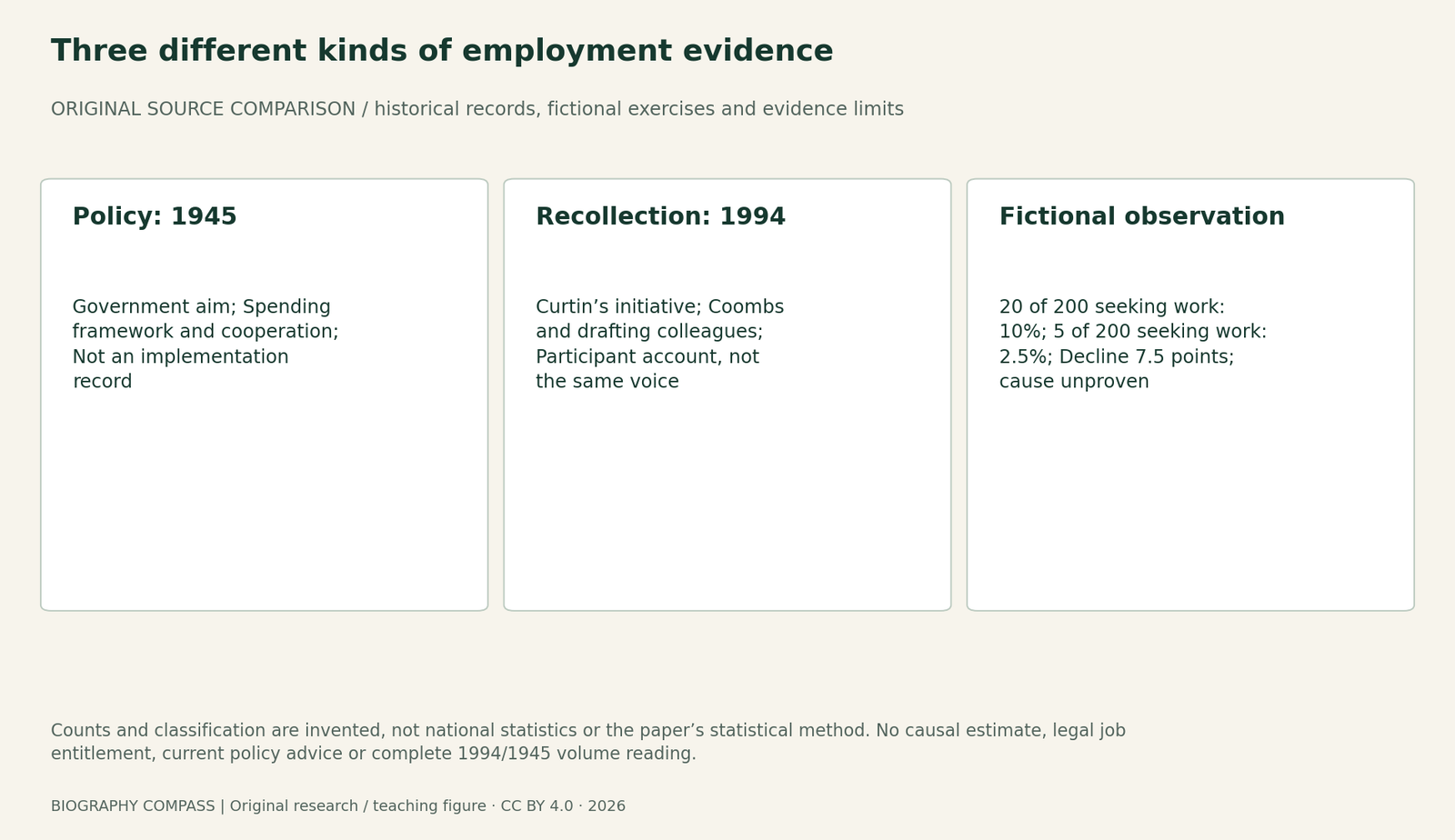
| 1945 paper | Government aim, proposed tools and cooperation | Not the complete evidence of later implementation or outcomes. |
| Coombs 1994 | Participant recollection of initiative and drafting | Not identical to the contemporary public policy text. |
| Fictional two-observation table | A change from 10% to 2.5% under stated assumptions | Not historical data or proof of a causal policy effect. |
Chronology
A timeline of the turning points
Government policy
Full Employment in Australia sets out an aim and proposed approach.
Chifley sworn in
The reconstruction work preceded his premiership.
Retrospective account
Coombs recalls preparation and reproduces the earlier paper.
Two historical voices in one volume
The ANU volume From Curtin to Keating, published in 1994 by H. C. Coombs, contains his retrospective account and an appendix reproducing the 1945 White Paper on full employment. Their dates and purposes differ. Coombs was recalling the creation of a policy; the appendix presents the policy’s public formulation. Neither should be silently substituted for the other.
On the inspected opening pages, Coombs credits John Curtin’s initiative and the Ministry of Post-War Reconstruction, which he directed. He names Gerald Firth, Lloyd Ross and Fin Crisp among the drafting group. His account also discusses Chifley’s practical approach to the ministry. That participant perspective helps reconstruct collaboration without making the paper a document authored by Chifley alone.
Sources for this section: [1]
The policy described responsibility and cooperation
The 1945 introduction identified full employment as a central government aim and sought cooperation from unions, employers, servicemen’s organisations and state and local authorities. It contrasted prewar unemployment with wartime mobilisation, while recognising that peacetime employment had to be pursued consistently with a free society.
The paper proposed government responsibility for stimulating spending sufficiently to sustain employment. It described a framework in which individuals and private businesses could operate, and rejected work created merely for its own sake. These are more specific propositions than either “government would employ everyone directly” or “government would leave employment entirely to private choices.”
Sources for this section: [1]
A public commitment is not an outcome series
The language establishes an intention and a proposed approach. It does not, simply by existing, supply later unemployment rates, prove that every administrative measure was implemented, or establish the causal contribution of a particular policy. The inspected pages also discuss efficiency, training and resource limits, rather than presenting employment as an isolated number.
Chifley’s archival biography places this work within wartime finance and reconstruction, preceding his July 1945 appointment as prime minister. A later ministry or programme may be relevant to implementation, but it requires its own dated evidence. Coombs’s recollection is valuable testimony about preparation; it is not a substitute for a complete statistical or administrative record of the postwar years.
Original exercise: calculate, then limit the claim
For a fictional locality, define the exercise labour force as employed people plus people available for and seeking work. At the first observation there are 180 employed and 20 seeking work; at the second there are 195 employed and 5 seeking work. Assume the same 200 people remain in the labour force and that these categories are exhaustive for the exercise. Calculate the seeking-work share at each observation and the percentage-point change.
Now assess three labels: A, “The paper stated a government commitment”; B, “The fictional table shows a lower seeking-work share”; C, “The change proves the 1945 paper caused the improvement.” Identify the evidence supporting each, and the additional records needed for the strongest claim. The numbers and definitions are teaching assumptions, not reconstructed Australian statistics or the paper’s own statistical method.
Sources for this section: [1]
Worked answer: observation and causation differ
The first share is 20÷200=10 percent; the second is 5÷200=2.5 percent. The decline is 7.5 percentage points. Label A is supported by the policy text. Label B is supported by the stipulated fictional observations. Label C is not established: the exercise supplies no evidence isolating the paper’s influence from other changes, nor any actual implementation record.
To investigate a real outcome, seek dated employment series with consistent definitions, records of implemented measures and evidence about other economic conditions. The original policy, a participant’s retrospective account and a measured result answer different questions. Keeping them distinct allows the paper’s ambition and collaborative preparation to be understood without turning either a promise or a simple before-and-after comparison into proof of complete success.
Sources for this section: [1]
Continue the chronology
Related history guides
Who Could Vote Under the 1902 Franchise Act?
Read the original Commonwealth Franchise Act 1902 to distinguish women’s inclusion, voting qualifications, racial exclusions and its constitutional exception.
Read the timeline1950–1951Why Did the 1951 Communism Referendum Fail?
Compare the 1951 communism referendum and court chronology, then test how fictional vote switches affect national and state majorities separately.
Read the timelineBiography context
Explore Australia through connected lives
Connected biographies
People in this history
1885–1951
Ben Chifley
Railway unionist, treasurer and prime ministerBen Chifley moved from railway work and union advocacy into public finance, wartime administration and the leadership of Australia’s postwar Labor government.Read biographyQuick answers
Common questions
- Does this exercise reproduce the official 1945 unemployment rate?
- No. Its locality, counts and definitions are invented and explicitly stated.
- Was the paper solely Chifley’s work?
- No. Coombs describes Curtin’s initiative, the reconstruction ministry and a research drafting group.
Primary and institutional sources
How this history was checked
Read the dated records alongside their purposes, qualifications and limits. This article was reviewed on 28 October 2026.