
The short answer
The Act widened federal participation while preserving significant exclusions. Its clauses need to be read together rather than reduced to a single suffrage milestone.
Documentary comparison
Five clauses perform different jobs
Match the conclusion to the record and its specific purpose.
| Record or test | What it establishes | Limit |
|---|---|---|
| Section 2 | Defines an exception to application during the existing House | Not every by-election was governed by the new Act. |
| Section 3 | General qualifications include sex-neutral wording | Not universal eligibility for every adult resident. |
| Sections 4–5 | Disqualifications, a constitutional exception and one-vote rule | Individual constitutional entitlement needs further evidence. |
Chronology
A timeline of the turning points
Assent
The original Act records assent and its application limits.
Qualifications
Section 3 includes men and women subject to its conditions.
Exclusions and conduct
Sections 4 and 5 impose disqualifications and prohibit multiple voting.
Begin with the enacted document
The Commonwealth Franchise Act 1902 received assent on 12 June 1902. Its opening section linked it with the Commonwealth Electoral Act 1902. Section 2 also limited its application: it would not affect an election to fill a House vacancy during the continuance of the existing House. Even a short franchise law therefore had a temporal boundary, as well as rules about people.
The inspected original is only two pages. Its first page identifies the Act, assent and application provision; the second contains qualifications, disqualifications and the rule against multiple voting. A historical caption should keep these parts together. A later account of women gaining the federal vote is a useful starting point, but does not reproduce every statutory condition.
Inclusion was subject to qualifications
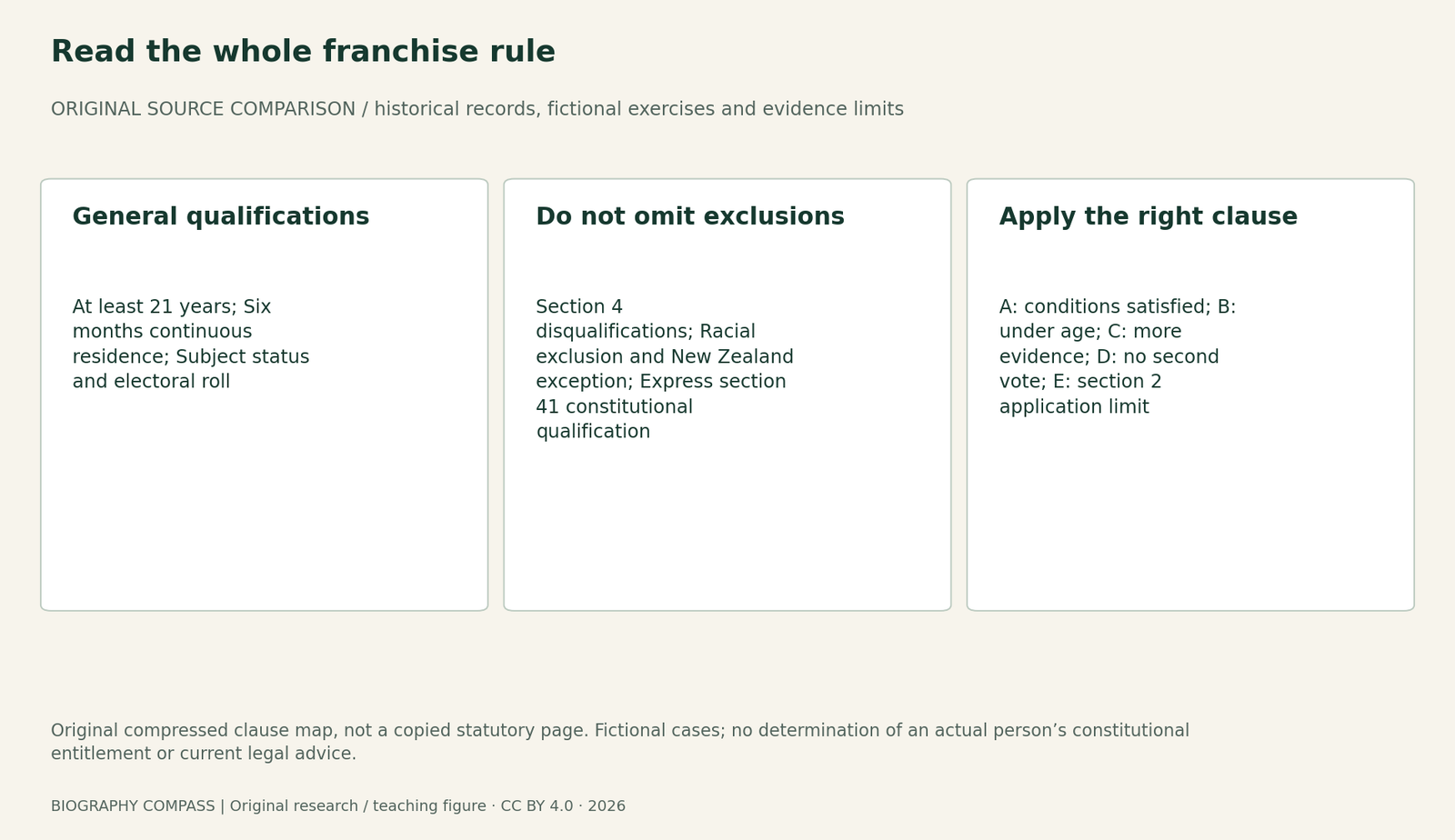
Section 3 applied its general qualifications to men and women, whether married or unmarried. It required a person to be at least 21, to have lived continuously in Australia for six months, to be a natural-born or naturalised subject of the King, and to be on an electoral roll. It began by making entitlement subject to the disqualifications that followed.
This was an important change in federal representation, but it was not a statement that every woman or every adult resident automatically became eligible. Nor should its subject-status language be silently replaced by present Australian citizenship rules. The original text concerns a particular imperial and federal constitutional setting.
Sources for this section: [1]
Exclusions and an exception remained in the text
Section 4 imposed several disqualifications, including those concerning mental status, treason and specified criminal sentences. It also excluded people through racial categories directed at Indigenous Australians and people described as natives of Asia, Africa and the Pacific islands, with New Zealand excepted. Those historical categories record the law’s discrimination; they are not categories endorsed by this guide.
The racial provision expressly preserved entitlement under section 41 of the Constitution. That qualification must not disappear from a summary. The Act alone does not settle every person’s possible constitutional entitlement, and this guide does not adjudicate the relevant case law. Section 5 separately prohibited voting more than once at the same election. Eligibility and permitted conduct at an election were different questions.
Sources for this section: [1]
Worksheet: repair five fictional case labels
Assume these are invented teaching cases. A is a 25-year-old woman who satisfies the residence, subject-status and roll conditions and none of the disqualifications. B has the same circumstances but is 20. C is an Indigenous Australian whose possible section 41 entitlement has not been researched. D satisfies all qualifications but proposes to vote twice at the same election. E concerns a House by-election during the continuance of the House existing when the Act passed.
For each, choose the appropriate label: general conditions satisfied; age condition failed; constitutional entitlement needs further evidence; multiple voting prohibited; or this Act does not affect that election. Then explain why “all adult women could vote immediately” does not accurately summarise these five cases. The cases are fictional, not judgments about named historical people.
Sources for this section: [1]
Worked answer and the larger political context
A satisfies the stipulated general conditions. B fails the 21-year age threshold. C requires research into the express constitutional exception; neither automatic inclusion nor automatic exclusion is justified by the information given. D’s second vote is prohibited by section 5. E falls within section 2’s application limit, so this Act does not determine that by-election’s franchise.
The proposed universal caption leaves out residence, subject status, enrolment, disqualifications and the Act’s application rule. Barton’s government and Deakin’s legal work helped build national institutions, but the original franchise shows that political inclusion was unequal. Reading the operative clauses preserves both the expansion of women’s participation and the discrimination within the same settlement. It also identifies what further records would be needed before making a claim about an individual voter.
Continue the chronology
Related history guides
Why Did the 1951 Communism Referendum Fail?
Compare the 1951 communism referendum and court chronology, then test how fictional vote switches affect national and state majorities separately.
Read the timeline1945; 1994 recollectionWhat Did the 1945 Employment Paper Promise?
Read the 1945 employment paper beside Coombs’s 1994 recollection, distinguish policy from outcomes and test what an invented employment table establishes.
Read the timelineBiography context
Explore Australia through connected lives
Connected biographies
People in this history
1849–1920
Edmund Barton
Federation organiser, first Commonwealth prime minister and High Court justiceEdmund Barton helped turn the federation movement into a constitutional settlement, led Australia’s first federal ministry and later joined the High Court.Read biography1856–1919
Alfred Deakin
Lawyer, journalist, federation advocate and three-time prime ministerAlfred Deakin combined advocacy for federation with legal drafting and the parliamentary bargaining required to sustain three early Commonwealth governments.Read biographyQuick answers
Common questions
- Is this the current federal voting law?
- No. It is a historical reading of the Act as enacted in 1902.
- Does the Act alone resolve every Indigenous voter’s entitlement?
- No. Its express section 41 exception points to a constitutional question requiring additional evidence.
Primary and institutional sources
How this history was checked
Read the dated records alongside their purposes, qualifications and limits. This article was reviewed on 28 October 2026.